 Back
BackMicrobial Control, Growth, and Genetics: Comprehensive Study Notes
Study Guide - Smart Notes
 Tailored notes based on your materials, expanded with key definitions, examples, and context.
Microbial Control and Antimicrobial Actions
Six Actions of Antibiotic Microbial Control
Antibiotics and antimicrobial agents control microbial growth by targeting specific cellular structures and processes:
Inhibit protein synthesis: Target 70S ribosomes, preventing translation of proteins.
Inhibit metabolic pathways: Block essential enzymes, disrupting cellular metabolism.
Disrupt cytoplasmic membrane: Damage phospholipid bilayer, causing cell lysis.
Inhibit nucleic acid synthesis: Prevent DNA replication and RNA transcription.
Cell wall inhibitor: Block cross-linking of NAM subunits, weakening cell wall.
Inhibit attachment: Prevent formation of extracellular matrix (ECM) and block protein receptors.
Definitions: Cidal, Static, Sanitation, Sterilization, Pasteurization
Cidal: Refers to agents that kill microorganisms.
Static: Refers to agents that inhibit microbial growth without killing.
Sanitation: Reduction of microbial organisms to safe public health levels.
Sterilization: Complete removal or killing of all microorganisms, including spores.
Pasteurization: Heat process that kills most pathogens while preserving other cellular structures. Methods include:
Low-temperature long-time (LTLT)
High-temperature short-time (HTST)
Ultra-high-temperature (UHT)
Definitions: Antiseptic, Disinfectant, Antibiotic, Ultraviolet Light, Heat/Freezing, Psychro, Meso, Thermo
Antiseptic: Chemical agent used on skin/mucous membranes to destroy or inhibit microorganisms.
Disinfectant: Chemical agent used on inanimate objects to destroy microorganisms (few kill spores).
Antibiotic: Natural products from fungi/bacteria that inhibit growth of other microorganisms.
Ultraviolet light: Nonpenetrating, nonionizing radiation (1-400 nm) causing thymine dimers in DNA.
Heat/Freezing: Heat denatures proteins; freezing halts metabolic activity.
Psychro: Cold-loving organisms (-5°C to 20°C).
Meso: Moderate temperature organisms (20°C to 50°C).
Thermo: Heat-loving organisms (50°C to 80°C).
Autoclave, Biosafety Levels, Obligate, Facultative
Autoclave: Device that kills all microorganisms by using pressurized steam.
Obligate: Organisms with limited environmental range.
Facultative: Organisms with broad environmental range.
Biosafety Levels (BSL): Classification of laboratory safety based on pathogen risk:
BSL-1: Non-disease-causing in healthy humans.
BSL-2: Moderately hazardous, easily controlled (e.g., Salmonella, Staphylococcus aureus, MRSA, influenza).
BSL-3: Severe disease if inhaled (e.g., SARS-CoV-2, TB, yellow fever, anthrax).
BSL-4: Always severe/fatal disease (e.g., Ebola, smallpox).
Moist Heat vs Dry Heat
Moist heat: More effective for disinfecting, sterilizing, and pasteurizing.
Dry heat: Used for sterilizing powders, glassware, metal; less effective.
Structures Targeted by Heat
Proteins, enzymes, and DNA are denatured or damaged by heat.
Mechanism of Autoclaving
Increased pressure raises boiling point of water, allowing steam to reach >100°C.
Standard autoclave operates at 15 psi to achieve sterilization.
Filtration and Filter Sizes
Filtration: Sterilizes by passing liquids/gases through membranes with specific pore sizes.
Virus filtration: Requires pores of 0.1 nm or smaller.
Osmosis and Solution Types
Osmosis: Water moves across membrane from high to low concentration.
Hypertonic: Higher solute outside; cell shrinks (plasmolysis).
Hypotonic: Lower solute outside; cell swells.
Isotonic: Equal solute concentration.
Oxidizing Agents and Halogens
Oxidizing agents: Rip electrons from cellular components via redox reactions (e.g., iodine, hydrogen peroxide).
Halogens: Damage cellular components, disrupt vital processes (e.g., chlorine, iodine).
All halogens are oxidizing agents, but not all oxidizing agents are halogens.
Surfactants and QUATS
Surfactants: Reduce surface tension, aiding in cleaning and microbial removal.
QUATS (Quaternary Ammonium Compounds): Act as surfactants and disinfectants; Pseudomonas aeruginosa can grow in them.
Heavy Metals and Gaseous Agents
Heavy metals: Denature proteins and damage DNA (e.g., silver sulfadiazine, silver nitrate, copper sulfate).
Gaseous agents: Sterilize by alkylation; used for heat/moisture-sensitive materials.
Lysozymes and Prionzymes
Lysozymes: Enzymes found in tears, saliva, mucus, sweat; break down peptidoglycan in bacterial cell walls.
Prionzyme: Enzyme developed to degrade prions.
Contributions of Key Scientists
Ehrlich: Magic bullet concept, syphilis treatment.
Fleming: Discovered penicillin.
Florey & Chain: Developed penicillin for medical use.
Domagk: Developed sulfa drugs (Prontosil).
Waksman & Schatz: Streptomycin for TB; coined 'antibiotic'.
Microbial Metabolism and Nutrition
Definitions: Chemotherapy, Antibiotic, Semisynthetic & Synthetic Antimicrobials, Selective Toxicity, Generation Time
Chemotherapy: Use of chemicals to destroy infectious agents without harming the host.
Semisynthetic: Antibiotics chemically modified in the lab.
Synthetic drugs: Fully synthesized chemical agents.
Selective toxicity: Agent is more harmful to pathogen than host.
Generation time: Time required for microbial population to double.
Microbial Nutrition Types
Chemoheterotroph: Energy from chemicals, carbon from organic compounds (most bacteria, animals).
Chemoautotroph: Energy from inorganic chemicals, carbon from CO2.
Photoheterotroph: Energy from light, carbon from organic compounds.
Photoautotroph: Energy from light, carbon from CO2 (plants, algae, cyanobacteria).
Examples of Antibiotics by Method
Inhibit protein synthesis: Tetracycline, Chloramphenicol
Inhibit metabolic pathways: Sulfamethoxazole/Trimethoprim (SxT)
Disrupt cytoplasm: Polymyxin B
Inhibit nucleic acid synthesis: Nalidixic acid
Cell wall inhibitor: Penicillin, Vancomycin
Spectrum of Antimicrobial Drugs
Broad-spectrum: Effective against many organisms.
Narrow-spectrum: Effective against few organisms.
Routes of Administration
Topical: External infections.
Oral: Self-administered, no needles.
Intramuscular: Injection into muscle.
Intravenous: Directly into vascular system.
Synergism and Resistance
Synergism: Combined effect of two antimicrobials is greater than sum of individual effects.
Slowing resistance: Limit antibiotic use, promote vaccination, educate on completing antibiotics.
Superbugs: Pathogens resistant to common medications (e.g., MRSA).
Multi-drug resistance: Resistance to three or more antibiotics.
Microbial Genetics and Growth
Genetic Exchange Mechanisms
Transformation: Uptake of DNA from environment.
Transduction: Transfer of bacterial DNA by viruses.
Conjugation: Direct transfer of genetic material between bacteria.
Cidal vs Static Modes of Action
Cidal: Disrupts cell wall, membrane, inhibits nucleic acid synthesis.
Static: Inhibits metabolic pathways.
Either: Inhibits protein synthesis.
Probiotics and R-Plasmids
Probiotics: Live normal flora (bacteria/yeasts) providing health benefits when consumed.
R-plasmids: Small, circular DNA molecules conferring antibiotic resistance; transferred during conjugation.
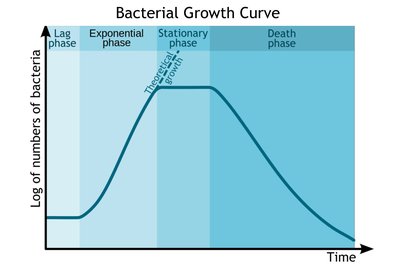
Bacterial Growth Curve
The bacterial growth curve illustrates the population dynamics of bacteria over time in a closed system. It consists of four main phases:
Lag phase: Cells adapt to environment; no significant increase in number.
Exponential (log) phase: Rapid cell division; population doubles at regular intervals.
Stationary phase: Growth rate slows; nutrients deplete, waste accumulates; cell division equals cell death.
Death phase: Cell death exceeds cell division; population declines.
Oxygen Requirements of Microorganisms
Aerobe: Requires oxygen for growth.
Anaerobe: Cannot survive in oxygen.
Facultative anaerobe: Can use oxygen if present, but can switch to fermentation.
Nitrogen Fixation
Bacteria: Rhizobium and cyanobacteria perform nitrogen fixation.
Importance: Converts atmospheric N2 to usable forms for organisms.
Phosphorus and Sulfur
Phosphorus: Essential for phospholipid membranes, DNA, RNA, ATP, and some proteins.
Sulfur: Component of sulfur-containing amino acids, disulfide bonds, and some vitamins.
Trace Elements and Growth Factors
Trace elements: Required in small amounts (e.g., zinc, iron).
Growth factors: Organic chemicals not synthesized by certain organisms (e.g., vitamins, amino acids, purines, pyrimidines, cholesterol, NADH, heme).
Biofilms and Microbiomes
Biofilm Protection and Communication
Protection: Extracellular matrix and glycocalyx shield biofilms from environmental threats.
Communication: Quorum sensing enables coordinated behavior among biofilm cells.
Biofilm Growth and Examples
Growth surfaces: Environmental surfaces, implanted medical devices, mucous membranes.
Helpful examples: Sewage plants, septic tanks.
Biofilm-associated infections: Common in medical devices and oral cavity.
Human Microbiome Project
Research initiative to characterize microbial communities in the human body and their roles in health and disease.
Halophiles
Microorganisms that thrive in high-salt environments.
