 Back
Microbial Diseases of the Skin and Eyes: Bacterial, Viral, and Fungal Infections
Study Guide - Smart Notes
 Tailored notes based on your materials, expanded with key definitions, examples, and context.
Diseases of the Skin and Eyes
Bacterial Skin Diseases
Microbial infections of the skin are common and can be caused by bacteria, viruses, or fungi. Bacterial skin diseases often result from the invasion of the skin or underlying tissues by pathogenic bacteria, leading to a range of clinical manifestations.
Acne
Definition: Acne is a common skin disorder characterized by clogged pores and pimples, primarily affecting adolescents and young adults.
Causative Agent: Propionibacterium acnes (Gram-positive rod).
Transmission: Fomites (inanimate objects).
Pathogenesis: Hair follicles become plugged with excess sebum and dead skin cells, forming a soft plug.
Treatment: Topical agents (benzoyl peroxide, salicylic acid), retinoids, topical and oral antibiotics, and in severe cases, isotretinoin (Accutane).
Complications: Scarring of the skin.
Staphylococcal Skin Infections
Folliculitis: Infection of hair follicles, presenting as pimples or pustules. Severe cases may cause permanent hair loss and scarring.
Boils (Furuncles): Deep infection of hair follicles, forming painful, pus-filled bumps.
Carbuncles: Encapsulated clusters of boils, deeper and more severe than single boils. May require lancing and draining.
Cellulitis: Potentially serious infection of the skin and underlying tissues, often caused by Streptococcus and Staphylococcus species. Can spread to lymph nodes and bloodstream, leading to life-threatening conditions if untreated.
Osteomyelitis/Septic Arthritis: Infection of bone or joints, most commonly caused by Staphylococcus aureus. Symptoms include persistent pain, redness, warmth, and decreased range of motion.
Impetigo: Highly contagious, pus-producing skin infection, mainly affecting children. Caused by Staphylococcus aureus, Streptococcus pyogenes, or both. Presents as red sores that rupture and form honey-colored crusts.
Burn Infections: Common in burn patients, often caused by Pseudomonas aeruginosa, Serratia marcescens, and Providencia species.
Hansen’s Disease (Leprosy)
Definition: Chronic infectious disease affecting skin, nerves, and mucous membranes.
Causative Agent: Mycobacterium leprae.
Transmission: Likely spread from person to person, primarily via respiratory droplets.
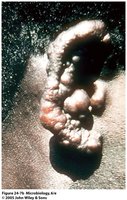
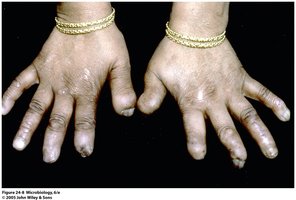
Pathogenesis: Slow multiplication (incubation 3–6 years), heat-sensitive organism. Tumor-like growths (lepromas) form on skin and in the respiratory tract; nerve damage leads to loss of sensation and deformities.
Treatment: Dapsone, rifampicin, clofazimine. Early detection is important.
Viral Skin Diseases
Viruses can cause a variety of skin diseases, often characterized by rashes, vesicles, or warts. Many are highly contagious and preventable by vaccination.
Measles (Rubeola)
Causative Agent: Rubeola virus.
Transmission: Respiratory droplets.
Incubation: 10–12 days.
Symptoms: Fever, white spots with blue centers (Koplik spots) in the mouth, followed by a red, raised rash starting at the hairline and spreading to the trunk and extremities.
Complications: Encephalitis, subacute sclerosing panencephalitis (SSPE).
Prevention: MMR vaccine (measles, mumps, rubella).
Rubella (German Measles)
Causative Agent: Rubella virus.
Transmission: Respiratory droplets.
Symptoms: Pale pink rash on trunk and extremities, mild cold symptoms, swollen lymph nodes.
Complications: Congenital rubella syndrome (birth defects if infection occurs during pregnancy).
Prevention: MMR vaccine.
Chickenpox and Shingles
Chickenpox
Causative Agent: Varicella-zoster virus (VZV).
Transmission: Direct contact or droplets.
Symptoms: Fever, malaise, headache, blister-like rash, itching.
Complications: Pneumonia, encephalitis, secondary bacterial infections, Reye’s syndrome.
Prevention: Live attenuated vaccine.
Shingles
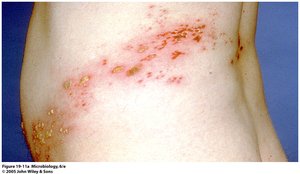
Definition: Reactivation of latent VZV, usually in older or immunocompromised individuals.
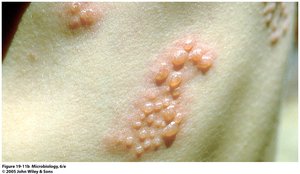
Symptoms: Numbness, itching, severe pain, clusters of blister-like lesions in a strip-like pattern on one side of the body. Pain may persist as post-herpetic neuralgia.
Transmission: Shingles is not directly contagious, but VZV can cause chickenpox in susceptible individuals.
Smallpox
Causative Agent: Variola major virus.
Transmission: Prolonged face-to-face contact, contact with infected fluids or objects, rarely airborne in enclosed settings.
Incubation: 12 days (not contagious during this period).
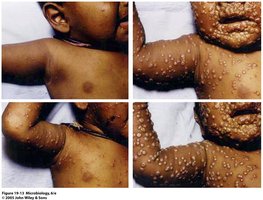
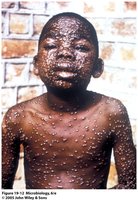
Symptoms: Fever, rash starting in the mouth/throat, spreading to face, extremities, and trunk. Rash progresses to raised bumps, then pustules, then scabs, often leaving pitted scars.
Complications: Death in up to 30% of cases, permanent scarring.
Prevention: Vaccination (no longer routine due to eradication).
Public Health: Smallpox is considered eradicated; concern remains about use as a bioterrorism agent.
Warts
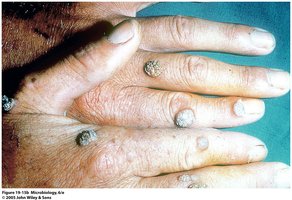
Definition: Noncancerous skin growths caused by human papillomaviruses (HPV).
Transmission: Direct contact or fomites.
Symptoms: Rapid growth of outer skin cells, commonly on hands and fingers.
Treatment: Salicylic acid, cryotherapy, duct tape occlusion.
Cutaneous Herpes Simplex Virus (HSV) Infections
Causative Agent: HSV-1 (primarily oral infections).
Transmission: Entry through abraded skin or mucous membranes; lifelong latent infection in neural tissue.
Reactivation Triggers: Immunodeficiency, trauma, fever, menstruation, UV light.
Treatment: Antiviral drugs such as acyclovir, famciclovir, valacyclovir.
Fungal Skin Diseases (Dermatomycoses)
Fungal infections of the skin are caused by dermatophytes, which invade keratinized tissues such as skin, hair, and nails.
Ringworm (Tinea)
Causative Agents: Epidermophyton, Microsporum, Trichophyton.
Forms: Tinea corporis (body), tinea cruris (groin/jock itch), tinea unguium (nails), tinea pedis (feet/athlete’s foot).
Transmission: Fomites (towels, showers, locker rooms).
Symptoms: Itching, burning, blisters, thickened or discolored nails.
Treatment: Topical antifungals (clotrimazole, terbinafine), oral antifungals for severe cases.
Prevention: Keep skin dry, avoid sharing towels, ventilate skin.
Superficial Candidiasis
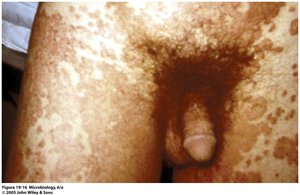
Causative Agent: Candida species.
Common Sites: Diaper area in children, hands of dishwashers.
Symptoms: Red rash, often with small pimples.
Treatment: Topical or oral antifungal agents.
Diseases of the Eyes
Microbial diseases of the eyes can lead to significant morbidity, including blindness if untreated. Common infections include conjunctivitis, trachoma, and keratitis.
Conjunctivitis
Definition: Inflammation of the conjunctiva, commonly known as "pink eye." Highly contagious, especially among children.
Causative Agents: Haemophilus influenzae, Staphylococcus aureus, Streptococcus pneumoniae, Neisseria gonorrhoeae, Pseudomonas species.
Symptoms: Itchiness, foreign body sensation, discharge, pinkish sclera, temporary blurred vision, sensitivity to light.
Inclusion Blenorrhea (Chlamydial Conjunctivitis)
Causative Agent: Chlamydia trachomatis.
Transmission: In newborns, acquired during passage through an infected birth canal.
Treatment: Tetracycline ointment, erythromycin.
Prevention: Silver nitrate prophylaxis in newborns.
Trachoma
Definition: Chronic conjunctivitis leading to scarring and blindness, endemic in areas with poor sanitation.
Causative Agent: Chlamydia trachomatis.
Transmission: Person-to-person via ocular and respiratory secretions, or by flies.
Complications: Repeated infections cause scarring, in-turned eyelashes, corneal damage, and irreversible blindness.
Prevention: Antibiotics, improved hygiene, and sanitation (WHO GET2020 initiative).
Keratitis
Definition: Infection of the cornea, more serious than conjunctivitis.
Causative Agents: Herpes simplex virus (HSV), bacteria.
Symptoms: Pain, redness, watery eyes, sensitivity to light, recurrent infections can cause corneal damage.
Treatment: Antiviral eye drops (trifluridine, vidarabine), oral acyclovir.
