 Back
BackMicrobial Ecology and Environmental Parameters: Foundations for Microbiology
Study Guide - Smart Notes
 Tailored notes based on your materials, expanded with key definitions, examples, and context.
Environmental Parameters and Microbial Ecology
Introduction to Microbial Ecology and Environmental Parameters
Microorganisms are ubiquitous, and their growth and survival are determined by a complex interplay of physical, chemical, and biological parameters in their environment. Understanding these parameters is fundamental for microbiology, as they dictate microbial activity, diversity, and ecological roles.
Physical parameters: Water, pressure, temperature, phase changes, viscosity, radiation, electrostatics, and magnetism.
Chemical parameters: pH, redox state, dissolved oxygen, nutrients, toxins, and solute concentrations.
Biological parameters: Interactions such as commensalism, competition, antagonism, parasitism, predation, symbiosis, syntrophy, and synergy.
SI Units and Environmental Quantification
SI Units and Conversions
Standardization of units is essential for scientific communication and calculation. The International System of Units (SI) provides a universal framework for measuring and converting physical quantities relevant to microbiology and environmental science.
Base SI units: meter (m), kilogram (kg), second (s), kelvin (K), ampere (A), mole (mol), candela (cd).
Derived units: Joule (J) for energy, Pascal (Pa) for pressure, Newton (N) for force, etc.
Conversion: Always convert to SI units before calculations (e.g., kcal to J, g to kg).
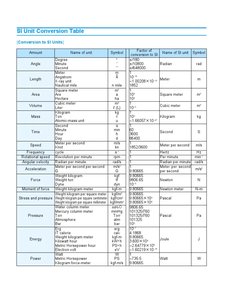
Examples of SI Unit Application
Practical examples illustrate the importance of unit conversion and dimensional analysis in environmental microbiology.
Energy conversion:
Water potential: (demonstrated by dimensional analysis)
Depth of temperature fluctuation: (where is thermal diffusivity, is angular frequency)

Logarithmic Scale and Order-of-Magnitude Estimation
Logarithmic Reasoning in Microbial Quantification
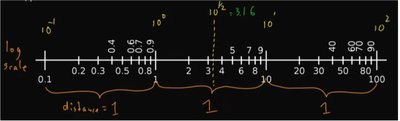
Microbial populations and environmental quantities often span several orders of magnitude. Logarithmic scales are used for estimation and comparison.
Logarithmic scale: Each unit step represents a tenfold change.
Order-of-magnitude estimation: Useful for rapid calculations (e.g., number of bacteria on skin, water usage, CO2 emissions).
Key value: 3.16 is the midpoint on a log scale between 1 and 10.
Systems and Environmental Boundaries
System Types in Environmental Microbiology
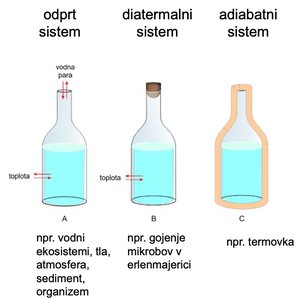
Defining the system and its boundaries is crucial for studying microbial processes. Systems can be open, closed (diathermal), or adiabatic.
Open system: Exchanges both matter and energy with the environment (e.g., aquatic ecosystems).
Closed (diathermal) system: Exchanges energy but not matter (e.g., microbial culture in a flask).
Adiabatic system: No exchange of matter or energy (e.g., thermos flask).
Soil Texture and Structure
Soil Texture Triangle
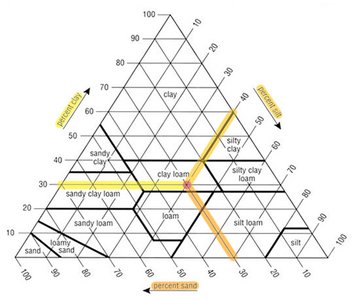
Soil texture and structure influence microbial habitats and nutrient cycling. The soil texture triangle classifies soils based on the proportions of sand, silt, and clay.
Texture: Proportion of sand, silt, and clay.
Structure: Aggregation of soil particles into larger units (aggregates).
Impact: Affects water retention, aeration, and microbial activity.
Microbial Adaptations to Environmental Extremes
Types of Extremophiles and Environmental Preferences
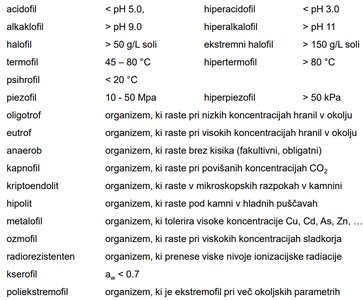
Microorganisms exhibit diverse adaptations to extreme environments, classified by their preferred or tolerated conditions.
Type | Definition |
|---|---|
Acidophil | Grows at pH < 5.0 |
Alkaliphil | Grows at pH > 9.0 |
Halophil | Grows at > 50 g/L salt |
Thermophil | Grows at 45–80°C |
Psychrophil | Grows at < 20°C |
Piezophil | Grows at 10–50 MPa |
Oligotroph | Grows at low nutrient concentrations |
Eutroph | Grows at high nutrient concentrations |
Anaerob | Grows without oxygen |
Capnophil | Grows at high CO2 |
Kriptoendolit | Grows in rock fissures |
Metalofil | Tolerates high metal concentrations |
Ozmofil | Tolerates high sugar concentrations |
Radiation-resistant | Tolerates high radiation |
Kserofil | Grows at low water activity (aw < 0.7) |
Polyextremofil | Adapted to multiple extremes |
Habitats and Ecological Niches
Habitat vs. Niche
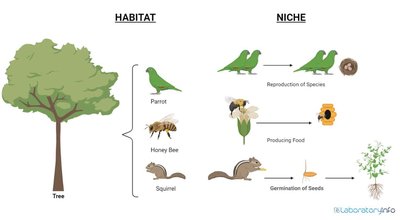
The concepts of habitat and ecological niche are central to understanding microbial distribution and function.
Habitat: The physical space where an organism lives (e.g., soil, water, host).
Niche: The functional role and multidimensional space (n-dimensional hypervolume) defined by environmental factors and resources that determine an organism's survival and growth.
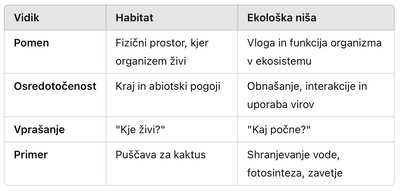
Comparison of Habitat and Niche
Aspect | Habitat | Ecological Niche |
|---|---|---|
Meaning | Physical space where the organism lives | Role and function in the ecosystem |
Focus | Location and abiotic conditions | Behavior, interactions, resource use |
Question | "Where does it live?" | "What does it do?" |
Example | Desert for a cactus | Water storage, photosynthesis, shelter |
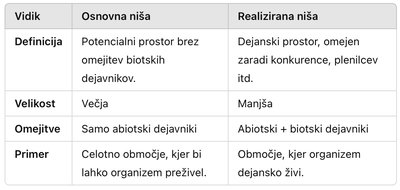
Fundamental vs. Realized Niche
Aspect | Fundamental Niche | Realized Niche |
|---|---|---|
Definition | Potential space without biotic limitations | Actual space limited by competition, predation, etc. |
Size | Larger | Smaller |
Limitations | Abiotic only | Abiotic + biotic |
Example | All areas where an organism could survive | Areas where it actually lives |
Key Environmental Parameters for Microbial Growth
Multidimensionality of Environmental Factors
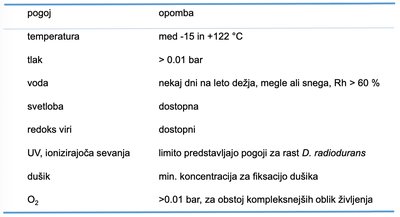
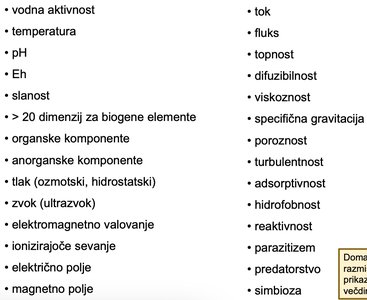
Microbial growth is determined by a multitude of environmental parameters, each representing a dimension of the ecological niche. These include:
Water activity
Temperature
pH
Redox potential (Eh)
Salinity
Concentration of biogenic elements
Organic and inorganic components
Pressure (osmotic, hydrostatic)
Sound, electromagnetic radiation
Ionizing radiation
Electric and magnetic fields
Flow, flux, porosity, turbulence, adsorption, hydrophobicity, reactivity, parasitism, predation, symbiosis
Atomic Structure and Lewis Structure of Water
Electronic Configuration and Lewis Structure
The unique properties of water, essential for microbial life, arise from its molecular structure and electronic configuration.
Hydrogen: 1s1 electronic configuration
Oxygen: 1s2 2s2 2p4 configuration, with two lone pairs
Lewis structure: Shows two bonding pairs (to H) and two lone pairs on O
Implication: Leads to a bent molecular geometry and strong hydrogen bonding
Summary
This guide provides foundational knowledge for understanding how environmental parameters shape microbial life. Mastery of SI units, system boundaries, soil structure, microbial adaptations, and the multidimensionality of ecological niches is essential for advanced study in microbiology and microbial ecology.
