Back
BackMicrobial Ecosystems: Structure, Diversity, and Function in Terrestrial and Aquatic Environments
Study Guide - Smart Notes
 Tailored notes based on your materials, expanded with key definitions, examples, and context.
Microbial Ecosystems
General Ecological Concepts
Microbial ecosystems are complex networks of microorganisms interacting with each other and with their physical environment. These systems are fundamental to Earth's biogeochemical cycles and are found in diverse habitats, from soils to aquatic environments.
Ecosystem: The sum total of all organisms and abiotic factors in a particular environment.
Habitat: The specific portion of an ecosystem where a community could reside.
Microbes account for approximately 50% of all biomass on Earth, highlighting their ecological significance.
Microbial Diversity: Richness and Abundance
The diversity of microbial species in an ecosystem is described by two main parameters:
Species richness: The total number of different species present in an ecosystem.
Species abundance: The proportion of each species in an ecosystem.
Both richness and abundance are influenced by the types and amounts of nutrients available in a habitat.
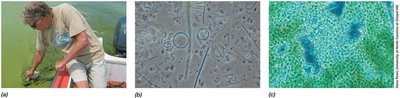
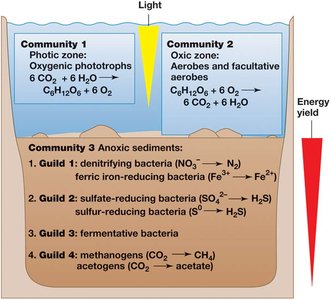
Guilds, Communities, and Niches
Microbial populations are organized into functional groups and communities:
Guilds: Metabolically related microbial populations that exploit similar resources in a similar way.
Sets of guilds form microbial communities that interact with macroorganisms and abiotic factors.
Niche: The habitat shared by a guild, providing nutrients and conditions for growth.
Biofilms
Biofilms are structured communities of microorganisms attached to surfaces and embedded in a self-produced matrix. They are common in natural, medical, and industrial settings.
Biofilms consist of bacterial cells adhered to a surface and enclosed in an adhesive matrix, typically composed of polysaccharides.
They trap nutrients for microbial growth and help prevent detachment in flowing systems.
Biofilms are implicated in medical conditions (e.g., periodontal disease, kidney stones) and industrial problems (e.g., pipeline corrosion).
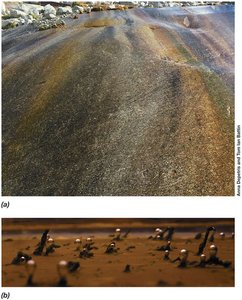
Specialized Microbial Communities
Cryptoendolithic communities: Microbial communities living within rocks, such as lichens in Antarctic sandstone.
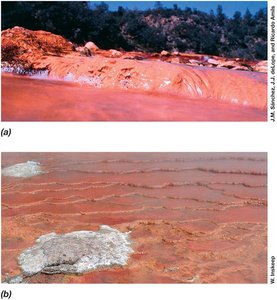
Iron-oxidizer microbial mats: Communities of iron-oxidizing bacteria that form mats in acidic, metal-rich environments, such as Rio Tinto (Spain) and Yellowstone hot springs.
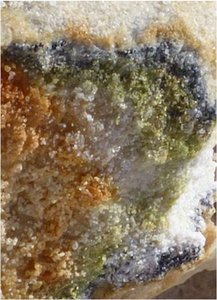
Terrestrial Environments
Soil Structure and Microbial Habitats
Soil is a dynamic environment with distinct layers, each supporting different microbial activities:
O horizon: Surface layer with undecomposed plant material.
A horizon: Rich in organic material and nutrients; most microbial growth occurs here.
B horizon: Subsoil where organic material leaches from above; less microbial activity.
C horizon: Base layer above bedrock, formed from weathered rock.

Biological Soil Crusts (BSC)
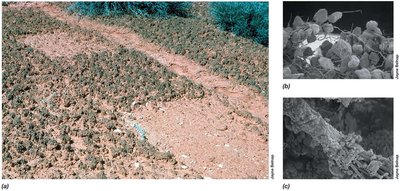
BSCs are communities of microorganisms, including cyanobacteria, that stabilize soil surfaces in arid environments.
Filamentous cyanobacteria bind sand grains together with sheath material, preventing erosion and contributing to soil fertility.
Soil Bacterial and Archaeal Diversity
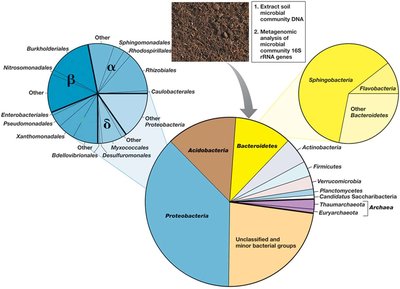
Soil is one of the most diverse microbial habitats on Earth, containing representatives from many bacterial and archaeal phyla.
Major groups include Proteobacteria, Bacteroidetes, Actinobacteria, and Acidobacteria.
Metagenomic analysis of 16S rRNA genes is used to assess community composition.
The Terrestrial Subsurface
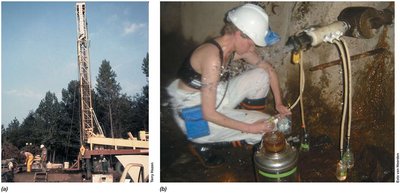
The deep soil subsurface extends hundreds of meters below the surface and supports microbial life under extreme nutrient limitation.
Archaea and Bacteria are present in variable concentrations, depending on nutrient availability.
Small cell size is common due to limited resources.
The subsurface is home to Lokiarcheota, Archaea closely related to eukaryotes.
Aquatic Environments
Freshwater Systems
Freshwater environments, such as lakes and rivers, are highly variable and support diverse microbial communities.
The balance between photosynthesis (by phytoplankton) and respiration controls oxygen and carbon cycles.
Phytoplankton: Oxygenic phototrophs (algae and cyanobacteria) suspended in water.
Benthic species: Microbes attached to the bottom or sides of aquatic systems.

Oxygen Dynamics and Stratification
Oxygen concentrations in aquatic systems are influenced by organic matter and physical mixing. Stratification occurs in many lakes, creating distinct layers:
Epilimnion: Warm, less dense surface water.
Hypolimnion: Cooler, denser bottom water.
Thermocline: Zone of rapid temperature transition separating the two layers.
Deep layers can become anoxic due to oxygen consumption.

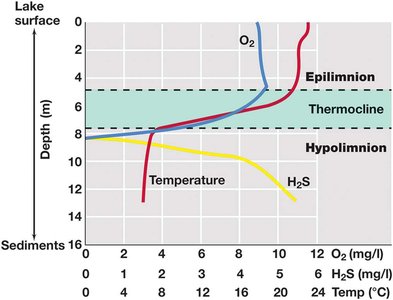
Rivers and Biochemical Oxygen Demand (BOD)
Rivers are often well mixed but can experience oxygen deficiencies due to pollution. BOD is a key measure of water quality:
BOD: The microbial oxygen-consuming capacity of a body of water, which increases with organic material input and decreases as material is degraded.
High BOD can lead to oxygen depletion and affect aquatic life.
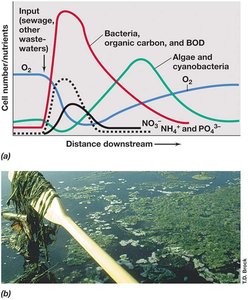
Freshwater Microbial Diversity
Freshwater lakes harbor diverse bacterial and archaeal communities, with Proteobacteria, Actinobacteria, and Bacteroidetes being prominent groups.
Metagenomic analysis of 16S rRNA genes reveals the composition of these communities.
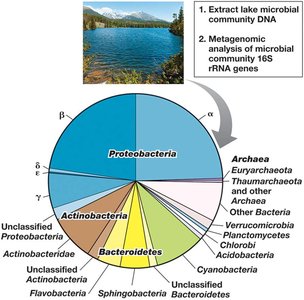
Summary Table: Key Microbial Guilds in Aquatic Sediments
Community/Guild | Metabolic Activity | Representative Reaction |
|---|---|---|
Community 1: Photic zone | Oxygenic phototrophs | |
Community 2: Oxic zone | Aerobes and facultative aerobes | |
Guild 1 | Denitrifying and ferric iron-reducing bacteria | , |
Guild 2 | Sulfate- and sulfur-reducing bacteria | , |
Guild 3 | Fermentative bacteria | Fermentation reactions |
Guild 4 | Methanogens and acetogens | , acetate |