 Back
Microbial Energetics: Metabolic Pathways and Energy Conservation
Study Guide - Smart Notes
 Tailored notes based on your materials, expanded with key definitions, examples, and context.
Microbial Energetics
Overview of Microbial Metabolism
Microbial metabolism encompasses the biochemical reactions that allow microorganisms to obtain energy and build cellular components. Central to microbial energetics are the processes of glycolysis, the citric acid cycle, and the electron transport chain, which together enable the conversion of nutrients into usable energy in the form of ATP.
Glycolysis
Pathway and Energy Yield
Glycolysis is the metabolic pathway that converts glucose into pyruvate, generating ATP and NADH in the process. It consists of two main stages: the preparatory stage and the energy-conserving stage.
Preparatory Stage: Glucose is split into two molecules of glyceraldehyde 3-phosphate, consuming 2 ATP.
Energy-Conserving Stage: Each glyceraldehyde 3-phosphate is oxidized to pyruvate, producing 4 ATP (via substrate-level phosphorylation) and 2 NADH.
Net Yield per Glucose: 2 ATP and 2 NADH.
Citric Acid Cycle (Krebs Cycle)
Complete Oxidation of Pyruvate
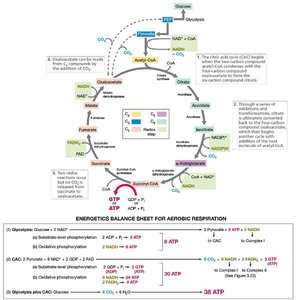
The citric acid cycle (CAC) is responsible for the complete oxidation of pyruvate to CO2, generating high-energy electron carriers (NADH and FADH2) and GTP (or ATP).
Per Pyruvate: 3 CO2, 4 NADH, 1 FADH2, 1 GTP produced.
Per Glucose: 6 CO2, 8 NADH, 2 FADH2, 2 GTP produced.
NADH and FADH2 are oxidized in the electron transport chain, leading to ATP production.
Fermentation
Energy Generation in the Absence of Electron Transport Chain
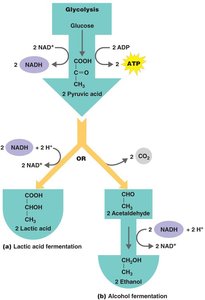
Fermentation is an anaerobic process where organic molecules serve as both electron donors and acceptors. It results in the incomplete oxidation of substrates, producing various organic end products such as acids, alcohols, or gases.
ATP is generated only by substrate-level phosphorylation.
Common Products: Lactic acid, ethanol, CO2, and others.
Regeneration of NAD+: Essential for glycolysis to continue.
Examples of Fermentation Pathways
Lactic Acid Fermentation: Pyruvate is reduced to lactic acid (e.g., Streptococcus).
Alcoholic Fermentation: Pyruvate is converted to ethanol and CO2 (e.g., yeast).
Respiration
Aerobic and Anaerobic Respiration
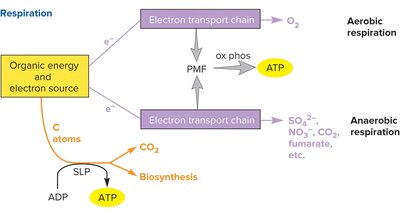
Respiration involves the transfer of electrons from organic or inorganic donors to terminal electron acceptors via an electron transport chain (ETC), generating a proton motive force (PMF) used to synthesize ATP.
Aerobic Respiration: Oxygen (O2) is the terminal electron acceptor, producing water.
Anaerobic Respiration: Other inorganic molecules (e.g., NO3-, SO42-, CO2) serve as terminal electron acceptors.
ATP Yield: Respiration yields much more ATP than fermentation (up to 38 ATP per glucose in aerobic respiration).
Electron Transport Chain and Proton Motive Force
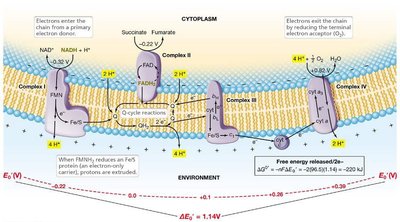
The ETC is a series of membrane-associated redox enzymes and carriers that transfer electrons, releasing energy to pump protons across the membrane, creating an electrochemical gradient (PMF).
Key Components: NADH dehydrogenases, flavoproteins, iron-sulfur proteins, cytochromes, and quinones.
PMF: Drives ATP synthesis via ATP synthase (oxidative phosphorylation).
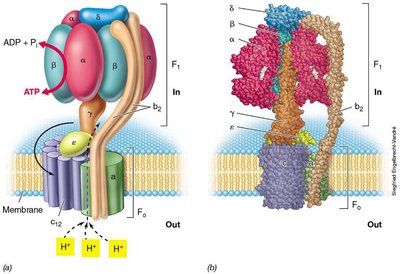
ATP Synthase (ATPase)
ATP synthase is a protein complex that uses the energy stored in the PMF to convert ADP and inorganic phosphate (Pi) into ATP. It consists of two main components: F1 (catalytic) and F0 (proton channel), both functioning as rotary motors.
Electron Carriers in Respiration
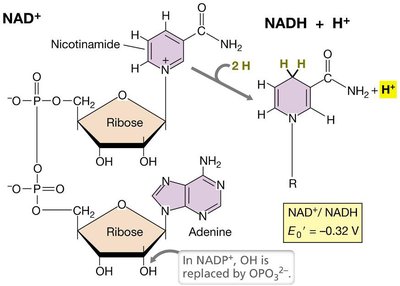
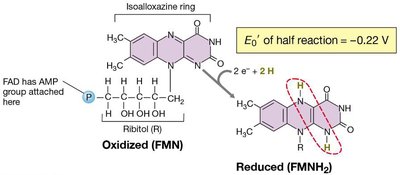
NAD+, NADH, FMN, FAD, and Cytochromes
Electron carriers facilitate redox reactions in metabolism by shuttling electrons between different enzymes and complexes.
NAD+/NADH: Accepts and donates electrons; recycled during metabolism.
FMN/FAD: Flavin-containing molecules that participate in redox reactions.
Cytochromes: Proteins with heme groups that transfer electrons via iron atoms.
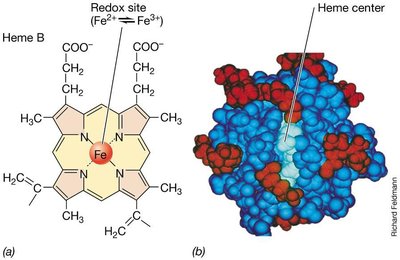
Terminal Electron Acceptors and Metabolic Diversity
Variety of Electron Acceptors in Microbial Respiration
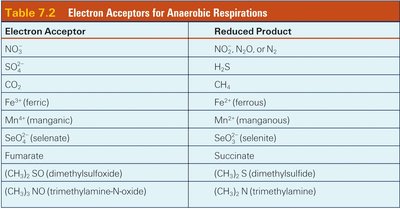
The diversity of terminal electron acceptors reflects the metabolic versatility of bacteria and archaea. This allows microbes to thrive in a wide range of environments and play key roles in biogeochemical cycles.
Electron Acceptor | Reduced Product |
|---|---|
NO3- | N2, N2O, or N2 |
SO42- | H2S |
CO2 | CH4 |
Fe3+ (ferric) | Fe2+ (ferrous) |
Mn4+ (manganic) | Mn2+ (manganous) |
SeO42- (selenate) | SeO32- (selenite) |
Fumarate | Succinate |
(CH3)2SO (dimethylsulfoxide) | (CH3)2S (dimethylsulfide) |
(CH3)3NO (trimethylamine-N-oxide) | (CH3)3N (trimethylamine) |
Energy and Carbon Sources in Microbes
Classification by Energy and Carbon Source
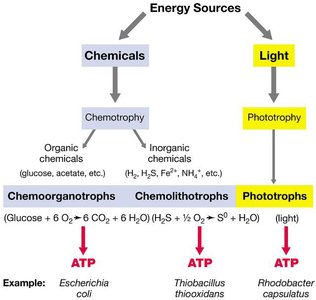
Microorganisms are classified based on their sources of energy and carbon:
Chemoorganotrophs: Use organic chemicals for energy and carbon (e.g., Escherichia coli).
Chemolithotrophs: Use inorganic chemicals for energy (e.g., Thiobacillus thiooxidans).
Phototrophs: Use light as an energy source (e.g., Rhodobacter capsulatus).
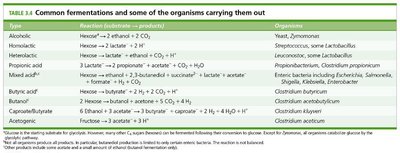
Summary Table: Common Fermentations
Type | Reaction (substrate → products) | Organisms |
|---|---|---|
Alcoholic | Hexose → 2 ethanol + 2 CO2 | Yeast, Zymomonas |
Homolactic | Hexose → 2 lactate + 2H+ | Streptococcus, some Lactobacillus |
Heterolactic | Hexose → lactate + ethanol + CO2 + H2O | Leuconostoc, some Lactobacillus |
Propionic acid | Hexose → 2 propionate + acetate + CO2 + H2O | Propionibacterium, Clostridium propionicum |
Mixed acid | Hexose → lactate + succinate + ethanol + acetate + formate + H2 + CO2 | Enteric bacteria (Escherichia, Salmonella, Shigella, Klebsiella, Enterobacter) |
Butyric acid | Hexose → butyrate + 2 CO2 + 2 H2 | Clostridium butyricum |
Butanol/Butyrate | 6 Hexose → butanol + butyrate + caproate + 2H2 + 4H2O + H+ | Clostridium acetobutylicum |
Acetone | Fructose → acetone + 3H2 | Clostridium acetobutylicum |
Key Equations
ATP Synthesis (Oxidative Phosphorylation):
General Redox Reaction:
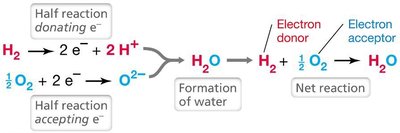
Summary
Microbial energetics is fundamental to understanding how microorganisms obtain and conserve energy. The diversity of metabolic pathways, electron carriers, and terminal electron acceptors underpins the ecological and evolutionary success of microbes in a wide range of environments.
