 Back
BackMicrobial Genetics and Biotechnology: Core Concepts and Applications
Study Guide - Smart Notes
 Tailored notes based on your materials, expanded with key definitions, examples, and context.
Microbial Genetics
Introduction to Microbial Genetics
Microbial genetics is the study of heredity in microorganisms, focusing on how traits are transmitted, expressed, and varied, as well as the structure, function, and changes of genetic material. Understanding microbial genetics is essential for biotechnology and medicine.
Genotype: The complete genetic makeup of an organism (all its genes).
Phenotype: The observable characteristics or traits of an organism.
Chromosome: A DNA molecule containing many genes; in bacteria, usually a single circular chromosome.
Gene: A segment of DNA that codes for an RNA molecule or protein.
Comparison of Prokaryotic and Eukaryotic Genetics
Key Similarities and Differences
Both prokaryotes and eukaryotes share fundamental genetic processes but differ in chromosome structure, gene organization, and gene expression mechanisms.
Similarities: Double-stranded DNA, genes, promoters, universal codons, DNA replication, transcription, and translation.
Differences:
Prokaryotes usually have one chromosome (haploid), no histones, and use polyamines for DNA condensation.
Genes are often organized in operons (polycistronic mRNA).
Transcription and translation are coupled (occur simultaneously).
No splicing, capping, or poly-A tails in prokaryotic mRNAs.
Central Dogma of Molecular Biology
Flow of Genetic Information
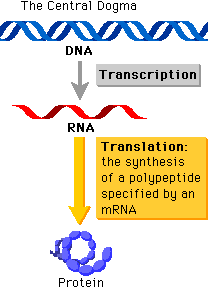
The central dogma describes the flow of genetic information from DNA to RNA to protein. Transcription produces mRNA from DNA, and translation synthesizes proteins from mRNA templates.
Transcription: Synthesis of RNA from a DNA template by RNA polymerase.
Translation: Synthesis of a polypeptide (protein) specified by the mRNA sequence.
Bacterial Transcription and Translation
Transcription in Bacteria
Transcription in bacteria involves the binding of sigma factors to promoter sequences, recruitment of RNA polymerase, and synthesis of mRNA complementary to one DNA strand. Transcription ends at a terminator sequence.
Sigma factors: Proteins that recognize specific promoter sequences and initiate transcription.
Operators: DNA regions that regulate the binding and activity of RNA polymerase.
Direction: RNA polymerase synthesizes RNA in the 5’ to 3’ direction.
Polycistronic mRNA: In prokaryotes, a single mRNA may encode multiple proteins (operons).
Translation in Bacteria
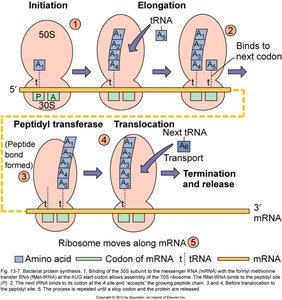
Translation is the process by which ribosomes synthesize proteins using mRNA as a template. The Shine-Dalgarno sequence in mRNA helps ribosomes bind and locate the start codon. Translation proceeds from the start codon to the stop codon, forming an open reading frame (ORF).
tRNA: Transfers specific amino acids to the ribosome, matching codons via its anticodon.
Peptidyl transferase: Ribosomal enzyme that forms peptide bonds between amino acids.
Direction: Ribosomes move along mRNA from 5’ to 3’.
Regulation of Bacterial Gene Expression
Operons: Inducible and Repressible Systems
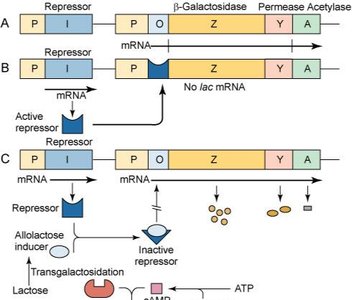
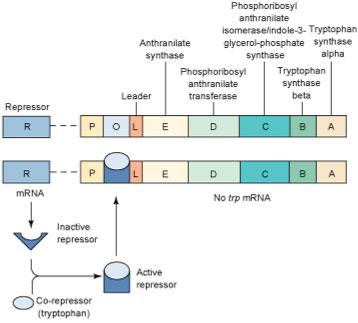
Operons are clusters of genes regulated as a unit, producing a single polycistronic mRNA. They allow bacteria to efficiently regulate gene expression in response to environmental changes.
Inducible operons: Turned ON by the presence of a substrate (e.g., lac operon).
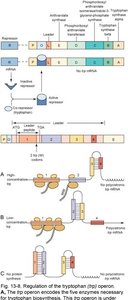
Repressible operons: Turned OFF by the accumulation of the end product (e.g., trp operon).
Attenuation
Attenuation is a regulatory mechanism in prokaryotes where transcription is prematurely terminated, often in response to metabolic signals. This is possible because transcription and translation are coupled in bacteria.
DNA Replication in Bacteria
Semi-Conservative Replication
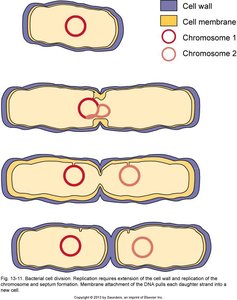
Bacterial DNA replication is semi-conservative, meaning each new DNA molecule consists of one old (parental) and one new strand. This ensures genetic continuity during cell division.
Replication fork: The site where DNA is unwound and new strands are synthesized.
Enzymes: DNA polymerase, helicase, primase, ligase, etc.
Mutations: Changes in Genetic Code
Types and Effects of Mutations
Mutations are changes in the DNA sequence that can alter genotype and phenotype. They may be spontaneous or induced by mutagens.
Wild type: The non-mutated, original sequence.
Null mutant: Mutation resulting in a non-functional gene product.
Point mutations: Single nucleotide changes (substitution, transition, transversion).
Frameshift mutations: Insertions or deletions that shift the reading frame.
Silent, missense, nonsense mutations: Affect protein coding in different ways.
Back-mutation: Reversion to the wild-type sequence.
Causes: Spontaneous errors in replication or induced by physical/chemical mutagens (e.g., radiation, base analogues).
Effects: Can be harmful, neutral, or beneficial, depending on the environment and selection pressures.
DNA Repair Mechanisms
Bacteria possess several mechanisms to repair DNA damage and maintain genetic integrity.
Direct repair: Enzymatic removal of DNA modifications.
Excision repair: Removal of incorrect bases and replacement using the complementary strand.
Recombinational repair: Uses undamaged DNA as a template at the replication fork.
SOS response: Induced under severe DNA damage, involves error-prone repair systems.
Mechanisms of Bacterial Gene Transfer
Horizontal Gene Transfer
Bacteria can exchange genetic material through several mechanisms, contributing to genetic diversity and adaptation.
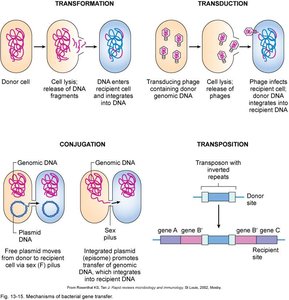
Transformation: Uptake of free DNA fragments from the environment.
Transduction: Transfer of DNA by bacteriophages (viruses that infect bacteria).
Conjugation: Direct transfer of DNA between bacteria via a sex pilus.
Transposition: Movement of DNA segments (transposons) within and between DNA molecules.
Importance of Gene Transfer
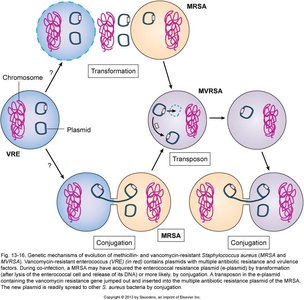
Gene transfer allows bacteria to acquire new traits, such as antibiotic resistance or virulence factors, which can have significant clinical and evolutionary consequences.
Restriction Enzymes and Plasmids in Biotechnology
Restriction Enzymes
Restriction enzymes are bacterial proteins that recognize and cut specific DNA sequences, enabling genetic engineering. They are named after the organisms from which they were first isolated (e.g., EcoRI from Escherichia coli).
EcoRI: Recognizes 5’…GAATTC…3’
SmaI: Recognizes 5’…CCCGGG…3’
EcoRV: Recognizes 5’…GATATC…3’
Plasmids for Biotechnology
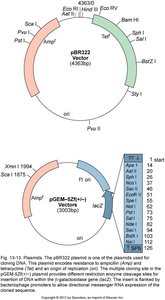
Plasmids are small, circular DNA molecules used as vectors to clone and express foreign genes in bacteria. They often carry selectable markers (e.g., antibiotic resistance genes) and multiple cloning sites.
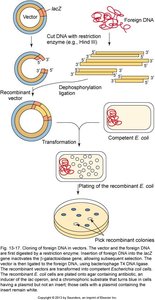
Example: Cloning with Plasmids
Cloning involves inserting foreign DNA into a plasmid vector, transforming competent E. coli cells, and selecting recombinant colonies. Restriction enzymes and ligases are used to cut and join DNA fragments.
Additional info: These concepts are foundational for understanding microbial genetics, gene regulation, and the tools of modern biotechnology, including genetic engineering and recombinant DNA technology.
