 Back
BackMicrobial Genetics and Growth: Step-by-Step Study Guidance
Study Guide - Smart Notes
 Tailored notes based on your materials, expanded with key definitions, examples, and context.
Q11. In Figure 8.2, if base 4 is adenine, what is base 4'?
Background
Topic: DNA Structure and Base Pairing
This question tests your understanding of the complementary base pairing rules in DNA, specifically how adenine pairs with another base on the opposite strand.
Key Terms and Concepts:
Adenine (A): A purine base found in DNA.
Thymine (T): A pyrimidine base found in DNA.
Base Pairing Rule: In DNA, adenine pairs with thymine via hydrogen bonds.
Antiparallel Strands: DNA strands run in opposite directions, and bases pair across the two strands.
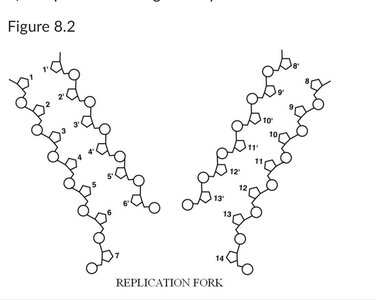
Step-by-Step Guidance
Identify the location of base 4 on one strand and base 4' on the opposite strand in Figure 8.2.
Recall the base pairing rules: Adenine (A) pairs with Thymine (T) in DNA.
Since base 4 is adenine, base 4' must be its complementary base according to the pairing rules.
Check that the diagram represents DNA (not RNA), so uracil is not involved.
Try solving on your own before revealing the answer!
Final Answer: Thymine
Base 4' is thymine because adenine pairs with thymine in DNA. This follows the standard base pairing rule: A-T.
Q12. In Figure 8.2, if base 4 is adenine, what is base 11' (remember the complementary configuration of bases in DNA)?
Background
Topic: DNA Structure and Complementary Base Pairing
This question tests your ability to identify complementary bases at specific positions in a DNA molecule, considering the antiparallel nature of DNA strands.
Key Terms and Concepts:
Antiparallel Configuration: DNA strands run in opposite directions, so base positions are mirrored across the replication fork.
Base Pairing: Adenine pairs with thymine, guanine pairs with cytosine.
Step-by-Step Guidance
Locate base 4 on one strand and base 11' on the opposite strand in Figure 8.2.
Determine if base 11' is directly opposite base 4 or if the numbering reflects the antiparallel nature of DNA.
Recall that the complementary base to adenine is thymine.
Consider the antiparallel arrangement: base 11' may correspond to a different base depending on the sequence alignment.
Try solving on your own before revealing the answer!
Final Answer: Thymine
Base 11' is thymine, as it is complementary to adenine in DNA. The antiparallel configuration ensures proper base pairing.
Q13. In Figure 8.2, base 5 (and ONLY the base) is covalently bound/attached to:
Background
Topic: DNA Structure – Nucleotide Components
This question tests your knowledge of the chemical structure of DNA nucleotides and how bases are attached within the DNA molecule.
Key Terms and Concepts:
Nucleotide: Consists of a base, a sugar (deoxyribose), and a phosphate group.
Covalent Bond: The base is covalently attached to the sugar (deoxyribose) in DNA.
Phosphodiester Bond: Links the sugar-phosphate backbone, not the base directly.
Step-by-Step Guidance
Identify the components of a nucleotide: base, sugar, and phosphate.
Recall that the base is attached to the sugar (deoxyribose) via a covalent bond.
Understand that the phosphate group is attached to the sugar, not directly to the base.
Review the diagram to confirm the base's attachment point.
Try solving on your own before revealing the answer!
Final Answer: Deoxyribose
The base is covalently bound to deoxyribose, which is the sugar component of the nucleotide.
