 Back
BackMicrobial Genetics and Immunity: Unit 3 Study Guide
Study Guide - Smart Notes
 Tailored notes based on your materials, expanded with key definitions, examples, and context.
Bacterial Genetics and DNA Structure
Bacterial Plasmids
Bacterial plasmids are small, circular, double-stranded DNA molecules distinct from chromosomal DNA. They often carry genes beneficial for survival, such as antibiotic resistance, and can be transferred between bacteria.
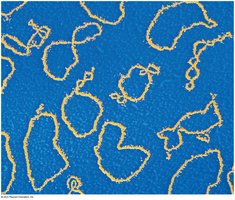
DNA and Chromosomes
Bacteria typically possess a single, circular chromosome composed of DNA and associated proteins. The chromosome is highly supercoiled to fit within the cell. The genome includes both protein-coding genes and noncoding regions, such as short tandem repeats (STRs), which are repeating sequences of 2-5 base pairs.
Gene: A sequence of nucleotides in DNA that codes for a functional product.
Example: Escherichia coli chromosome contains approximately 4.6 million base pairs.
DNA Replication and Expression
Adding a Nucleotide to DNA
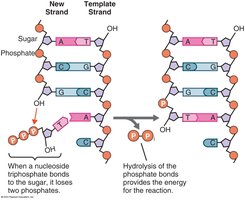
DNA replication involves the addition of nucleotides to a growing DNA strand. Each nucleotide is added by DNA polymerase, and the energy for this process comes from the hydrolysis of phosphate bonds in nucleoside triphosphates.
Key Point: When a nucleoside triphosphate bonds to the sugar, it loses two phosphates, providing energy for the reaction.
Events at the DNA Replication Fork
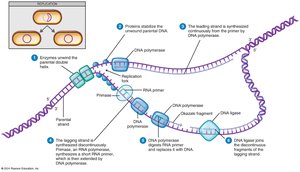
DNA replication occurs at the replication fork, where the double helix is unwound and new strands are synthesized. The leading strand is synthesized continuously, while the lagging strand is synthesized in fragments (Okazaki fragments).
Enzymes involved: DNA polymerase, primase, DNA ligase.
Replication is semi-conservative: Each new DNA molecule contains one old and one new strand.
Transcription
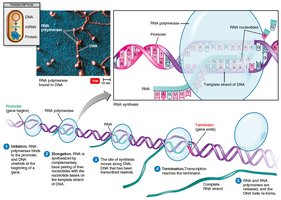
Transcription is the process by which RNA is synthesized from a DNA template. RNA polymerase binds to the promoter region and synthesizes RNA until it reaches a terminator sequence.
Initiation: RNA polymerase binds to the promoter.
Elongation: RNA is synthesized as the DNA unwinds.
Termination: Transcription ends at the terminator.
Translation
Translation is the process by which mRNA is decoded to synthesize proteins. Codons, groups of three mRNA nucleotides, specify amino acids. The genetic code is degenerate, meaning multiple codons can code for the same amino acid.
Start codon: AUG
Stop codons: Three codons signal termination.
miRNA: Can inhibit protein synthesis by binding to mRNA.
Gene Regulation and Mutation
The Operon Model of Gene Expression
Operons are clusters of genes regulated together. In inducible operons, such as the lac operon, genes are transcribed only when an inducer is present. The lac operon encodes enzymes for lactose metabolism and is regulated by promoter and operator regions.
Promoter: Site where transcription begins.
Operator: Regulatory region acting as a stop/go signal.
Positive Regulation
Catabolite repression prevents cells from using carbon sources other than glucose. Cyclic AMP (cAMP) accumulates when glucose is absent and binds to catabolic activator protein (CAP), which then binds the lac promoter to initiate transcription.
Alarmone: cAMP is a chemical that signals environmental or nutritional stress.
Conjugation in E. coli
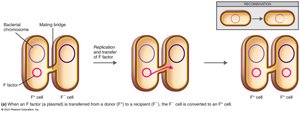
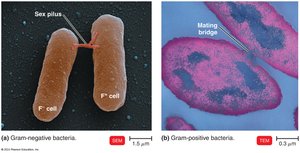
Conjugation is a process where genetic material is transferred between bacterial cells via direct contact. The F factor (fertility factor) is transferred from a donor (F+) to a recipient (F-) cell, converting the recipient into an F+ cell.
Transduction in Bacteria
Transduction is the transfer of DNA from one bacterium to another via a bacteriophage. Generalized transduction involves random DNA packaging, while specialized transduction transfers specific genes.
The Ames Reverse Gene Mutation Test
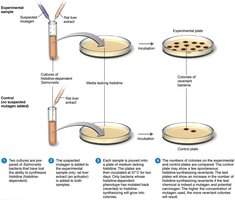
The Ames test is used to identify mutagenic substances by observing the reversion of mutated bacteria to their original state.
Biotechnology and DNA Technology
Restriction Enzymes and Vectors
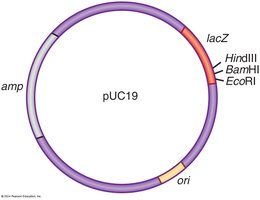
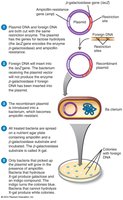
Restriction enzymes cut DNA at specific sequences, creating fragments. Vectors, such as plasmids, are self-replicating DNA segments used to carry foreign genes.
Genomic Libraries and cDNA
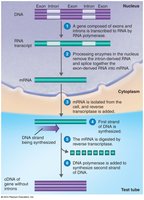
Genomic libraries are collections of DNA fragments. Complementary DNA (cDNA) is synthesized from mRNA by reverse transcriptase and lacks introns, making it useful for expressing eukaryotic genes in prokaryotes.
Blue-White Screening
Blue-white screening is a method for selecting recombinant bacteria. Bacteria with recombinant plasmids disrupt the lacZ gene, resulting in white colonies, while non-recombinant bacteria produce blue colonies.
Scientific Applications
Bioinformatics: Computer-assisted analysis of DNA sequences to understand gene function.
Proteomics: Study of proteins expressed in a cell.
Reverse genetics: Discovering gene function from genetic sequence.
The Polymerase Chain Reaction (PCR)
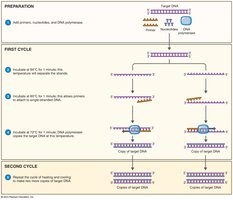
PCR is a technique used to amplify specific DNA sequences. It involves cycles of denaturation, annealing, and extension.
Immunity and Host Defenses
The Concept of Immunity
Immunity is the ability to ward off disease, while susceptibility is the lack of resistance. Innate immunity provides rapid, nonspecific defense, whereas adaptive immunity is specific and has memory.
Physical Factors Protecting Skin and Mucous Membranes
Multiple cell layers provide a barrier.
Mucous membranes line body tracts and secrete mucus to trap microbes.
Lacrimal apparatus washes the eye.
Ciliary escalator moves mucus out of the lungs.
The Process of Inflammation
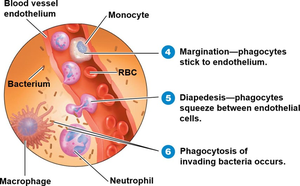
Inflammation is a response to infection or injury, involving vasodilation, increased permeability, phagocyte migration, and tissue repair.
Outcomes of Complement Activation
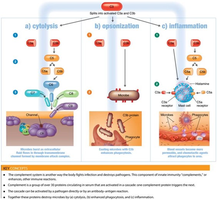
The complement system enhances immune responses through cytolysis, opsonization, and inflammation.
Cytolysis: Formation of membrane attack complex (MAC).
Opsonization: Promotes phagocyte attachment to microbes.
Inflammation: Complement proteins trigger release of histamine.
The Classical Pathway
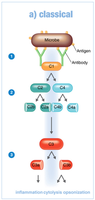
The classical pathway is initiated when antibodies bind to antigens, activating complement proteins C1, C2, and C4, leading to activation of C3 and subsequent immune responses.
The Lectin Pathway
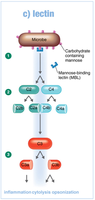
The lectin pathway is triggered by mannose-binding lectin binding to microbial carbohydrates, activating complement proteins and leading to similar outcomes as the classical pathway.
Mechanism of Phagocytosis
Phagocytosis involves chemotaxis, adherence, ingestion, and digestion of microbes. Opsonization enhances adherence by coating microbes with serum proteins.
Stages of Inflammation
Vasodilation and increased permeability
Phagocyte migration and phagocytosis
Tissue repair
Fever
Fever is an elevated body temperature, often caused by infection. Cytokines reset the hypothalamus to a higher temperature, which persists until cytokines are eliminated.
Hematopoiesis
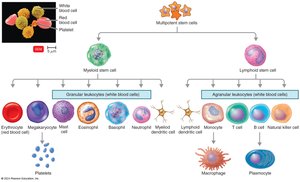
Hematopoiesis is the formation of blood cells from multipotent stem cells, producing erythrocytes, leukocytes, and platelets.
Adaptive Immunity
Humoral Immunity Response Process
B cells interact with antigens in lymphoid organs. Clonal selection activates B cells, which proliferate and differentiate into plasma cells (antibody-secreting) and memory B cells.
Humoral Immunity: Antibodies
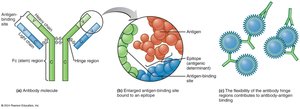
Antibodies are Y-shaped proteins composed of two light and two heavy chains. The variable regions bind epitopes, while the constant region determines the antibody class.
Five classes: IgG, IgM, IgA, IgD, IgE
Valence: Number of antigen-binding sites (bivalent = two sites)
IgG
Monomer
80% of serum antibodies
Found in blood, lymph, and intestine
Crosses placenta, triggers complement, enhances phagocytosis, neutralizes toxins/viruses
IgA
Monomer in serum, dimer in secretions
13% of serum antibodies
Common in mucous membranes, saliva, tears, breast milk
Prevents microbial attachment to mucous membranes
Primary and Secondary Immune Responses
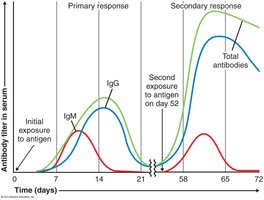
The primary response occurs upon first exposure to an antigen, producing IgM and then IgG. The secondary response is faster and stronger due to memory cells.
Types of Adaptive Immunity
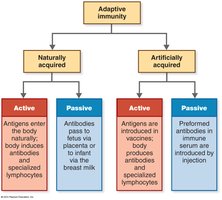
Adaptive immunity can be naturally or artificially acquired, and active or passive.
Active: Antigens enter the body, inducing antibody production.
Passive: Antibodies are transferred from another source.
Cellular Immunity Response Process
T cells combat intracellular pathogens and abnormal cells. They mature in the thymus and migrate to lymphoid tissues, where they recognize antigens via T-cell receptors.
Pathogen Entry and Antigen Presentation
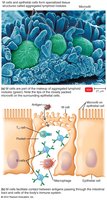
Pathogens entering the gastrointestinal tract pass through microfold (M) cells over Peyer's patches, transferring antigens to lymphocytes and antigen-presenting cells.
Cytokines: Chemical Messengers of Immune Cells
Cytokines are protein messengers produced in response to stimuli. Types include interleukins (communication), chemokines (migration), interferons (antiviral), tumor necrosis factor alpha (inflammation), and hematopoietic cytokines (blood cell development). Overproduction can cause cytokine storms.
