 Back
BackMicrobial Genetics: DNA Structure, Replication, Transcription, Translation, Mutation, and Gene Transfer
Study Guide - Smart Notes
 Tailored notes based on your materials, expanded with key definitions, examples, and context.
Microbial Genetics
Introduction
Microbial genetics is the study of how microorganisms inherit and express genetic information. This field explores the structure and function of genetic material, mechanisms of gene transfer, and the processes by which genetic information is replicated, transcribed, and translated into proteins. Understanding microbial genetics is fundamental to microbiology, biotechnology, and medicine.
Key Terms & Definitions
Genetics: The study of heredity and the variation of inherited characteristics.
Chromosomes: DNA-containing structures that carry genetic information.
Genes: Segments of DNA that encode functional products, usually proteins.
Genome: The complete set of genetic information in a cell.
Genomics: The study of genomes and their interactions.
Genetic Code: The set of rules by which nucleotide sequences are translated into amino acid sequences.
Central Dogma: The flow of genetic information: DNA → RNA → Protein.
Genotype: The genetic makeup of an organism.
Phenotype: The observable characteristics resulting from gene expression.
Short Tandem Repeats (STRs): Repeating sequences of noncoding DNA, useful in forensics.
Vertical Gene Transfer: Transmission of genes from parent to offspring.
Horizontal Gene Transfer: Transfer of genes between cells of the same generation.
Mutation: A permanent change in the DNA sequence.
Mutagen: An agent that causes mutations.
Spontaneous Mutation: Mutation occurring without a known mutagen.
Genetic Recombination: Exchange of genes between DNA molecules.
Recombinant: A cell that has incorporated foreign DNA.
Plasmid: A small, self-replicating DNA molecule in bacteria.
Transposon: A DNA segment that can move within the genome.
Operon: A cluster of genes under the control of a single promoter and operator.
Constitutive Genes: Genes that are always expressed.
Genetic Information Flow in Microbes
Expression, Recombination, and Replication
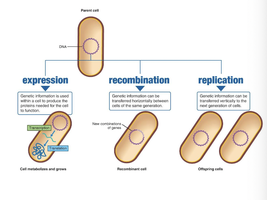
Genetic information in microbes can be expressed, recombined, or replicated. Expression involves using genetic information to synthesize proteins, recombination introduces new gene combinations, and replication ensures genetic information is passed to offspring.
Expression: DNA is transcribed to RNA and translated to protein, allowing the cell to grow and function.
Recombination: Genetic information can be exchanged between cells, creating new gene combinations.
Replication: DNA is copied and passed to the next generation during cell division.
DNA Structure & Replication
DNA Structure
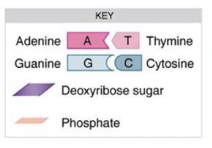
DNA is a double helix composed of two antiparallel strands. Each strand consists of a sugar-phosphate backbone and nitrogenous bases (adenine, thymine, guanine, cytosine). Base pairing follows specific rules: A pairs with T, and G pairs with C, held together by hydrogen bonds.
Backbone: Deoxyribose sugar and phosphate groups.
Base Pairing: Adenine (A) pairs with Thymine (T); Guanine (G) pairs with Cytosine (C).
Antiparallel Strands: One strand runs 5'→3', the other 3'→5'.
Genetic Instructions: The sequence of bases encodes genetic information.
DNA Replication
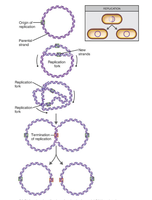
DNA replication is semiconservative: each new DNA molecule contains one old and one new strand. In bacteria, replication is bidirectional and highly accurate due to proofreading by DNA polymerase.
Semiconservative: Each daughter DNA has one parental and one new strand.
Bidirectional: Replication forks move in opposite directions around the circular chromosome.
Proofreading: DNA polymerase corrects errors during synthesis.
Steps of DNA Replication
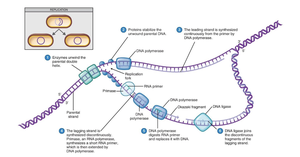
Relaxing: Topoisomerase and gyrase relax supercoiled DNA.
Unwinding: Helicase separates the DNA strands, forming a replication fork.
Priming: RNA primer is added to provide a starting point for DNA polymerase.
Elongation (Leading Strand): DNA polymerase synthesizes continuously toward the fork (5'→3').
Elongation (Lagging Strand): DNA polymerase synthesizes discontinuously away from the fork, creating Okazaki fragments.
Joining: DNA polymerase removes RNA primers; DNA ligase joins Okazaki fragments.
RNA & Transcription
RNA vs. DNA
Feature | DNA | RNA |
|---|---|---|
Strands | Double-stranded | Single-stranded |
Sugar | Deoxyribose | Ribose |
Bases | A, T, G, C | A, U, G, C |
Function | Stores genetic information | Implements genetic instructions |
Types of RNA
mRNA (Messenger RNA): Carries genetic code from DNA to ribosomes.
tRNA (Transfer RNA): Brings amino acids to the ribosome during translation.
rRNA (Ribosomal RNA): Structural and functional component of ribosomes.
Transcription in Prokaryotes
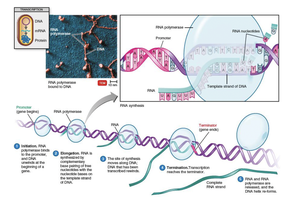
Transcription is the synthesis of mRNA from a DNA template. In prokaryotes, it occurs in the cytoplasm and involves three main steps: initiation, elongation, and termination.
Initiation: RNA polymerase binds to the promoter region of DNA.
Elongation: RNA polymerase synthesizes mRNA in the 5'→3' direction.
Termination: RNA polymerase reaches a terminator sequence and releases the mRNA.
Transcription in Eukaryotes
Occurs in the nucleus; translation occurs in the cytoplasm.
Genes contain exons (coding) and introns (noncoding).
After transcription, introns are removed and exons are spliced together to form mature mRNA.
Memory trick: EXons are EXpressed; INtrons are INterrupting (removed).
Translation
Key Terms
Codon: Three-nucleotide sequence on mRNA coding for an amino acid.
Start Codon: AUG (methionine) — signals the start of translation.
Stop Codons: UAA, UAG, UGA — signal the end of translation.
Anticodon: Three-nucleotide sequence on tRNA complementary to mRNA codon.
Degeneracy: Most amino acids are encoded by more than one codon.
Peptide Bond: Joins amino acids during translation.
Polypeptide: Chain of amino acids forming a protein.
Ribosome Sites
Site | Name | Function |
|---|---|---|
A site | Aminoacyl site | Entry of tRNA with amino acid |
P site | Peptidyl site | Holds tRNA with growing polypeptide |
E site | Exit site | tRNA exits ribosome |
Steps of Translation
Initiation: Ribosome assembles at start codon; first tRNA binds at P site.
tRNA Attachment: Second tRNA binds at A site.
Peptide Bond Formation: Ribosome forms peptide bond between amino acids.
Translocation: Ribosome moves along mRNA; tRNAs shift positions.
Elongation: Process repeats, polypeptide grows.
Termination: Ribosome reaches stop codon; polypeptide is released.
Mutations
Types of Mutations
Type | What Changes | Effect on Protein |
|---|---|---|
Base substitution (point mutation) | One nucleotide replaced | Missense, nonsense, or silent |
Missense mutation | Wrong amino acid coded | Protein function altered |
Nonsense mutation | Stop codon introduced | Premature termination |
Silent mutation | Codon changes, same amino acid | No effect |
Frameshift mutation | Insertion/deletion shifts reading frame | Severely disrupts protein |
Chemical and Physical Mutagens
Nucleoside Analogs: Mimic normal bases, cause mispairing.
Ionizing Radiation: Breaks DNA backbone.
UV Radiation: Causes thymine dimers, blocking replication and transcription.
Nucleotide Excision Repair
Enzyme cuts DNA around damage (e.g., thymine dimer).
DNA polymerase fills in the gap.
DNA ligase seals the strand.
Gene Regulation: The Operon Model
Why Regulate Genes?
Gene regulation ensures that proteins are produced only when needed, conserving energy and resources.
Constitutive Genes: Always on, essential for cell function.
Inducible Genes: Turned on by an inducer (e.g., substrate).
Repressible Genes: Turned off by a corepressor (e.g., product).
Operon Components
Component | Function |
|---|---|
Promoter | RNA polymerase binding site |
Operator | Regulatory site; repressor binding blocks transcription |
Structural Genes | Code for proteins |
Repressor | Protein that blocks transcription |
Inducer | Turns on gene expression |
Corepressor | Turns off gene expression |
Examples: lac and trp Operons
lac Operon (Inducible): Off unless lactose (inducer) is present.
trp Operon (Repressible): On unless tryptophan (corepressor) is abundant.
Genetic Transfer & Recombination
Vertical vs. Horizontal Gene Transfer
Vertical: Parent to offspring.
Horizontal: Between cells of the same generation (unique to prokaryotes).
Mechanisms of Horizontal Gene Transfer
Mechanism | Description | Key Details |
|---|---|---|
Transformation | Uptake of naked DNA from environment | No cell contact; demonstrated by Griffith's experiment |
Conjugation | Direct transfer via sex pilus | Requires F factor; donor (F+) to recipient (F-) |
Transduction | Transfer by bacteriophage (virus) | Generalized or specialized; phage acts as vector |
Plasmids and Transposons
Plasmid: Small, circular DNA; can carry antibiotic resistance or toxin genes.
Conjugative Plasmid (F factor): Enables conjugation.
Transposon: DNA segment that can move within the genome.
Griffith's Transformation Experiment
Smooth (S) strain of Streptococcus pneumoniae: virulent, kills mice.
Rough (R) strain: non-virulent.
Heat-killed S strain: non-virulent.
Live R + heat-killed S: kills mice; R strain transformed by DNA from S strain.
Conclusion: DNA is the transforming principle.
Quick Reference Summary
Central Dogma
Process | What Happens | Key Enzyme/Molecule |
|---|---|---|
DNA Replication | DNA → DNA | DNA polymerase, helicase, ligase, topoisomerase |
Transcription | DNA → mRNA | RNA polymerase |
Translation | mRNA → Protein | Ribosome, tRNA, mRNA |
Codon Reference
Start Codon: AUG (methionine)
Stop Codons: UAA, UAG, UGA
Total Codons: 64 (61 sense, 3 stop)
Degeneracy: Multiple codons for most amino acids
Mutation Types at a Glance
Mutation | Cause | Result |
|---|---|---|
Missense | Base substitution | Altered protein |
Nonsense | Base substitution | Truncated protein |
Silent | Base substitution | No change |
Frameshift | Insertion/deletion | Disrupted protein |
Gene Transfer Comparison
Mechanism | Vehicle for DNA | Direct Contact Required? |
|---|---|---|
Transformation | Naked DNA | No |
Conjugation | Plasmid (F factor) | Yes |
Transduction | Bacteriophage | No |
Additional info: This guide covers the essential concepts of microbial genetics, including DNA structure, replication, gene expression, mutation, and gene transfer mechanisms, as outlined in a typical college-level microbiology curriculum.
