 Back
BackMicrobial Genetics: Gene Expression, Regulation, and Mutation
Study Guide - Smart Notes
 Tailored notes based on your materials, expanded with key definitions, examples, and context.
Microbial Genetics: Gene Expression, Regulation, and Mutation
Central Dogma of Molecular Biology
The central dogma describes the flow of genetic information in cells, from DNA to RNA to protein. This process is fundamental to all living organisms and underlies gene expression and cellular function.
DNA stores genetic information.
RNA acts as an intermediary, carrying instructions from DNA.
Protein is synthesized based on RNA instructions and performs cellular functions.
Mutations in DNA can alter RNA and protein, affecting cell function.

Transcription: Synthesis of RNA from DNA
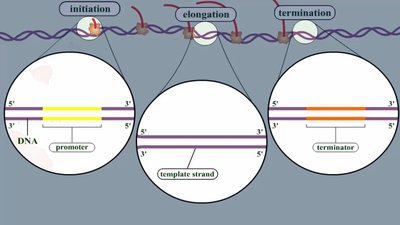
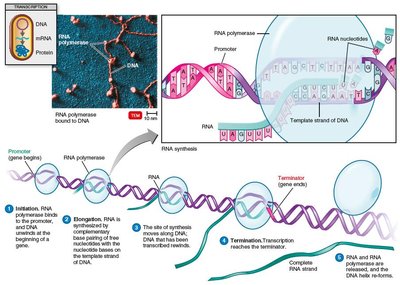
Transcription is the process by which a complementary RNA strand is synthesized from a DNA template. It is the first step in gene expression and occurs in both prokaryotes and eukaryotes, though with some differences.
Initiation: RNA polymerase binds to the promoter region of DNA, unwinding the double helix.
Elongation: RNA polymerase moves along the template strand, synthesizing RNA by complementary base pairing.
Termination: Transcription stops when RNA polymerase reaches the terminator sequence.
Only one DNA strand is transcribed for each gene.
Translation: Protein Synthesis from mRNA
Translation is the process by which the sequence of nucleotides in mRNA is decoded to produce a specific sequence of amino acids, forming a protein. This occurs at the ribosome and involves tRNA and rRNA.
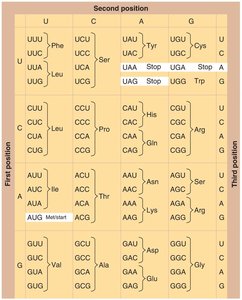
Codons: Groups of three mRNA nucleotides that code for specific amino acids.
There are 64 codons: 61 sense codons (for amino acids), 1 start codon (AUG), and 3 stop codons (UAA, UAG, UGA).
tRNA: Brings amino acids to the ribosome and matches codons with anticodons.
Peptide bonds: Form between amino acids, creating a polypeptide chain.
Simultaneous Transcription and Translation in Prokaryotes
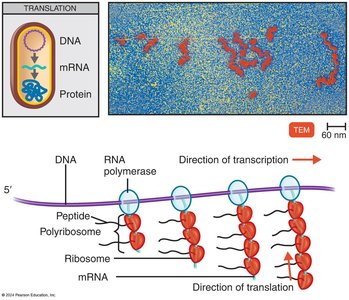
In prokaryotes, transcription and translation can occur simultaneously because both processes take place in the cytoplasm. This allows rapid protein synthesis and efficient gene expression.
mRNA is available to ribosomes before transcription is complete.
Polysomes (polyribosomes) form as multiple ribosomes translate a single mRNA.
Transcription and RNA Processing in Eukaryotes
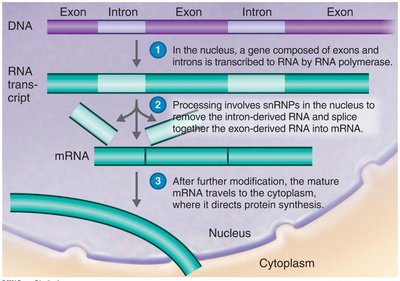
In eukaryotes, transcription occurs in the nucleus, and translation occurs in the cytoplasm. Genes are interrupted by noncoding regions (introns), which are removed during RNA processing.
Exons: Coding regions of DNA.
Introns: Noncoding regions that are spliced out.
snRNPs: Small nuclear ribonucleoproteins that remove introns and splice exons together.
The mature mRNA is exported to the cytoplasm for translation.
Regulation of Gene Expression in Bacteria
Bacterial gene expression is regulated at multiple levels, including pre-transcriptional and post-transcriptional control. The operon model explains how groups of genes are regulated together.
Constitutive genes: Always expressed at a fixed rate.
Inducible genes: Expressed only when needed, turned on by inducers.
Repressible genes: Turned off by repressors and corepressors.
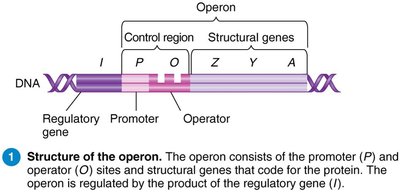
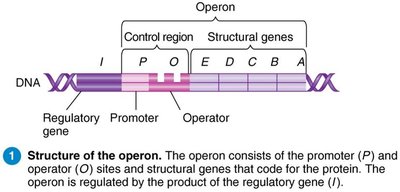
Operon: Includes promoter, operator, and structural genes regulated together.
Inducible Operon: The lac Operon
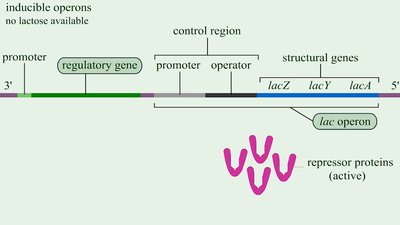
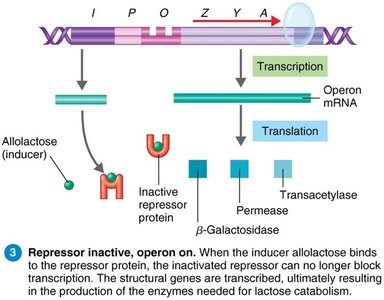
The lac operon in E. coli is an example of an inducible operon. It is activated in the presence of lactose, allowing the cell to metabolize lactose.
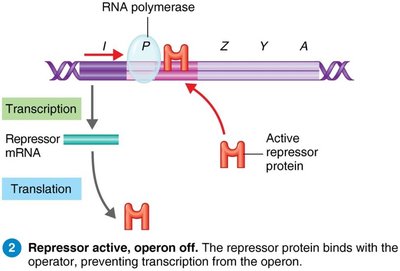
In the absence of lactose, the repressor binds to the operator, preventing transcription.
In the presence of lactose, allolactose (inducer) binds to the repressor, inactivating it and allowing transcription.
Repressible Operon: The trp Operon
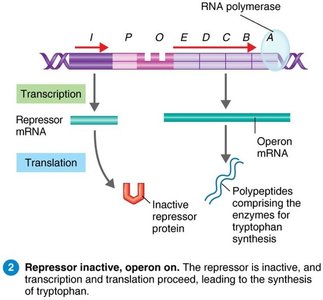
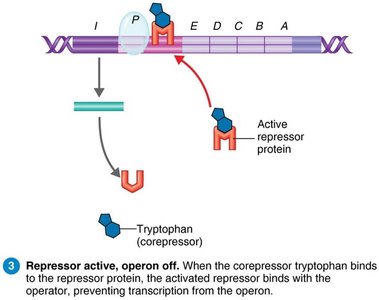
The trp operon is an example of a repressible operon. It is turned off when tryptophan (corepressor) is abundant.
When tryptophan is absent, the repressor is inactive and transcription occurs.
When tryptophan is present, it binds to the repressor, activating it and blocking transcription.
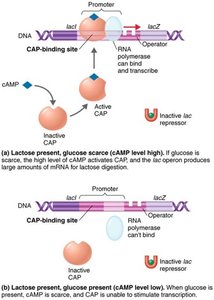
Positive Regulation: Catabolite Repression
Catabolite repression ensures that cells preferentially use glucose over other carbon sources. The lac operon is regulated by cAMP and CAP.
When glucose is scarce, cAMP levels rise, activating CAP and promoting transcription of the lac operon.
When glucose is present, cAMP is low, CAP is inactive, and lac operon transcription is reduced.
Post-Transcriptional Control: Riboswitches and microRNAs
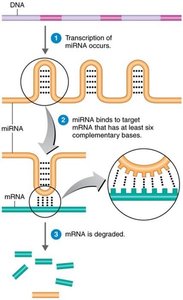
Post-transcriptional regulation can stop protein synthesis after transcription. Riboswitches and microRNAs are key mechanisms.
Riboswitch: mRNA structure that binds substrates and alters translation.
microRNAs (miRNAs): Bind to mRNA, making it double-stranded and targeting it for degradation.
Mutations: Types and Effects
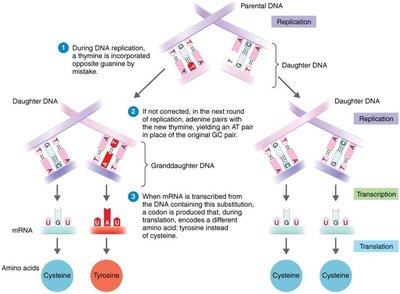
Mutations are permanent changes in the DNA sequence. They can be neutral, beneficial, or harmful, and are a source of genetic diversity.
Base substitution (point mutation): One base is changed, possibly altering the protein.
Missense mutation: Changes one amino acid.
Nonsense mutation: Creates a stop codon, truncating the protein.
Frameshift mutation: Insertion or deletion shifts the reading frame, affecting downstream amino acids.
Genetic Transfer and Recombination in Bacteria
Bacteria can exchange genetic material through several mechanisms, increasing genetic diversity and adaptability.
Vertical gene transfer: Genes passed from parent to offspring.
Horizontal gene transfer: Genes transferred between cells of the same generation.
Transformation: Uptake of naked DNA from the environment.
Conjugation: Transfer of plasmids via cell-to-cell contact.
Transduction: Transfer of DNA via bacteriophages.
Plasmids and Transposons
Plasmids and transposons are mobile genetic elements that contribute to genetic variation and can carry important traits such as antibiotic resistance.
Plasmids: Self-replicating, circular DNA molecules found in bacteria.
Resistance (R) factors: Plasmids that encode antibiotic resistance.
Transposons: DNA segments that move within and between genomes, sometimes carrying resistance or toxin genes.
Summary Table: Types of Mutations
Type | Description | Effect |
|---|---|---|
Silent | Base change does not alter amino acid | No effect on protein function |
Missense | Base change alters amino acid | Protein may be altered |
Nonsense | Base change creates stop codon | Protein truncated |
Frameshift | Insertion/deletion shifts reading frame | Many amino acids changed |
Key Equations
Mutation Rate: Probability that a gene will mutate when a cell divides.
Conclusion
Microbial genetics encompasses the mechanisms of gene expression, regulation, mutation, and genetic transfer. Understanding these processes is essential for studying microbial physiology, evolution, and the development of antibiotic resistance.
