 Back
BackMicrobial Genetics: Genetic Recombination, Horizontal and Vertical Gene Transfer, and Transposons
Study Guide - Smart Notes
 Tailored notes based on your materials, expanded with key definitions, examples, and context.
Genetic Recombination
Definition and Importance
Genetic recombination is the exchange of nucleotide sequences between homologous DNA regions, resulting in recombinant DNA with new genetic combinations. This process is fundamental for increasing genetic diversity, stabilizing foreign DNA acquired through horizontal gene transfer (HGT), and supporting DNA repair mechanisms.
Increases genetic diversity: Enables adaptation and evolution in microbial populations.
Stabilizes foreign DNA: Integrates DNA acquired from other sources, such as HGT.
Supports DNA repair: Facilitates correction of damaged DNA.
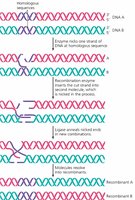
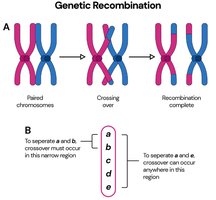
Basic Steps of Genetic Recombination
Initiation: Enzyme recognizes homologous sequences and nicks DNA.
Strand Exchange: Nicked strand inserts into another DNA molecule.
Ligation: DNA ligase seals the strands.
Resolution: DNA separates into two recombinant molecules.
Vertical Gene Transfer (VGT)
Vertical gene transfer is the transmission of genetic material from parent to offspring during reproduction, ensuring genetic continuity.
Occurs during binary fission: Each daughter cell receives a copy of the parental genome.
Slow introduction of new traits: Variation mainly arises from mutations.
Genetic continuity: Maintains lineage traits.
Horizontal Gene Transfer (HGT)
Horizontal gene transfer is the movement of genetic material between organisms without reproduction, and is a major driver of microbial evolution.
Can occur between different species: Facilitates rapid genetic innovation.
Spreads antibiotic resistance, virulence factors, metabolic abilities: Key mechanism for adaptation.
Three mechanisms: Transformation, Transduction, Conjugation.
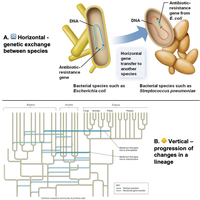
Comparison of Vertical and Horizontal Gene Transfer
Feature | Vertical Gene Transfer | Horizontal Gene Transfer |
|---|---|---|
Direction | Parent → offspring | Between unrelated cells |
Requires reproduction | Yes | No |
Speed of new traits | Slow | Fast |
Occurs between species | No | Yes |
Main purpose | Genetic continuity | Genetic innovation |
Mechanisms of Horizontal Gene Transfer
Transformation
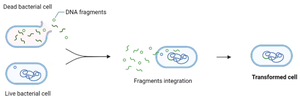
Transformation is the uptake of free DNA from the environment by a bacterial cell.
Donor cell dies and releases DNA fragments.
Competent recipient cell absorbs fragments.
Integration through recombination: If DNA is similar enough, it is incorporated.
Recipient gains new traits: Such as capsule formation or antibiotic resistance.
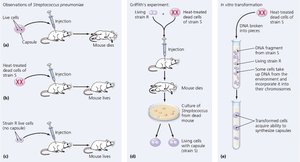
Transduction
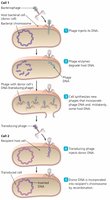
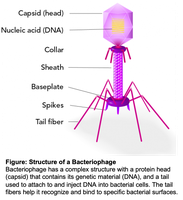
Transduction is the transfer of bacterial DNA via a bacteriophage (virus that infects bacteria).
Lytic phage: Replicates and bursts host cell.
Temperate phage: Inserts DNA into host chromosome and lies dormant as a prophage.
Generalized transduction: Random bacterial DNA is packaged and transferred.
Specialized transduction: Specific genes adjacent to prophage insertion site are transferred.
Conjugation
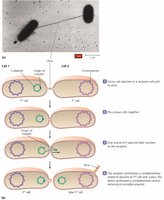
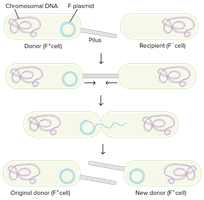
Conjugation is the transfer of genetic material between bacterial cells through direct contact, typically via a pilus.
Donor cell (F⁺) forms a pilus and attaches to recipient (F⁻).
Copy of F plasmid is transferred.
Recipient becomes F⁺ and can donate to others.
Spreads plasmids carrying antibiotic resistance or virulence genes.
Summary Table of HGT Mechanisms
Mechanism | What Moves | How It Moves | Key Feature |
|---|---|---|---|
Transformation | Free DNA | Uptake from environment | Requires competent cells |
Transduction | Bacterial DNA | Virus transfers DNA | Uses bacteriophages |
Conjugation | Plasmids or chromosomal DNA | Direct cell-to-cell contact | Uses pilus + F plasmid |
F Plasmid and Conjugation Types
The F (Fertility) Plasmid
The F plasmid is a circular DNA molecule carrying genes required for conjugation, including those encoding the sex pilus and the origin of transfer (oriT).
Encodes proteins for pilus formation.
Allows cell to act as donor.
F⁺ Cells (Donor Cells)
F⁺ cells contain the F plasmid and can initiate conjugation by forming a pilus and transferring the plasmid to F⁻ cells.
Spread ability to conjugate.
F⁻ Cells (Recipient Cells)
F⁻ cells lack the F plasmid and can receive DNA from F⁺ or Hfr cells, becoming F⁺ after plasmid acquisition.
Hfr Cells (High-Frequency Recombination Cells)
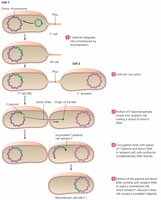
Hfr cells form when the F plasmid integrates into the bacterial chromosome, enabling transfer of chromosomal DNA during conjugation.
Transfer begins at oriT, chromosomal genes transferred first.
Recipient usually remains F⁻.
Key Differences Between F⁺ and Hfr Conjugation
Feature | F⁺ → F⁻ | Hfr → F⁻ |
|---|---|---|
What transfers | F plasmid | Chromosomal DNA (plus part of F plasmid) |
Does recipient become F⁺? | Yes | Usually no |
Genetic outcome | Gains plasmid only | Gains new chromosomal genes |
Speed of trait spread | Fast | Slower but more diverse |
Transposons (“Jumping Genes”)
Definition and Importance
Transposons are DNA segments that can move within a genome, between chromosomes, or onto plasmids. This movement, called transposition, is a major driver of microbial evolution.
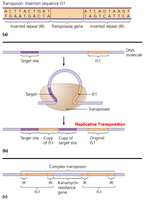
Contain inverted repeat sequences at each end.
Require transposase enzyme.
Can disrupt genes, increase genome size, or rearrange DNA.
Types of Transposition Mechanisms
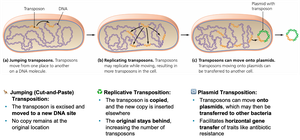
Cut-and-Paste (Jumping): Transposon excised and inserted elsewhere; no copy remains at original site.
Replicative Transposition: Transposon is copied; one copy stays, new copy inserts elsewhere.
Plasmid Transposition: Transposons move onto plasmids, which can be transferred between bacteria.
Simple vs. Complex Transposons
Simple Transposons (IS elements): Only inverted repeats and transposase gene; no extra genes.
Complex Transposons: Inverted repeats, transposase, and additional genes (e.g., antibiotic resistance).
Effects of Transposition on a Genome
Frameshift mutations: Insertion into coding regions can disrupt protein function.
Gene disruption: Inactivation or altered regulation of genes.
Genome rearrangement: Deletions, inversions, duplications, movement of operons.
Spread of antibiotic resistance: Transposons on plasmids can transfer resistance genes between bacteria.
Increased genetic diversity: Constant reshuffling of DNA.
Summary Table: Simple vs. Complex Transposons
Feature | Simple Transposon (IS) | Complex Transposon |
|---|---|---|
Contains transposase | ✔ | ✔ |
Contains inverted repeats | ✔ | ✔ |
Extra genes (e.g., resistance) | ✘ | ✔ |
Can move within genome | ✔ | ✔ |
Can spread antibiotic resistance | Rare | Very common |
Microbial Genetic Ancestry
Why Microbial Ancestry Is Difficult to Trace
Microbial genomes are mosaics due to frequent horizontal gene transfer, transposons, plasmids, conjugation, transformation, and transduction. This constant exchange blurs evolutionary lines, making ancestry much harder to determine than in animals, where vertical inheritance predominates.
Key Equations and Concepts
Recombination Frequency
The frequency of recombination between two genes is proportional to their physical distance on a chromosome.
Transposition Mechanism
Summary
Understanding genetic recombination, horizontal and vertical gene transfer, and transposons is essential for grasping microbial genetics, evolution, and the spread of traits such as antibiotic resistance. These mechanisms drive rapid adaptation and diversity in microbial populations. Additional info: Academic context was added to clarify mechanisms, provide definitions, and expand on the effects and importance of each process.
