 Back
BackMicrobial Genetics: Mechanisms of Genetic Exchange in Bacteria
Study Guide - Smart Notes
 Tailored notes based on your materials, expanded with key definitions, examples, and context.
Microbial Genetics
Introduction to Bacterial Genetics
Microbial genetics explores the structure, function, and transfer of genetic material in microorganisms, particularly bacteria. Understanding these processes is crucial for comprehending microbial evolution, adaptation, and the spread of traits such as antibiotic resistance.
Bacterial DNA Organization
Chromosomes and Plasmids
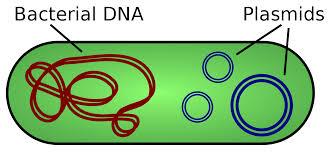
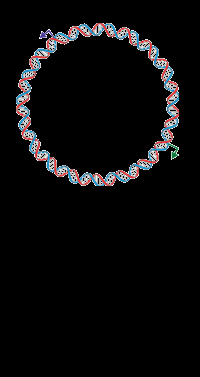
Bacterial Chromosome: Most bacteria possess a single, closed, circular, double-helical DNA molecule located in the nucleoid region. Some species, such as Agrobacterium tumefaciens, have both linear and circular chromosomes.
Plasmids: Small, circular, double-stranded DNA molecules that replicate independently of the bacterial chromosome. Plasmids are extrachromosomal and can exist in multiple copies within a cell.
Function: Plasmids often carry genes that confer selective advantages, such as antibiotic resistance, virulence factors, or metabolic capabilities.
Types of Plasmids in Bacteria
Classification and Functions
Fertility (F) Plasmids: Enable horizontal gene transfer via conjugation (sex pilus formation).
Resistance (R) Plasmids: Carry genes for antibiotic resistance (e.g., AmpR, TetR, KanR).
Bacteriocin (Col) Plasmids: Encode toxins that inhibit closely related bacterial strains.
Virulence Plasmids: Encode factors such as toxins, adhesins, and invasins, enhancing pathogenicity.
Horizontal Gene Transfer (HGT) in Prokaryotes
Mechanisms of Genetic Exchange
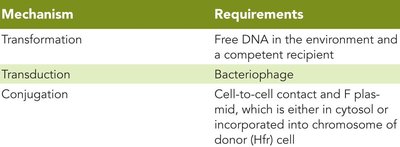
Horizontal gene transfer allows bacteria to acquire new genetic traits from other organisms, contributing to genetic diversity and adaptation. There are three main mechanisms:
Mechanism | Requirements |
|---|---|
Transformation | Free DNA in the environment and a competent recipient |
Transduction | Bacteriophage |
Conjugation | Cell-to-cell contact and F plasmid (in cytosol or integrated in donor chromosome) |
Transformation
Uptake of Free DNA
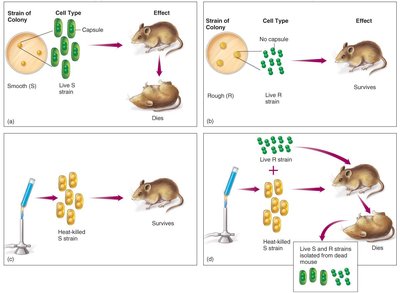
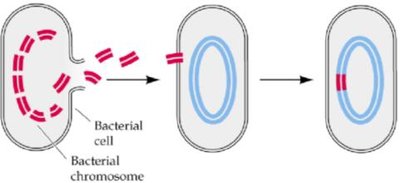
Definition: Transformation is the process by which a bacterial cell takes up free (naked) DNA from its environment.
Competence: Only 'competent' cells can undergo transformation. Some bacteria are naturally competent (e.g., Streptococcus, Neisseria), while others can be made competent in the lab (e.g., E. coli with CaCl2 treatment).
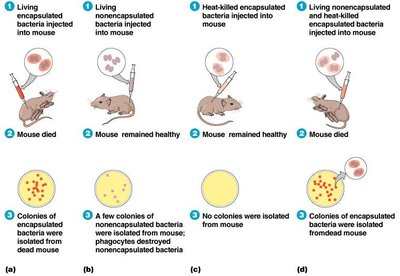
Historical Example: Frederick Griffith's experiment with Streptococcus pneumoniae demonstrated transformation, showing that non-virulent bacteria could acquire virulence by taking up DNA from dead virulent cells.


Transduction
Gene Transfer via Bacteriophages
Bacteriophages: Viruses that infect bacteria and can mediate gene transfer between cells.
Lytic Cycle: Virulent phages cause host cell lysis, sometimes packaging host DNA into new phage particles (generalized transduction).
Lysogenic Cycle: Temperate phages integrate into the host genome as prophages. Upon induction, they may carry adjacent host genes to new cells (specialized transduction).
Significance: Many bacterial virulence factors are encoded by prophages (e.g., Shiga toxin in E. coli).

Conjugation
Direct Cell-to-Cell DNA Transfer
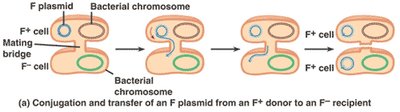
Mechanism: Requires physical contact between donor (F+) and recipient (F-) cells via a sex pilus.
F Plasmid: Encodes genes for pilus formation and DNA transfer. Can exist as an independent plasmid or integrate into the chromosome (Hfr strain).
Hfr Conjugation: When the F plasmid is integrated, chromosomal genes can be transferred to the recipient, conferring new traits.
Rolling Circle Replication: DNA transfer begins at the origin of transfer (oriT) and proceeds in a unidirectional manner.

Auxotrophy and Genetic Mapping
Auxotrophs in Bacterial Genetics
Auxotrophy: The inability of an organism to synthesize a particular organic compound required for its growth (e.g., arginine auxotroph cannot synthesize arginine).
Application: Conjugation experiments with auxotrophic strains are used to map bacterial genes and study gene transfer mechanisms.
Summary Table: Mechanisms of Horizontal Gene Transfer
Mechanism | Key Features | Requirements |
|---|---|---|
Transformation | Uptake of free DNA | Competent recipient, free DNA |
Transduction | Phage-mediated DNA transfer | Bacteriophage |
Conjugation | Direct cell-to-cell transfer | F plasmid, cell contact |
Key Terms
Plasmid: Small, circular DNA molecule separate from the chromosome.
Competence: Ability of a cell to take up extracellular DNA.
Bacteriophage: Virus that infects bacteria.
Sex Pilus: Protein tube used in conjugation for DNA transfer.
Hfr Strain: Bacterial cell with F plasmid integrated into its chromosome.
Auxotroph: Mutant organism unable to synthesize a required nutrient.
