 Back
BackMicrobial Genetics: Structure and Function of Genetic Material
Study Guide - Smart Notes
 Tailored notes based on your materials, expanded with key definitions, examples, and context.
Microbial Genetics: Structure and Function of Genetic Material
The Science of Heredity
Microbial genetics explores how genetic information is stored, transmitted, and expressed in microorganisms. Understanding these principles is fundamental to microbiology, as they underpin cellular function, inheritance, and evolution.
Genetics: The scientific study of heredity and variation in organisms.
Heredity: The transmission of genetic information from parent to offspring, primarily through DNA (or RNA in some viruses).
Genome: The complete set of genetic material in a cell, organized into chromosomes. The study of genomes is called genomics.
Chromosomes and Genes
Genetic information is organized into chromosomes, which are long molecules of DNA containing many genes. Genes are the basic units of heredity, encoding functional products such as proteins or RNAs.
Chromosomes: Circular in prokaryotes and linear in eukaryotes; contain genes.
Genes: Segments of DNA (or RNA in some viruses) that code for functional products.
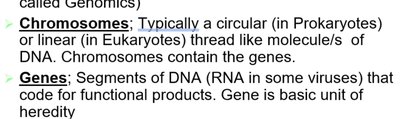
Prokaryotic Chromosomes
Prokaryotic chromosomes are typically single, circular DNA molecules found in the nucleoid region of the cell. They contain all the essential genetic information for the organism's survival and reproduction.
Structure of DNA
DNA (deoxyribonucleic acid) is a macromolecule composed of repeating units called nucleotides. It forms a double helix structure, with two strands held together by hydrogen bonds between complementary bases.
Nucleotides: Each consists of a nitrogenous base, a pentose sugar, and a phosphate group.
Nitrogenous Bases: Adenine (A), Cytosine (C), Guanine (G), Thymine (T) in DNA; Uracil (U) replaces Thymine in RNA.
Pentose Sugar: Deoxyribose in DNA, ribose in RNA.
Phosphate Group: Links the sugars of adjacent nucleotides, forming the backbone of DNA.
Complementarity of Base Pairing
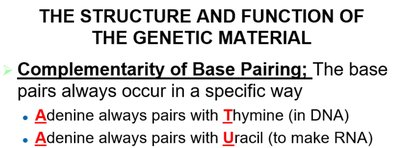
Base pairing in DNA is highly specific: Adenine pairs with Thymine (A-T) and Cytosine pairs with Guanine (C-G). In RNA, Adenine pairs with Uracil (A-U). This complementarity ensures accurate DNA replication and transcription.
A-T (DNA) and A-U (RNA)
C-G
Complementary base sequences allow for precise duplication of DNA during cell division.
The Genetic Code
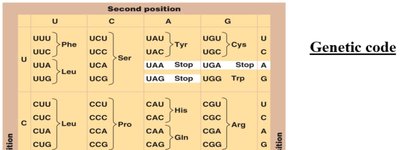
The genetic code is a set of rules by which nucleotide sequences are translated into amino acid sequences of proteins. Each triplet of nucleotides (codon) specifies a particular amino acid or a stop signal during protein synthesis.
Genes are transcribed into messenger RNA (mRNA), which is then translated into proteins.
Gene products can also be ribosomal RNA (rRNA) or transfer RNA (tRNA).
Genotype and Phenotype
The genotype is the complete genetic makeup of an organism, representing its potential characteristics. The phenotype is the set of expressed traits, determined by the genotype and environmental influences.
Genotype: The entire collection of genes; potential properties.
Phenotype: The actual, expressed properties; an organism's collection of proteins and observable traits.

Transfer of Genetic Information
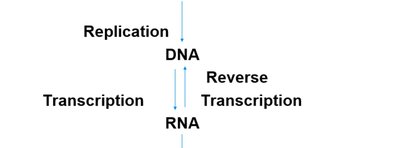
Genetic information flows from DNA to RNA to protein, a process described by the central dogma of molecular biology. This involves replication, transcription, and translation.
Replication: Copying DNA to produce identical DNA molecules.
Transcription: Synthesis of RNA from a DNA template.
Translation: Synthesis of proteins from an mRNA template.
Reverse Transcription: Synthesis of DNA from an RNA template (in some viruses).

DNA Replication
Mechanism of DNA Replication
DNA replication is essential for cell division, ensuring that each daughter cell receives a complete copy of genetic material. The process is semiconservative, meaning each new DNA molecule contains one original and one newly synthesized strand.
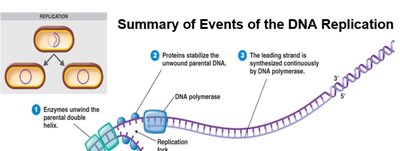
Replication begins at the replication fork, where the double helix separates.
Each strand serves as a template for the synthesis of a new complementary strand.
DNA polymerase adds nucleotides to the 3' end of the new strand, synthesizing DNA in the 5' to 3' direction.
Antiparallel Structure and Leading/Lagging Strands
The two strands of DNA are antiparallel, oriented in opposite directions. The leading strand is synthesized continuously, while the lagging strand is synthesized discontinuously in short fragments called Okazaki fragments, which are later joined by DNA ligase.
Leading Strand: Synthesized continuously toward the replication fork.
Lagging Strand: Synthesized discontinuously away from the replication fork; Okazaki fragments joined by DNA ligase.
Summary Table: Key Terms in Microbial Genetics
Term | Definition |
|---|---|
Genetics | Science of heredity |
Genome | All genetic material in a cell |
Chromosome | DNA molecule containing genes |
Gene | Segment of DNA coding for a functional product |
Genotype | Complete genetic makeup |
Phenotype | Expressed traits |
Key Equations and Concepts
Base Pairing: (in DNA), (in RNA),
Direction of DNA Synthesis:
Central Dogma:
Additional info: The above notes provide foundational knowledge for understanding microbial genetics, including the structure and function of genetic material, mechanisms of DNA replication, and the flow of genetic information in cells.
