 Back
Microbial Genetics: Structure, Function, and Expression
Study Guide - Smart Notes
 Tailored notes based on your materials, expanded with key definitions, examples, and context.
Genetics in Microbiology
Heredity Basics
Genetics is the study of genes, their functions, and how variations arise in genomes. The genome is the entire collection of genetic material in a cell or virus. The relationship between genotype and phenotype is fundamental to understanding heredity.
Genotype: The genetic makeup of an organism; the set of genes it carries.
Phenotype: The observable physical and functional traits of an organism, determined by the genotype and environmental influences.
Example: Streptococcus mutans produces a sticky slime layer only in the presence of sucrose, demonstrating environmental regulation of phenotype.


Historical Foundations
Gregor Mendel, the father of modern genetics, demonstrated that traits are heritable and passed from one generation to the next. By the early 1900s, the concept of the gene as a heritable unit was established, and the influence of genotype on phenotype became widely accepted.
Organization of Genetic Material
Prokaryotic vs. Eukaryotic Genomes
Cells organize their genomes into chromosomes, which are strands of DNA associated with organizational proteins. The complexity and organization of genomes differ between prokaryotes and eukaryotes.
Prokaryotes: Usually have a single circular chromosome located in the nucleoid region; may also contain plasmids.
Eukaryotes: Possess multiple linear chromosomes housed in the nucleus; DNA is organized by histones.
Viruses: May have DNA or RNA genomes.
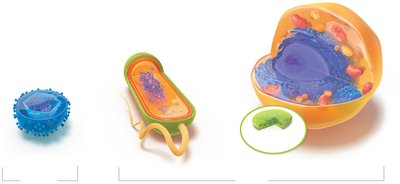

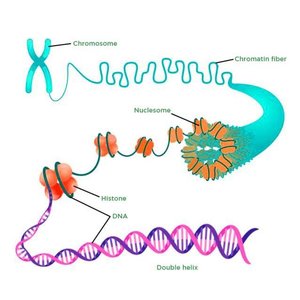
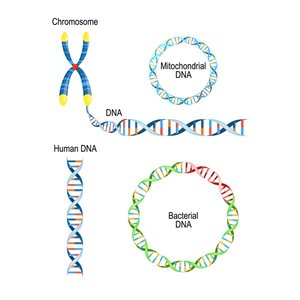
Genome Characteristics Table
Factor | Prokaryotic Genomes | Eukaryotic Genomes |
|---|---|---|
Complexity | Simple | More complex |
Genome can include | Chromosomal DNA, plasmids | Chromosomal DNA, plasmids, mitochondrial and chloroplastic DNA |
Chromosomes | Few (usually one), circular | Many, linear |
Location | Nucleoid region | Nucleus |
DNA organized by | Histone-like proteins | Histones |
Nucleic Acids: DNA and RNA
Structure of DNA
DNA is composed of nucleotides, each consisting of a phosphate group, a five-carbon sugar (deoxyribose), and a nitrogenous base. The nitrogenous bases are classified as purines (adenine, guanine) or pyrimidines (cytosine, thymine).
Double Helix: DNA consists of two antiparallel strands twisted into a helix.
Base Pairing: Adenine pairs with thymine, and guanine pairs with cytosine, stabilized by hydrogen bonds.
Directionality: DNA strands have 5' and 3' ends, important for replication and transcription.

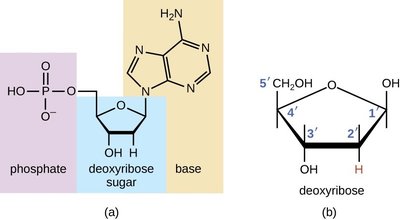


DNA and RNA Nitrogen Bases Table
Nitrogen Base | Family | Pairs with | Found in |
|---|---|---|---|
Adenine (A) | Purine | Thymine (T) | DNA and RNA |
Guanine (G) | Purine | Cytosine (C) | DNA and RNA |
Cytosine (C) | Pyrimidine | Guanine (G) | DNA and RNA |
Thymine (T) | Pyrimidine | Adenine (A) | Only DNA |
Uracil (U) | Pyrimidine | Adenine (A) | Only RNA |
Structure of RNA
RNA is typically single-stranded and composed of ribonucleotides, which include a phosphate group, ribose sugar, and nitrogenous bases (adenine, guanine, cytosine, uracil).
Uracil: Replaces thymine in RNA.
Short-term Functions: RNA is less stable than DNA, suitable for temporary roles in gene expression.
Intramolecular Base Pairing: RNA can fold into complex structures essential for its function.


Central Dogma: Flow of Genetic Information
DNA to RNA to Protein
The central dogma of molecular biology describes the flow of genetic information: DNA directs the production of RNA, which in turn directs the assembly of proteins.
Transcription: DNA is used as a template to synthesize RNA.
Translation: RNA is used to assemble proteins.
Reverse Transcription: Some viruses can convert RNA back to DNA.

DNA Replication
Mechanism and Enzymes
DNA replication is the process by which a cell copies its genome before division. It is highly accurate due to complementary base pairing and proofreading by enzymes.
Steps:
DNA unwinds at the origin of replication.
Helicase opens the DNA, forming replication forks.
Single-strand binding proteins stabilize the DNA.
Topoisomerase prevents supercoiling.
Primase synthesizes RNA primers.
DNA polymerase adds nucleotides to the primer.
Elongation of leading and lagging strands.
RNA primers are removed.
Gaps are filled by DNA polymerase.
Ligase seals the DNA fragments.
Key Enzymes:
Helicase: Unwinds DNA helix.
Primase: Builds RNA primers.
DNA polymerase III: Main enzyme for DNA synthesis.
DNA polymerase I: Replaces RNA primers with DNA.
Ligase: Seals nicks in DNA backbone.
Gyrase/Topoisomerase: Relieves torsion stress.
DNA Replication Enzymes Table
Enzyme | Function |
|---|---|
Helicase | Unwinds DNA helix |
Primase | Builds RNA primers |
DNA polymerase III | Main enzyme for DNA synthesis |
DNA polymerase I | Replaces RNA primers with DNA |
Ligase | Seals nicks in DNA backbone |
Gyrase/Topoisomerase | Relieves torsion stress |
Transcription and Translation
Transcription: Making RNA
Transcription is the process by which RNA is synthesized from a DNA template. It occurs in three steps: initiation, elongation, and termination.
Initiation: RNA polymerase binds to the promoter and unwinds DNA.
Elongation: RNA polymerase synthesizes RNA in the 5' to 3' direction.
Termination: RNA polymerase releases the new RNA at a termination sequence.
Translation: Making Proteins
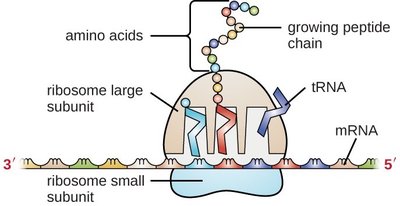
Translation is the process by which ribosomes synthesize proteins using mRNA as a template. Three main types of RNA are involved:
Messenger RNA (mRNA): Contains codons that code for amino acids or stop signals.
Transfer RNA (tRNA): Carries amino acids to the ribosome and matches them to the mRNA codon.
Ribosomal RNA (rRNA): Combines with proteins to form ribosomes.

RNA Types Table
Type | Structure | Function |
|---|---|---|
mRNA | Single-stranded, unstable | Intermediary between DNA and ribosome |
rRNA | Stable, forms ribosome structure | Aligns mRNA and tRNA, catalyzes peptide bond formation |
tRNA | Short, stable, cloverleaf shape | Carries amino acids to ribosome |
Regulation of Gene Expression
Pre- and Post-Transcriptional Regulation
Cells regulate gene expression at multiple levels to control the amount and timing of protein production.
Pre-transcriptional: Regulation of mRNA synthesis (e.g., operons, quorum sensing, epigenetic control).
Post-transcriptional: Regulation of mRNA translation (e.g., ribosome recruitment, mRNA stability, small noncoding RNAs).
Genetic Change: Mutation and Horizontal Gene Transfer
Mutation
A mutation is a change in the genetic material of a cell or virus, which can affect phenotype and lead to genetic diversity.
Horizontal Gene Transfer
Bacteria can share genes within the same generation through mechanisms such as transformation, transduction, and conjugation, contributing to rapid adaptation and evolution.
Transformation: Uptake of DNA from the environment.
Transduction: Transfer of DNA by bacteriophages.
Conjugation: Direct transfer of DNA between cells.
Summary
Microbial genetics encompasses the structure, function, and regulation of genetic material in prokaryotes, eukaryotes, and viruses. Understanding these principles is essential for studying microbial physiology, pathogenesis, and evolution.
