 Back
BackMicrobial Genetics: Structure, Function, and Expression of Genetic Material
Study Guide - Smart Notes
 Tailored notes based on your materials, expanded with key definitions, examples, and context.
Microbial Genetics
Introduction to Genetic Material
Microbial genetics is the study of the mechanisms of heritable information in microorganisms. The genetic material, or genome, includes all the DNA (or RNA in some viruses) present in an organism, encompassing chromosomes and extrachromosomal elements such as plasmids and organellar DNA.
Genome: The complete set of genetic material in a cell or virus (chromosomes + plasmids + mitochondrial/chloroplast DNA).
Chromosome: A single, long molecule of DNA containing many genes.
Gene: The fundamental unit of heredity, a segment of DNA that encodes a functional product (protein or RNA).
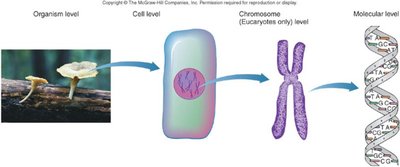
Variation in Genome Size
Genomes vary greatly in size and complexity among different organisms:
Smallest viruses: 4–5 genes
Escherichia coli: ~4,288 genes on a single chromosome
Human cells: ~31,000 genes on 46 chromosomes
Structure of Nucleic Acids
Nucleotides: Building Blocks of Nucleic Acids
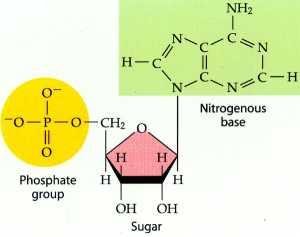
Nucleic acids (DNA and RNA) are polymers of nucleotides. Each nucleotide consists of three components:
A five-carbon sugar (deoxyribose in DNA, ribose in RNA)
A phosphate group
A nitrogenous base (adenine, thymine, cytosine, guanine, or uracil)

Nitrogenous Bases
Nitrogenous bases are classified as purines or pyrimidines:
Purines: Adenine (A) and Guanine (G)
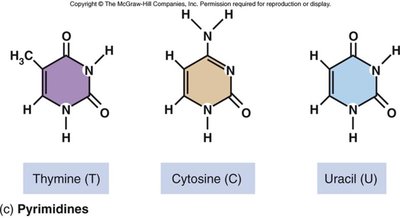
Pyrimidines: Thymine (T), Cytosine (C), and Uracil (U)


DNA Structure
DNA is a double-stranded helix with a sugar-phosphate backbone and nitrogenous bases forming the rungs. The two strands are antiparallel and held together by hydrogen bonds between complementary bases:
Adenine (A) pairs with Thymine (T) via 2 hydrogen bonds
Guanine (G) pairs with Cytosine (C) via 3 hydrogen bonds

DNA Replication
Mechanism of Replication
DNA replication is the process by which a cell duplicates its DNA before cell division. It is semiconservative, meaning each new DNA molecule consists of one parental and one new strand. The enzyme DNA polymerase synthesizes the new DNA strands.
Occurs only during cell division
Ensures genetic continuity

Gene Expression: From DNA to Protein
Overview of Gene Expression
Gene expression is the process by which information from a gene is used to synthesize functional gene products (RNAs and proteins). It involves two main steps: transcription and translation.
Transcription: Synthesis of RNA from a DNA template
Translation: Synthesis of protein using the information in mRNA
Transcription
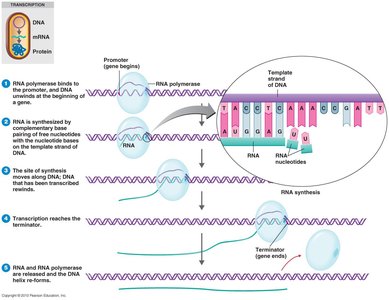
Transcription is catalyzed by RNA polymerase, which binds to the promoter region of a gene and synthesizes a complementary RNA strand in the 5' to 3' direction. In RNA, uracil (U) replaces thymine (T).
Initiation: RNA polymerase binds to promoter
Elongation: RNA nucleotides are added
Termination: RNA polymerase releases the RNA transcript

Types of RNA
There are three main types of RNA involved in gene expression:
Messenger RNA (mRNA): Carries genetic information from DNA to ribosomes
Transfer RNA (tRNA): Brings amino acids to the ribosome during translation
Ribosomal RNA (rRNA): Structural and catalytic component of ribosomes

Translation
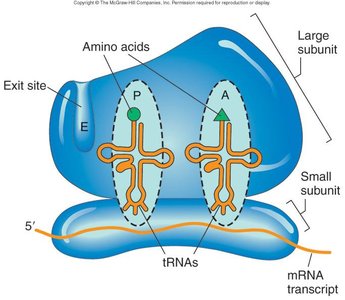
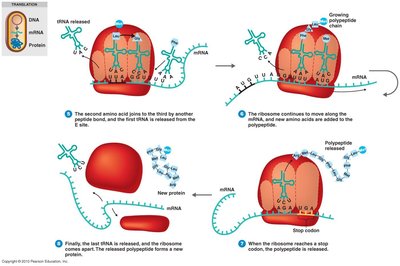
Translation is the process by which ribosomes synthesize proteins using the sequence of codons in mRNA. Each codon (a sequence of three nucleotides) specifies a particular amino acid.
Initiation: Ribosome assembles at the start codon (AUG - Methionine)
Elongation: tRNAs bring amino acids, and peptide bonds form
Termination: Stop codon is reached, and the polypeptide is released

Genetic Code
The genetic code is universal and redundant. Each amino acid is specified by one or more codons. There are start and stop codons that signal the beginning and end of translation.
Codon | Amino Acid | ||
|---|---|---|---|
AUG | Methionine (Start) | ||
UAA, UAG, UGA | Stop | ||
UUU, UUC | Phenylalanine | ||
UUA, UUG, CUU, CUC, CUA, CUG | Leucine | ||
... | ... |

Regulation of Gene Expression
Control of Protein Synthesis
Cells regulate gene expression to conserve energy and resources. One classic example is the lac operon in E. coli, which controls the metabolism of lactose.
Inducible operons are turned on in the presence of a substrate (e.g., lactose).
Repressible operons are turned off when the end product is abundant.

Mutations and Genetic Variation
Mutations
Mutations are changes in the DNA sequence that may alter the gene product. They are a source of genetic diversity and can have beneficial, neutral, or harmful effects.
Point mutation: Change in a single nucleotide
Frameshift mutation: Insertion or deletion of nucleotides that shifts the reading frame

Genetic Recombination
Genetic recombination is the exchange of genetic material between different DNA molecules, leading to new genetic combinations. In bacteria, this can occur through conjugation, transformation, or transduction.
Conjugation: Direct transfer of DNA between bacteria via a pilus
Transformation: Uptake of free DNA from the environment
Transduction: Transfer of DNA by bacteriophages (viruses that infect bacteria)


Antibiotics and Gene Expression
Antibiotics Affecting Protein Synthesis
Certain antibiotics target bacterial gene expression by interfering with transcription or translation:
Erythromycin: Inhibits attachment of mRNA to ribosomes
Tetracycline: Blocks elongation by binding to the ribosome
Streptomycin: Inhibits peptide initiation and elongation
Additional info: This guide expands on the provided notes with definitions, examples, and logical groupings for clarity and completeness. The most relevant images are included to reinforce key concepts in microbial genetics.
