 Back
Microbial Genetics: Structure, Function, and Genetic Variation in Prokaryotes
Study Guide - Smart Notes
 Tailored notes based on your materials, expanded with key definitions, examples, and context.
Microbial Genetics
Key Terms and Concepts
Microbial genetics is the study of genes, their functions, and how genetic information is transferred and expressed in microorganisms. Understanding these concepts is fundamental to microbiology, as genetic variation drives microbial evolution and adaptation.
Genetics: The study of genes, how they carry information, how information is expressed, and how genes are replicated.
Genes: Segments of DNA that encode functional products, usually proteins.
Genome: All the genetic information in a cell.
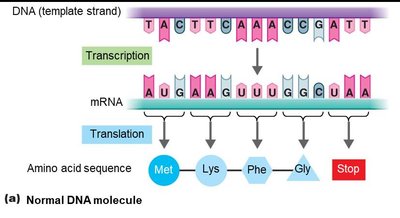
Genetic Code: The set of rules that determines how a nucleotide sequence is converted to an amino acid sequence of a protein.
Chromosome: Circular, double-stranded DNA necessary for survival in prokaryotes.
Plasmid: Small, circular, double-stranded DNA carrying additional traits (e.g., antibiotic resistance), not essential for survival.
Transposons: "Jumping genes" that can move within and between DNA molecules.
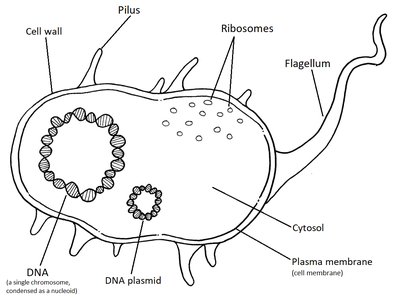
Structure of DNA
Nucleotides and Their Components
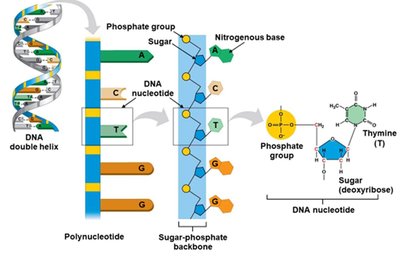
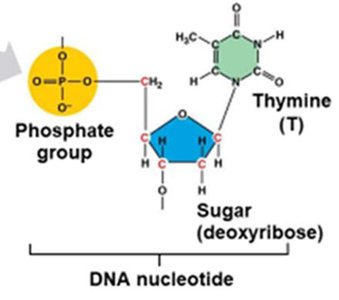
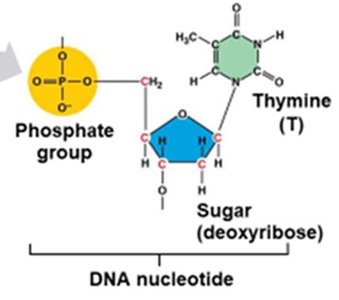
DNA and RNA are composed of nucleotides, which are the basic building blocks of nucleic acids. Each nucleotide consists of three components:
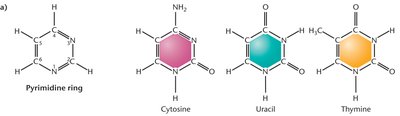
Nitrogenous base: Purines (adenine, guanine) and pyrimidines (cytosine, thymine, uracil).
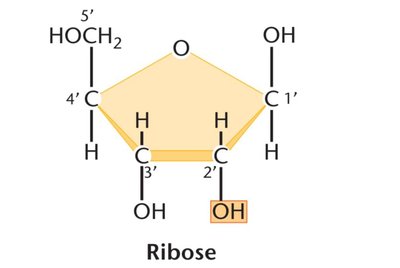
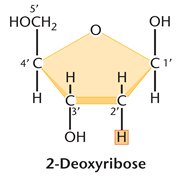
Pentose sugar: Ribose in RNA, deoxyribose in DNA.
Phosphate group: Provides the acidic property and negative charge.
Nitrogenous Bases
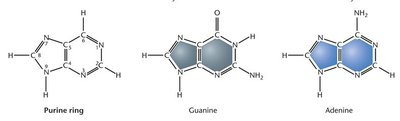
Nitrogenous bases are classified into two groups:
Purines: Double-ring structures (adenine, guanine).
Pyrimidines: Single-ring structures (cytosine, thymine, uracil).
Pentose Sugars
The pentose sugar determines whether the nucleic acid is DNA or RNA:
Ribose: Found in RNA, has a hydroxyl group at the 2' carbon.
Deoxyribose: Found in DNA, lacks the hydroxyl group at the 2' carbon.
Phosphate Group
The phosphate group links nucleotides together, forming the sugar-phosphate backbone of DNA and RNA.
DNA Double Helix and Base Pairing
Base Pairing Rules
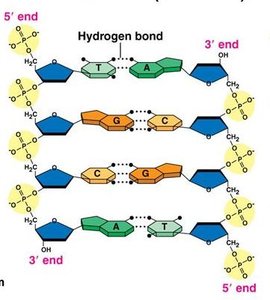
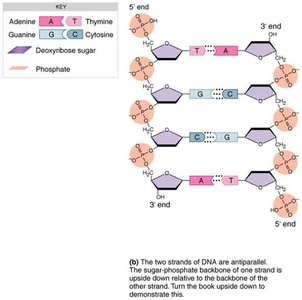
Base pairing occurs between a purine and a pyrimidine, stabilizing the double helix structure:
Adenine (A) pairs with Thymine (T) via two hydrogen bonds.
Guanine (G) pairs with Cytosine (C) via three hydrogen bonds.
The Flow of Genetic Information
Expression, Recombination, and Replication
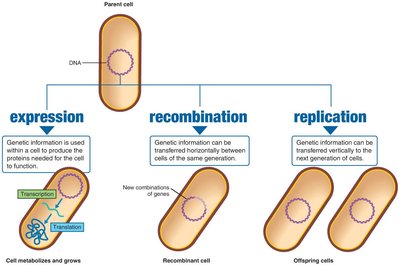
Genetic information in cells can be expressed, recombined, or replicated:
Expression: Genetic information is used to produce proteins needed for cell function.
Recombination: Genetic information can be transferred horizontally between cells of the same generation.
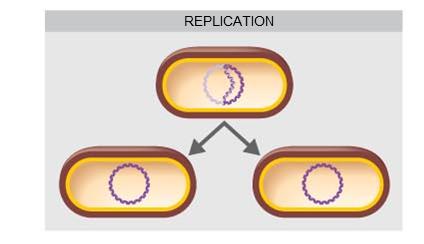
Replication: Genetic information is transferred vertically to the next generation of cells.
DNA Replication
Mechanism of Replication
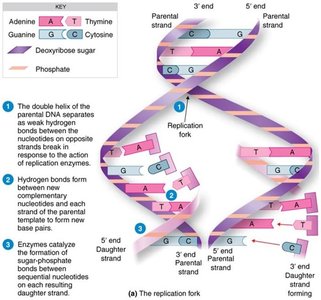
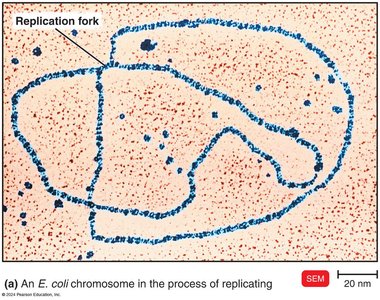
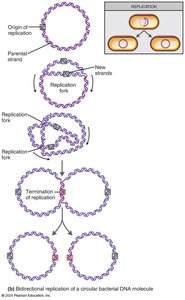
DNA replication is a semi-conservative process where each strand serves as a template for a new strand. Key enzymes involved include:
Topoisomerase and gyrase: Relax the DNA strands.
Helicase: Separates the DNA strands.
DNA polymerase: Adds nucleotides to the new strand.
Replication fork: The site where DNA is actively being replicated.
Strands are antiparallel, and the order of nitrogenous bases forms the genetic instructions.
Genetic Variation: Mutations and Horizontal Gene Transfer
Mutations
Mutations are permanent changes in the DNA sequence. They can be:
Neutral: No effect on protein function.
Beneficial: Enhance survival or reproduction.
Harmful: Reduce fitness or cause disease.
Types of mutations include:
Base substitution (point mutation): Changes a single base.
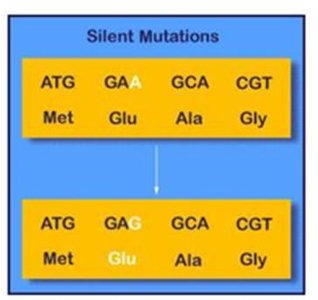
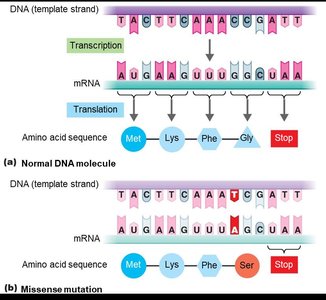
Silent mutation: No change in amino acid.
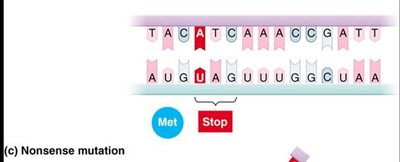
Missense mutation: Changes one amino acid.
Nonsense mutation: Introduces a stop codon.
Frameshift mutation: Insertion or deletion shifts the reading frame.
Mutation Rate
The mutation rate is the probability that a gene will mutate during cell division, typically expressed as a negative power of ten (e.g., ).
Horizontal Gene Transfer and Genetic Recombination
Mechanisms of Horizontal Gene Transfer
Horizontal gene transfer allows bacteria to acquire new genetic traits from other cells, contributing to genetic diversity and adaptation. The main mechanisms are:
Conjugation: Transfer of plasmids via direct cell-to-cell contact, often mediated by the F factor.
Transformation: Uptake of "naked" DNA from the environment by competent cells.
Transduction: Transfer of DNA via bacteriophages (viruses that infect bacteria).
Plasmids and Transposons
Plasmids are self-replicating, circular DNA molecules that often carry genes for antibiotic resistance or virulence. Transposons are mobile genetic elements that can move between chromosomes and plasmids, facilitating the spread of resistance genes.
Conjugation
Conjugation requires cell-to-cell contact and is mediated by conjugative plasmids (F factor). Donor cells (F+) transfer plasmids to recipient cells (F-), enabling the spread of traits such as antibiotic resistance.
Transformation
Transformation involves the uptake of free DNA from the environment by competent bacterial cells, which can then integrate the DNA into their genome by recombination.
Transduction
Transduction is the process by which bacterial DNA is transferred from one cell to another via a bacteriophage. This can result in the spread of new genetic traits within bacterial populations.
Summary Table: Types of Mutations
Mutation Type | Definition | Effect | Example |
|---|---|---|---|
Silent | Base change, no amino acid change | No effect on protein | ATG GAA → ATG GAG (both code for Glu) |
Missense | Base change, amino acid change | Protein function may change | ATG GAA → ATG GAC (Glu → Asp) |
Nonsense | Base change, stop codon introduced | Protein truncated | ATG GAA → ATG TAA (stop codon) |
Frameshift | Insertion/deletion shifts reading frame | Protein sequence altered | ATG GAA → ATG GA(A) |
Summary Table: Types of Plasmids
Plasmid Type | Function | Example |
|---|---|---|
F Factor | Conjugation, transfer of plasmid | Sex pili genes |
Virulence | Enhance pathogenicity | Toxin production in E. coli |
Disimilation | Catabolism of unusual substances | Hydrocarbon breakdown |
Col | Production of colicins (antibiotic activity) | Colicinogenic factor |
Resistance (R-factor) | Antibiotic resistance | Penicillin resistance gene |
Conclusion
Microbial genetics encompasses the structure and function of genetic material in prokaryotes, mechanisms of genetic variation, and the processes by which genetic information is transferred and expressed. Understanding these principles is essential for studying microbial evolution, antibiotic resistance, and biotechnology applications.
