 Back
BackMicrobial Genetics: Structure, Function, and Mechanisms
Study Guide - Smart Notes
 Tailored notes based on your materials, expanded with key definitions, examples, and context.
Microbial Genetics
Big Picture: Genetics
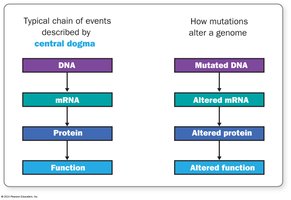
Genetics is the science of heredity, focusing on how genes carry information, how this information is expressed, and how genes are replicated. The central dogma of molecular biology describes the flow of genetic information from DNA to RNA to protein. Mutations and gene expression, often controlled by operons, are fundamental to microbial genetics.
Genetics: Study of genes, their functions, and inheritance.
Central Dogma: DNA → RNA → Protein → Function.
Mutations: Changes in DNA sequence that can affect gene function.
Operons: Groups of genes regulated together, can be inducible or repressible.
Structure and Function of the Genetic Material
Genetic material is organized into chromosomes, which contain genes. The genome encompasses all genetic information in a cell, and genomics involves sequencing and characterizing genomes. The genotype is the genetic makeup, while the phenotype is the expression of those genes.
Chromosomes: DNA structures carrying hereditary information.
Genes: DNA segments encoding functional products, usually proteins.
Genome: Complete genetic content of a cell.
Genotype vs. Phenotype: Genotype is the DNA sequence; phenotype is the observable trait.
The Genetic Code and Central Dogma
The genetic code determines how nucleotide sequences are translated into amino acid sequences. The central dogma outlines the process by which DNA is transcribed into mRNA, which is then translated into protein.
Genetic Code: Rules for converting nucleotide sequences to amino acids.
Gene Expression: Occurs when the encoded molecule is produced.

DNA and Chromosomes in Bacteria
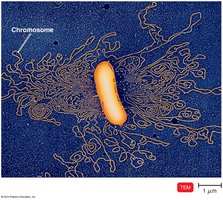
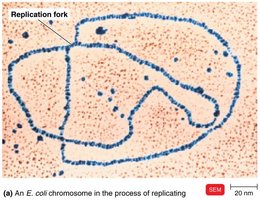
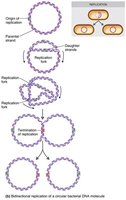
Bacterial chromosomes are typically single, circular DNA molecules associated with proteins. For example, E. coli has a highly supercoiled chromosome with millions of base pairs.
Structure: Circular chromosome, supercoiled for compactness.
Example: E. coli chromosome contains 4.6 million base pairs.
The Flow of Genetic Information
Genetic information flows vertically (from parent to offspring) and horizontally (between cells of the same generation). DNA is transcribed to mRNA and translated to protein.
Vertical Gene Transfer: Parent to offspring.
Horizontal Gene Transfer: Between cells of the same generation.
DNA Replication
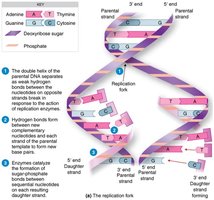
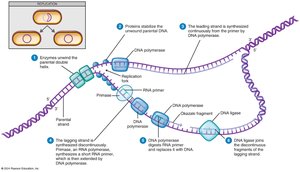
DNA replication is the process by which DNA is copied before cell division. The double helix is separated, and each strand serves as a template for a new strand. Replication is highly accurate due to proofreading by DNA polymerase.
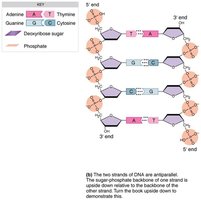
Double Helix: Two antiparallel strands held by hydrogen bonds (A-T, C-G).
Replication Fork: Site where DNA is actively being replicated.
Enzymes: Topoisomerase, gyrase, helicase, DNA polymerase, ligase.
Leading Strand: Synthesized continuously.
Lagging Strand: Synthesized discontinuously (Okazaki fragments).
Bidirectional Replication: Most bacterial DNA replication proceeds in both directions.
RNA and Protein Synthesis
RNA is a single-stranded molecule with ribose sugar and uracil instead of thymine. There are three main types: rRNA (ribosomal), tRNA (transfer), and mRNA (messenger).
rRNA: Integral part of ribosomes.
tRNA: Transports amino acids during protein synthesis.
mRNA: Carries genetic code from DNA to ribosomes.
Transcription in Prokaryotes
Transcription is the synthesis of a complementary mRNA strand from a DNA template. It involves initiation (RNA polymerase binds to promoter), elongation (RNA strand grows), and termination (transcription stops at terminator).
Initiation: RNA polymerase binds to promoter.
Elongation: RNA strand synthesized in 5' to 3' direction.
Termination: RNA polymerase reaches terminator sequence.
Translation
Translation converts mRNA into protein. Codons (three-nucleotide sequences) specify amino acids. tRNA brings amino acids to the ribosome, matching codons with anticodons. Translation begins at the start codon (AUG) and ends at stop codons (UAA, UAG, UGA).
Codons: 64 possible, 61 sense codons for 20 amino acids, 3 stop codons.
Degeneracy: Multiple codons can code for the same amino acid.
Peptide Bonds: Join amino acids during translation.
Bacterial Translation: Can begin before transcription is complete.
The Regulation of Bacterial Gene Expression
Gene expression in bacteria is regulated by constitutive, inducible, and repressible genes. Constitutive genes are always expressed, while inducible and repressible genes are regulated as needed.
Constitutive Genes: Always "on".
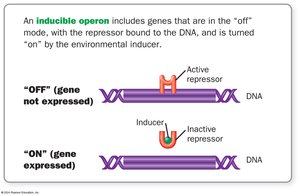
Inducible Genes: Turned "on" by inducers.
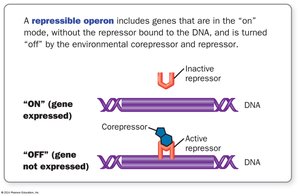
Repressible Genes: Turned "off" by repressors and corepressors.
The Operon Model of Gene Expression
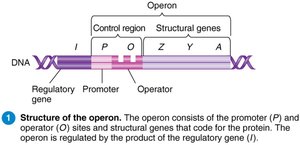
Operons are clusters of genes regulated together. The promoter is where transcription begins, and the operator is the regulatory region. Inducible operons (e.g., lac operon) are "off" unless an inducer is present. Repressible operons (e.g., trp operon) are "on" until turned "off" by a corepressor.
Promoter: Initiates transcription.
Operator: Regulatory region controlling gene expression.
Inducible Operon: Requires inducer to be expressed.
Repressible Operon: Turned off by corepressor.
Changes in Genetic Material
Mutation
Mutations are permanent changes in the DNA sequence. They can be neutral, beneficial, or harmful. Mutagens are agents that cause mutations, while spontaneous mutations occur without mutagens.
Silent Mutation: No effect on protein function.
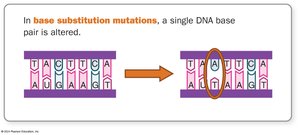
Base Substitution (Point Mutation): One base is changed.
Nonsense Mutation: Results in a stop codon.
Missense Mutation: Changes an amino acid.
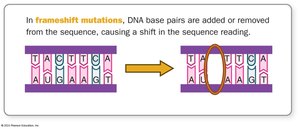
Frameshift Mutation: Insertion or deletion shifts reading frame.
Chemical and Radiation Mutagens
Chemical mutagens directly or indirectly cause mutations. Ionizing radiation (X-rays, gamma rays) and UV radiation can damage DNA, leading to mutations. Cells have repair mechanisms such as photolyases and nucleotide excision repair.
Ionizing Radiation: Causes DNA backbone breaks.
UV Radiation: Causes thymine dimers.
Repair Mechanisms: Photolyases, nucleotide excision repair.
The Frequency of Mutation
Mutation rate is the probability of a gene mutating during cell division. Spontaneous mutation rates are low, but mutagens can increase rates significantly.
Spontaneous Mutation Rate: 1 in 109 base pairs or 1 in 106 genes.
Mutagens: Increase mutation rate 10-1000 times.
Identifying Mutants and Carcinogens
Mutants can be identified by direct (positive) or indirect (negative) selection. The Ames test uses bacteria to detect mutagenic and carcinogenic substances.
Auxotroph: Mutant with a nutritional requirement absent in the parent.
Ames Test: Measures mutation reversion rate in Salmonella auxotrophs.
Genetic Transfer and Recombination
Vertical and Horizontal Gene Transfer
Vertical gene transfer is from parent to offspring, while horizontal gene transfer occurs between cells of the same generation. Horizontal transfer mechanisms involve donor and recipient cells, resulting in recombinants.
Genetic Recombination: Exchange of genes between DNA molecules.
Crossing Over: DNA segments break and rejoin, inserting foreign DNA.
Plasmids
Plasmids are self-replicating, circular DNA molecules found in bacteria. They may carry genes for toxin production, antibiotic resistance, and other functions. Resistance (R) factors encode antibiotic resistance and can be transferred horizontally.
Conjugative Plasmid: Carries genes for sex pili and plasmid transfer.
Dissimilation Plasmids: Encode enzymes for catabolism of unusual compounds.
R Factors: Encode resistance to antibiotics.
Transformation in Bacteria
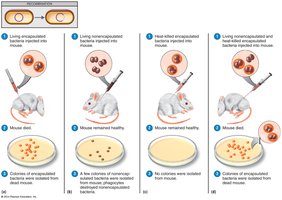
Transformation is the uptake of "naked" DNA from the environment by a bacterium, leading to genetic change.
Conjugation in Bacteria
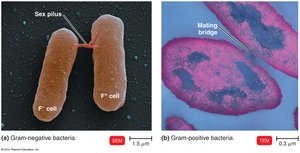
Conjugation involves the transfer of plasmids from one bacterium to another via cell-to-cell contact. Gram-negative bacteria use sex pili, while Gram-positive bacteria use a sticky substance. Donor cells have a conjugative plasmid; recipients lack it.
F Factor: Plasmid enabling conjugation.
Hfr Cells: F factor integrated into chromosome, can transfer chromosomal genes.
Transduction in Bacteria
Transduction is the transfer of DNA from a donor to a recipient via a bacteriophage. Generalized transduction transfers random DNA, while specialized transduction transfers specific genes.
Bacteriophage: Virus that infects bacteria.
Generalized Transduction: Random DNA packaged in phage.
Specialized Transduction: Specific genes packaged in phage.
Genes and Evolution
Mutations and recombination generate genetic diversity, which is the foundation for evolution. Natural selection acts on populations, favoring organisms best suited to their environment.
Diversity: Raw material for evolution.
Natural Selection: Ensures survival of the fittest.
----------------------------------------
