 Back
Microbial Genetics: Structure, Function, and Mechanisms of Genetic Change
Study Guide - Smart Notes
 Tailored notes based on your materials, expanded with key definitions, examples, and context.
Microbial Genetics
Overview of Genetics in Microbiology
Genetics is the science of heredity, focusing on how genes carry information, how this information is expressed, and how genes are replicated. In microbiology, understanding genetic mechanisms is crucial for explaining microbial function, disease causation, and biotechnological applications.
Genetics: Study of genes, their functions, and inheritance.
Chromosomes: Structures containing DNA that carry hereditary information.
Genes: Segments of DNA encoding functional products, usually proteins.
Genome: All genetic information in a cell.
Genomics: Sequencing and molecular characterization of genomes.
The Central Dogma of Molecular Biology
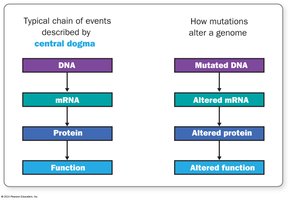
The central dogma describes the flow of genetic information from DNA to RNA to protein, which ultimately determines cellular function. Mutations can disrupt this flow, leading to altered proteins and functions.
DNA is transcribed to mRNA.
mRNA is translated to protein.
Proteins carry out cellular functions.
Mutations in DNA can result in altered mRNA, proteins, and functions.

Genotype and Phenotype
The genotype is the genetic makeup of an organism, while the phenotype is the expression of those genes as observable traits.
Genotype: The set of genes in an organism.
Phenotype: The physical and functional expression of the genotype.
Structure and Replication of Genetic Material
DNA and Chromosomes in Bacteria
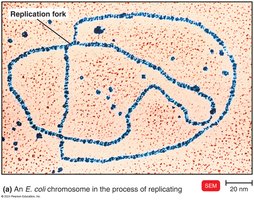
Bacterial chromosomes are typically single, circular DNA molecules associated with proteins. For example, E. coli has a highly supercoiled chromosome with millions of base pairs.
Single circular chromosome in most bacteria.
Supercoiling allows compact storage of genetic material.
DNA Replication
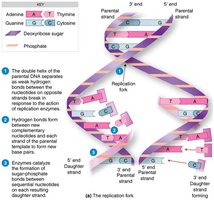
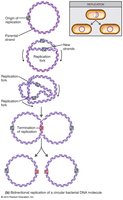
DNA replication is the process by which a cell copies its DNA before cell division. It is highly accurate due to proofreading by DNA polymerase and is usually bidirectional in bacteria.
Double helix structure with antiparallel strands.
Hydrogen bonds between A-T and C-G.
One strand serves as a template for the other.
Bidirectional replication ensures each offspring receives a copy.
Proofreading by DNA polymerase increases fidelity.
RNA and Protein Synthesis
Types of RNA
RNA is a single-stranded nucleic acid with ribose sugar and uracil instead of thymine. It plays several roles in protein synthesis.
Ribosomal RNA (rRNA): Integral part of ribosomes.
Transfer RNA (tRNA): Transports amino acids during protein synthesis.
Messenger RNA (mRNA): Carries coded information from DNA to ribosomes.
Transcription in Prokaryotes
Transcription is the synthesis of a complementary mRNA strand from a DNA template. It involves initiation, elongation, and termination steps.
Initiation: RNA polymerase binds to the promoter sequence.
Elongation: RNA polymerase synthesizes mRNA in the 5' to 3' direction.
Termination: Transcription stops at the terminator sequence.
Gene Expression and Regulation
The Operon Model
Gene expression in bacteria is often regulated by operons, which are clusters of genes controlled together. The lac operon is a classic example of an inducible operon.
Promoter: Site where transcription begins.
Operator: Regulatory site controlling transcription.
Operon: Includes promoter, operator, and structural genes.
Inducible operons require an inducer (e.g., allolactose for the lac operon) to activate transcription.
Repressor proteins can block transcription by binding to the operator.
Mutations and Genetic Variation
Mutation
A mutation is a permanent change in the DNA sequence. Mutations can be neutral, beneficial, or harmful, and may arise spontaneously or due to mutagens.
Mutagens: Agents causing mutations (e.g., chemicals, radiation).
Spontaneous mutations: Occur without mutagen exposure.
Natural selection: Favors survival of new genotypes.
Chemical and Radiation Mutagens
Chemical mutagens and radiation can induce mutations by altering DNA structure or base pairing.
Nitrous acid: Causes adenine to bind with cytosine.
Aflatoxin: A potent mutagen.
Ionizing radiation: Breaks DNA backbone.
UV radiation: Causes thymine dimers.
Identifying Chemical Carcinogens: The Ames Test
The Ames test uses bacteria to detect mutagenic and carcinogenic substances by measuring mutation reversion rates.
Uses Salmonella his- auxotrophs.
Rat liver extract provides activation enzymes.
Reversion rate indicates mutagenicity.
Genetic Transfer and Recombination
Vertical and Horizontal Gene Transfer
Vertical gene transfer occurs from parent to offspring, while horizontal gene transfer occurs between cells of the same generation, leading to genetic recombination.
Vertical gene transfer: Parent to offspring.
Horizontal gene transfer: Between cells of same generation.
Horizontal transfer mechanisms: conjugation, transformation, transduction.
Recipient cell incorporating donor DNA becomes a recombinant.
Conjugation in Bacteria
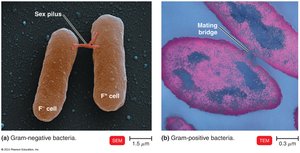
Conjugation involves the transfer of plasmids between bacteria via direct cell-to-cell contact. Gram-negative bacteria use sex pili, while Gram-positive bacteria use a mating bridge.
Donor cell has a conjugative plasmid; recipient lacks it.
Plasmids may carry genes for antibiotic resistance or toxin production.
R factors encode resistance to antibiotics.
Plasmids
Plasmids are self-replicating, circular DNA molecules found in bacteria. They often carry genes for antibiotic resistance, toxin production, or unusual metabolic pathways.
Conjugative plasmids: Carry genes for sex pili and transfer.
Dissimilation plasmids: Encode enzymes for catabolism of unusual compounds.
R factors: Encode resistance to multiple antibiotics.
R factor genes: Resistance transfer factor (RTF) and R-determinant.
Transformation in Bacteria
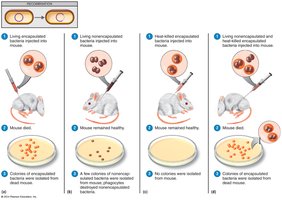
Transformation is the uptake of "naked" DNA from the environment by a bacterial cell, leading to genetic change. Griffith's experiment with Streptococcus pneumoniae demonstrated this process.
Occurs naturally in some genera (e.g., Bacillus, Haemophilus, Neisseria).
Dead cells release DNA, which can be incorporated by other bacteria.
Transduction in Bacteria
Transduction is the transfer of DNA from one bacterium to another via a bacteriophage. It can be generalized (random DNA transfer) or specialized (specific gene transfer).
Bacteriophage: Virus that infects bacteria.
Generalized transduction: Random bacterial DNA packaged in phage.
Specialized transduction: Specific genes transferred by phage.
Summary Table: Mechanisms of Horizontal Gene Transfer
Mechanism | Description | Key Features |
|---|---|---|
Conjugation | Direct transfer of plasmid DNA via cell-to-cell contact | Sex pili (Gram-negative), mating bridge (Gram-positive), antibiotic resistance |
Transformation | Uptake of naked DNA from environment | Natural in some bacteria, demonstrated by Griffith's experiment |
Transduction | DNA transfer via bacteriophage | Generalized (random), specialized (specific genes) |
