 Back
BackMicrobial Genetics: Structure, Function, and Regulation of Genetic Material
Study Guide - Smart Notes
 Tailored notes based on your materials, expanded with key definitions, examples, and context.
Microbial Genetics
Introduction to Microbial Genetics
Microbial genetics is the study of how microorganisms inherit traits, how their genetic information is expressed, and how it can be altered. Understanding microbial genetics is essential for grasping the mechanisms of disease, antibiotic resistance, and the manipulation of microbes for human benefit.
Genetics: The science of heredity, focusing on genes, their expression, and replication.
Genome: The complete set of genetic information in a cell.
Chromosomes: Structures containing DNA that carry hereditary information.
Genes: Segments of DNA encoding functional products, usually proteins.
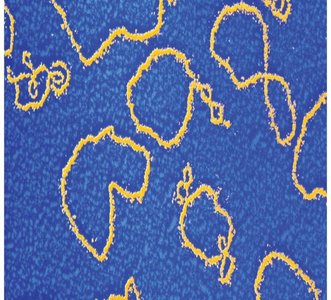
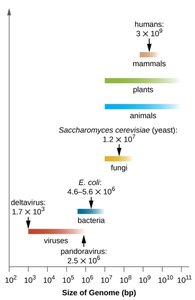
Genome Organization and Diversity
The size and organization of genomes vary widely among different organisms, from viruses to humans. Prokaryotes typically have a single circular chromosome, while eukaryotes possess multiple linear chromosomes.
Prokaryotes: Usually have a single, circular chromosome and may contain plasmids (extrachromosomal DNA).
Eukaryotes: Have multiple, linear chromosomes and may have extra DNA in mitochondria and chloroplasts.
The Central Dogma of Molecular Biology
The central dogma describes the flow of genetic information: DNA is transcribed into RNA, which is then translated into protein. This process underlies gene expression in all living cells.
Genotype: The genetic makeup of an organism.
Phenotype: The observable characteristics resulting from gene expression.

The Flow of Genetic Information
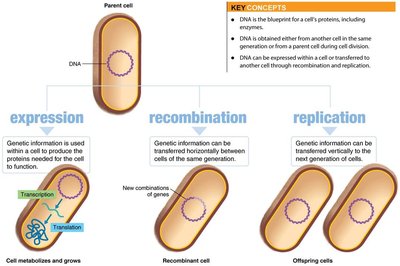
Genetic information can be expressed, recombined, or replicated. Expression involves transcription and translation, recombination introduces genetic diversity, and replication ensures genetic continuity.
Vertical gene transfer: Transmission of genes from parent to offspring.
Horizontal gene transfer: Transfer of genes between cells of the same generation.
Structure and Replication of DNA
DNA Structure
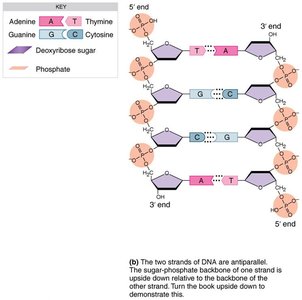
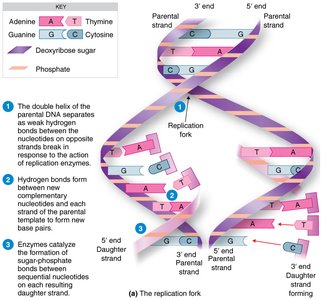
DNA is a double helix composed of nucleotides, each containing a deoxyribose sugar, a phosphate group, and a nitrogenous base (A, T, C, G). The strands are antiparallel and held together by hydrogen bonds between complementary bases (A-T, C-G).
DNA Replication
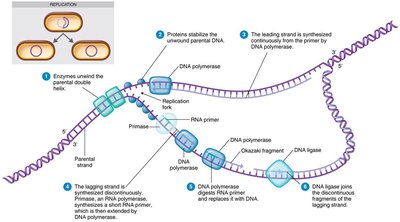
DNA replication is semiconservative, meaning each new DNA molecule consists of one parental and one newly synthesized strand. The process is highly accurate due to proofreading by DNA polymerases.
Key enzymes: Helicase (unwinds DNA), DNA polymerase (synthesizes new DNA), primase (synthesizes RNA primers), ligase (joins fragments), gyrase/topoisomerase (relieves supercoiling).
Leading strand: Synthesized continuously.
Lagging strand: Synthesized discontinuously as Okazaki fragments.
Energy for DNA Replication
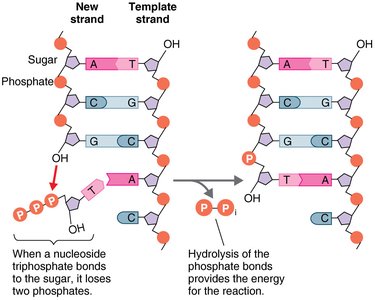
The energy required for DNA synthesis comes from the hydrolysis of nucleoside triphosphates, releasing pyrophosphate.
Bidirectional Replication in Bacteria
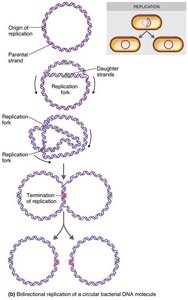
Most bacterial DNA replication is bidirectional, starting from a single origin and proceeding in both directions until the entire molecule is copied.
RNA and Protein Synthesis
Types of RNA
RNA is single-stranded and contains ribose sugar and uracil instead of thymine. The main types of RNA are:
mRNA (messenger RNA): Carries genetic code from DNA to ribosomes.
tRNA (transfer RNA): Brings amino acids to the ribosome during translation.
rRNA (ribosomal RNA): Forms the core of ribosome's structure and catalyzes protein synthesis.
Transcription in Prokaryotes
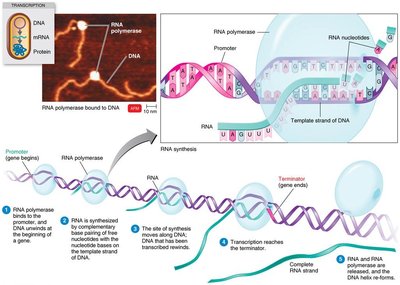
Transcription is the synthesis of a complementary mRNA strand from a DNA template. It begins at the promoter and ends at the terminator sequence.
Transcription in Eukaryotes
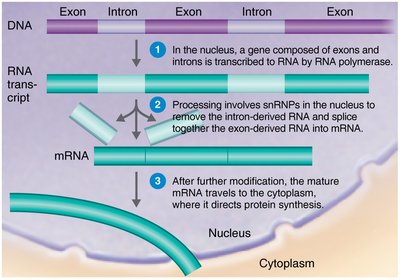
In eukaryotes, transcription occurs in the nucleus. The initial RNA transcript (pre-mRNA) contains exons (coding regions) and introns (non-coding regions). Introns are removed, and exons are spliced together by snRNPs to form mature mRNA, which is then exported to the cytoplasm for translation.
Translation and the Genetic Code
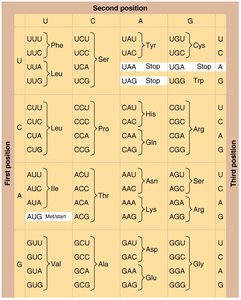
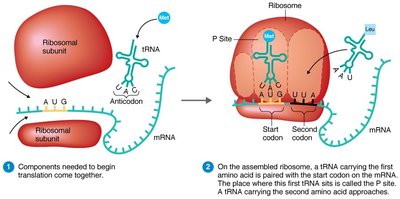
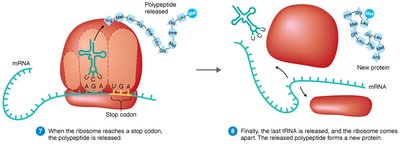
Translation is the process by which mRNA is decoded to synthesize proteins. The genetic code is read in codons (triplets of nucleotides), each specifying an amino acid. The code is universal, redundant, and unambiguous. UAA, UGA, UAG - stop codons AUG - start codon
Mechanism of Translation
Translation involves initiation, elongation, and termination:
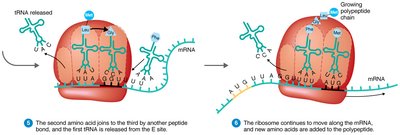
Initiation: The ribosome assembles around the start codon (AUG) on the mRNA.
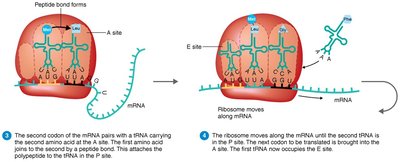
Elongation: tRNAs bring amino acids to the ribosome, where peptide bonds form between them.
Termination: The process ends when a stop codon is reached, releasing the newly synthesized protein.
Coupling of Transcription and Translation in Bacteria
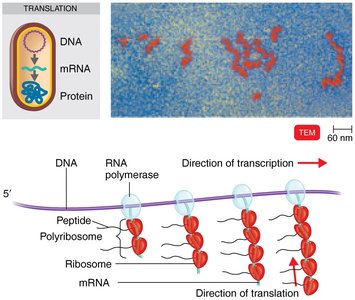
In prokaryotes, translation can begin before transcription is complete, allowing rapid protein synthesis.
Regulation of Gene Expression
Operon Model
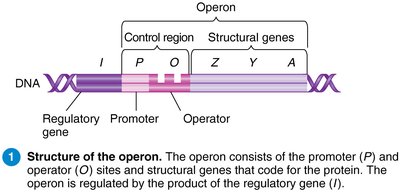
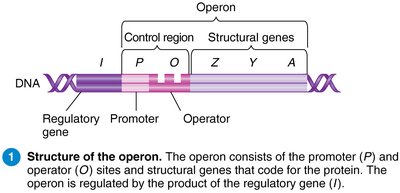
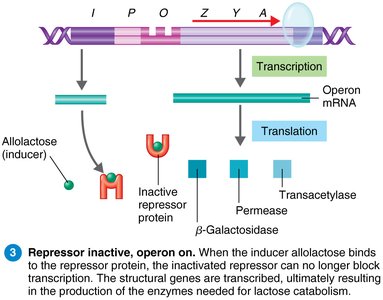
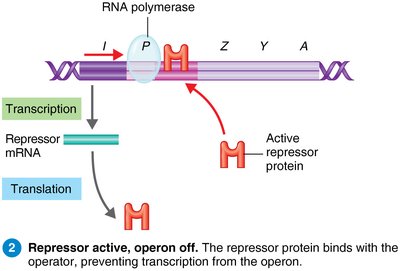
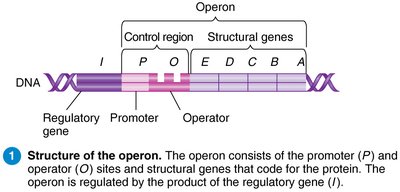
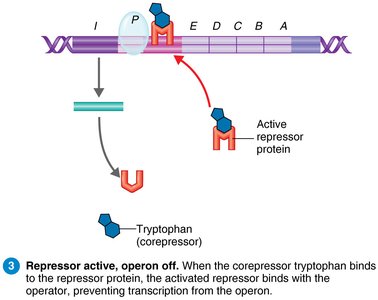
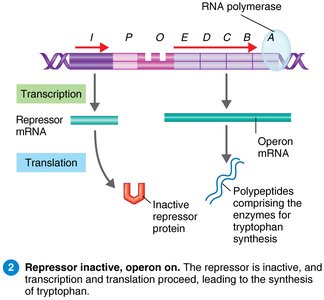
Gene expression in bacteria is often regulated by operons, which are clusters of genes under the control of a single promoter and operator.
Inducible operons (e.g., lac operon): Genes are off unless an inducer is present.
Repressible operons (e.g., trp operon): Genes are on unless a corepressor is present.
Positive Regulation and Catabolite Repression
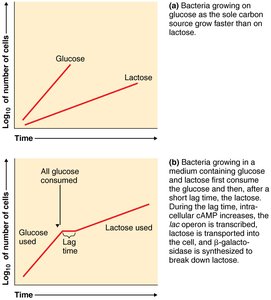
Catabolite repression ensures that bacteria preferentially use glucose over other sugars. When glucose is scarce, cAMP accumulates and activates the lac operon, allowing the use of lactose.
Mutations and Genetic Variation
Types of Mutations
Mutations are permanent changes in the DNA sequence. They can be spontaneous or induced by mutagens.
Base substitution (point mutation): One base is replaced by another.
Missense mutation: Results in a different amino acid.
Silent mutation: No change in amino acid sequence.
Nonsense mutation: Introduces a stop codon, truncating the protein.
Frameshift mutation: Insertion or deletion shifts the reading frame.
Mutagenic Agents
Chemical mutagens (e.g., nitrous acid, nucleoside analogs) and radiation (e.g., UV, X-rays) can increase mutation rates. Cells have repair mechanisms such as photolyase and nucleotide excision repair to correct DNA damage.
Identifying Mutants and Carcinogens
Mutants can be identified by direct or indirect selection. The Ames test is used to assess the mutagenic potential of chemicals.
Genetic Recombination and Horizontal Gene Transfer
Mechanisms of Genetic Exchange
Genetic recombination increases diversity and can occur through several mechanisms:
Transformation: Uptake of naked DNA from the environment.
Conjugation: Transfer of plasmids via direct cell-to-cell contact (sex pili).
Transduction: Transfer of DNA by bacteriophages.
Mobile Genetic Elements
Plasmids and transposons are mobile genetic elements that can move within and between genomes, often carrying genes for antibiotic resistance or other traits.
Evolutionary Implications
Mutations and genetic recombination provide the raw material for evolution. Natural selection acts on this diversity, shaping microbial populations over time.
Additional info: This guide covers the essential concepts of microbial genetics, including DNA structure, replication, gene expression, regulation, mutation, and genetic exchange, as relevant to a college-level microbiology course.
