 Back
Microbial Genetics: Structure, Function, and Regulation of Genetic Material
Study Guide - Smart Notes
 Tailored notes based on your materials, expanded with key definitions, examples, and context.
Microbial Genetics: Structure, Function, and Regulation of Genetic Material
Introduction to Genetics and Genomics
Genetics is the study of genes, how they carry information, how this information is expressed, and how genes are replicated. In microbiology, understanding genetics is fundamental to comprehending microbial function, diversity, and evolution.
Genome: All the genetic information in a cell.
Chromosome: Structure containing DNA that physically carries hereditary information; chromosomes contain genes.
Gene: Segment of DNA that encodes a functional product, usually a protein.
Genomics: Sequencing and molecular characterization of genomes.
Genotype: The genetic makeup of an organism.
Phenotype: The expression of the genes; the observable characteristics.
The Central Dogma of Molecular Biology
The central dogma describes the flow of genetic information within a biological system: DNA is transcribed into RNA, which is then translated into protein. This process underlies gene expression and cellular function.
Genetic code: Set of rules by which information encoded in DNA is translated into proteins.
Gene expression: When the molecule (usually a protein) encoded by the gene is produced.

Structure and Organization of Bacterial Genomes
Bacterial Chromosomes and Nucleoids
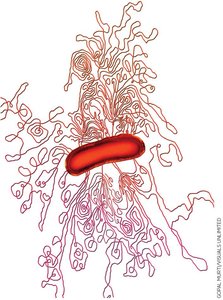
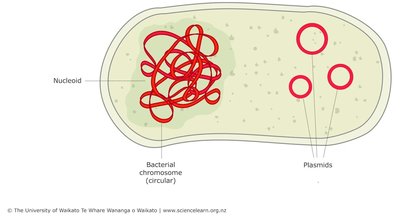
Bacteria typically possess a single, circular chromosome composed of DNA and associated proteins. The chromosome is highly compacted and organized into a region called the nucleoid.
Example: E. coli chromosome contains 4.6 million base pairs, highly supercoiled to fit inside the cell.
Short tandem repeats (STRs): Noncoding regions with repeating sequences (2–5 base pairs per repeat).
DNA Supercoiling and Nucleoid Structure
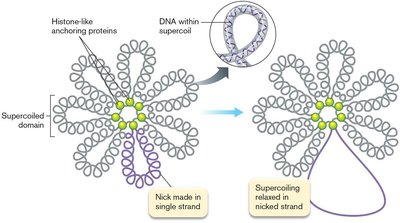
DNA in bacteria is organized into loops or domains, collectively called the nucleoid. Supercoiling compacts the chromosome and is essential for DNA packaging and accessibility.
Supercoiling: Over- or underwinding of DNA. Two types:
Positive supercoils: DNA is overwound.
Negative supercoils: DNA is underwound (most common in bacteria and eukaryotes).
Histone-like proteins: Anchor DNA loops in the nucleoid.
Chromosomes vs. Plasmids
In addition to chromosomes, bacteria may contain plasmids—small, circular DNA molecules that replicate independently and often carry accessory genes (e.g., antibiotic resistance).
Chromosome: Usually one per cell, contains essential genes.
Plasmid: 0 to several per cell, contains non-essential (accessory) genes.
DNA Replication in Bacteria
Structure of DNA
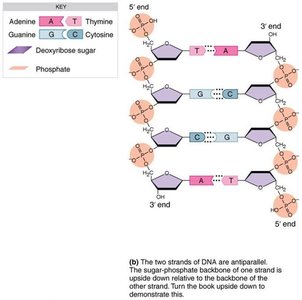
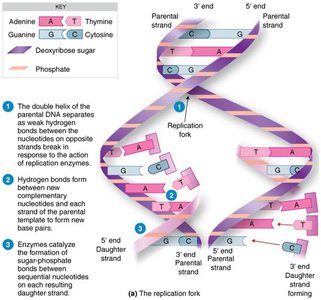
DNA is a double helix composed of two antiparallel strands held together by hydrogen bonds between complementary bases (A-T and G-C). The order of bases encodes genetic information.
Antiparallel orientation: One strand runs 5' to 3', the other 3' to 5'.
Base pairing: Adenine (A) pairs with Thymine (T); Guanine (G) pairs with Cytosine (C).
Mechanism of DNA Replication
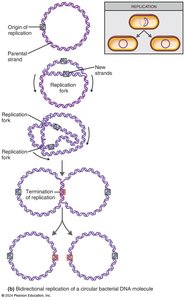
DNA replication is semiconservative: each new DNA molecule consists of one parental and one newly synthesized strand. Replication begins at the origin and proceeds bidirectionally.
Key enzymes:
Helicase: Unwinds the DNA double helix.
Topoisomerase/Gyrase: Relaxes supercoiling ahead of the replication fork.
Primase: Synthesizes RNA primers.
DNA polymerase: Adds nucleotides to the growing DNA strand (5'→3'), proofreads, and repairs.
DNA ligase: Joins Okazaki fragments on the lagging strand.
Leading strand: Synthesized continuously.
Lagging strand: Synthesized discontinuously as Okazaki fragments.
Energy Requirements for Replication
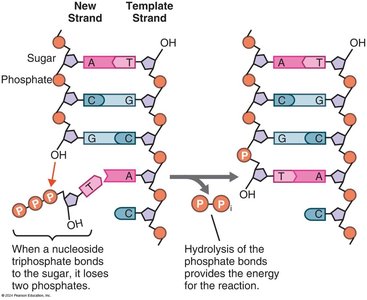
Energy for DNA synthesis is provided by the hydrolysis of nucleoside triphosphates (e.g., ATP). The breaking of phosphate bonds releases energy for polymerization.
Equation:
Bidirectional Replication in Bacteria
Most bacterial DNA replication is bidirectional, starting from a single origin and proceeding in both directions until the entire molecule is copied. Each daughter cell receives one complete DNA molecule.
High fidelity: DNA polymerase proofreading ensures accuracy.
Gene Expression: Transcription and Translation
Transcription in Prokaryotes
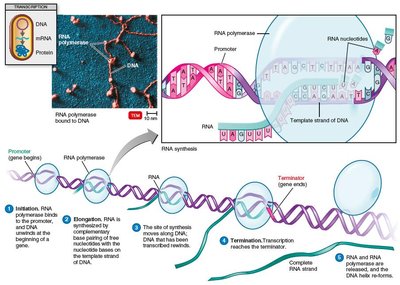
Transcription is the synthesis of a complementary mRNA strand from a DNA template. It consists of three main steps: initiation, elongation, and termination.
Initiation: RNA polymerase binds to the promoter region.
Elongation: RNA polymerase synthesizes RNA in the 5'→3' direction.
Termination: Transcription stops at the terminator sequence.
Translation and the Genetic Code
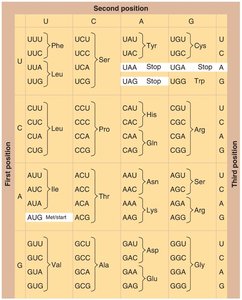
Translation is the process by which mRNA is decoded to synthesize proteins. The genetic code is read in triplets (codons), each specifying an amino acid or a stop signal.
Codons: 64 possible codons; 61 code for amino acids, 3 are stop codons.
Start codon: AUG (codes for methionine).
Degeneracy: Most amino acids are encoded by more than one codon.
Mechanism of Translation
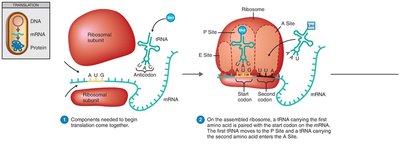
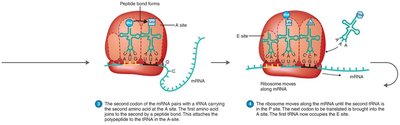
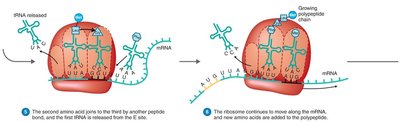
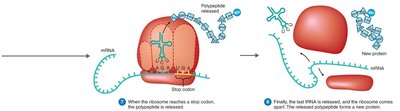
Translation occurs at the ribosome and involves mRNA, tRNA, and rRNA. tRNA molecules bring amino acids to the ribosome, matching codons with anticodons, and peptide bonds form between amino acids.
Initiation: Ribosome assembles at the start codon on mRNA.
Elongation: tRNAs bring amino acids, peptide bonds form, ribosome moves along mRNA.
Termination: Ribosome reaches a stop codon, releasing the polypeptide.
Regulation of Gene Expression in Bacteria
Operons and Gene Regulation
Bacterial gene expression is often regulated at the transcriptional level through operons—clusters of genes under the control of a single promoter and operator.
Inducible operon: Usually off; can be turned on by an inducer (e.g., lac operon).
Repressible operon: Usually on; can be turned off by a corepressor (e.g., trp operon).
Constitutive genes: Expressed at a fixed rate, not regulated.
Pre-Transcriptional and Post-Transcriptional Control
Repression: Inhibits gene expression via repressor proteins.
Induction: Turns on gene expression via inducers.
Catabolite repression: Inhibits use of alternative carbon sources when glucose is present (mediated by cAMP and CAP).
Epigenetic control: Methylation of DNA can turn genes off; this can be inherited but is reversible.
Post-transcriptional control: Mechanisms such as riboswitches and microRNAs can regulate translation after mRNA is made.
Mutations and Genetic Variation
Types of Mutations
Mutations are permanent changes in the DNA sequence. They can be spontaneous or induced by mutagens.
Silent mutation: No effect on protein function.
Missense mutation: Changes one amino acid in the protein.
Nonsense mutation: Introduces a stop codon, truncating the protein.
Frameshift mutation: Insertion or deletion shifts the reading frame, altering downstream amino acids.
DNA Repair Mechanisms
Photolyase: Uses light to repair UV-induced thymine dimers.
Nucleotide excision repair: Enzymes remove and replace damaged DNA segments.
Genetic Transfer and Recombination in Bacteria
Horizontal and Vertical Gene Transfer
Vertical gene transfer: Genes passed from parent to offspring.
Horizontal gene transfer: Genes transferred between cells of the same generation (transformation, conjugation, transduction).
Plasmids and Transposons
Plasmids: Self-replicating, circular DNA molecules carrying accessory genes (e.g., antibiotic resistance).
Transposons: Segments of DNA that can move within and between DNA molecules, often carrying additional genes.
Mechanisms of Genetic Exchange
Transformation: Uptake of naked DNA from the environment.
Conjugation: Direct transfer of DNA via cell-to-cell contact (often plasmid-mediated).
Transduction: Transfer of DNA by bacteriophages (viruses that infect bacteria).
Summary
Microbial genetics encompasses the structure, function, and regulation of genetic material in bacteria. Understanding these processes is essential for studying microbial physiology, evolution, and the development of antibiotic resistance.
