 Back
BackMicrobial Genetics: Structure, Function, and Regulation of Genetic Material
Study Guide - Smart Notes
 Tailored notes based on your materials, expanded with key definitions, examples, and context.
Microbial Genetics
Introduction to Genetics
Genetics is the science of heredity, focusing on how genetic information is stored, expressed, and transmitted in microorganisms. In microbiology, understanding genetics is crucial for explaining microbial diversity, adaptation, and the mechanisms behind disease and biotechnology.
Genetics: The study of genes, their functions, and inheritance.
Genome: The complete set of genetic material in a cell.
Chromosome: Structures containing DNA that carry hereditary information.
Gene: Segments of DNA encoding functional products, usually proteins.
Genotype: The genetic makeup of an organism (the alleles present).
Phenotype: The observable traits resulting from gene expression.
Genomics: The study of the sequencing and analysis of genomes.
The Central Dogma of Molecular Biology
The central dogma describes the flow of genetic information from DNA to RNA to protein, which determines cellular function. Mutations can disrupt this flow, leading to altered proteins and functions.
DNA is transcribed into mRNA.
mRNA is translated into protein.
Proteins determine the function and phenotype of the cell.

Genotype vs. Phenotype
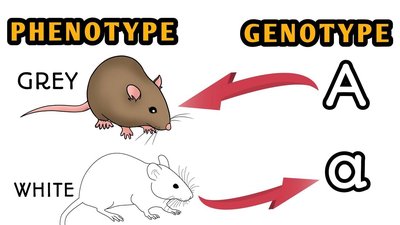
The genotype refers to the genetic composition, while the phenotype is the physical expression of those genes. Environmental factors and mutations can influence phenotype without altering genotype.
Genotype: The set of genes an organism carries.
Phenotype: The observable characteristics or traits.
Structure and Function of Genetic Material
DNA Structure
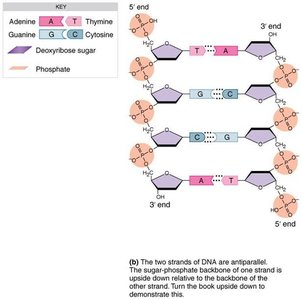
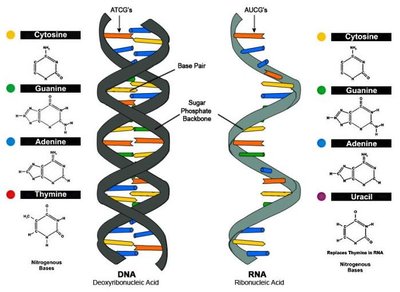
DNA is a double helix composed of nucleotides, each containing a deoxyribose sugar, a phosphate group, and a nitrogenous base (adenine, thymine, cytosine, or guanine). The strands are antiparallel and held together by hydrogen bonds between complementary bases (A-T, C-G).
Antiparallel: The two DNA strands run in opposite directions (5' to 3' and 3' to 5').
Base pairing: Adenine pairs with thymine, cytosine pairs with guanine.
Prokaryotic Chromosomes and Plasmids
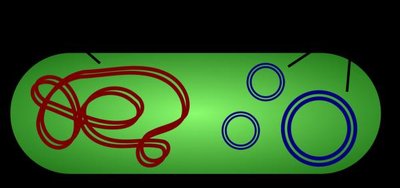
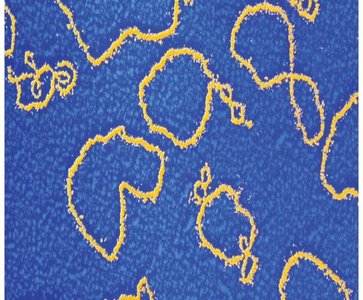
Bacteria typically have a single, circular chromosome and may contain plasmids—small, circular DNA molecules that replicate independently and often carry genes beneficial for survival, such as antibiotic resistance.
DNA Replication
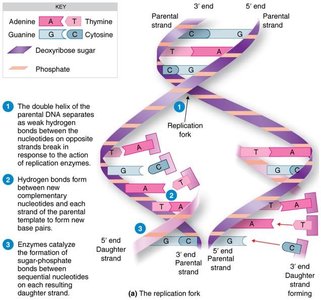
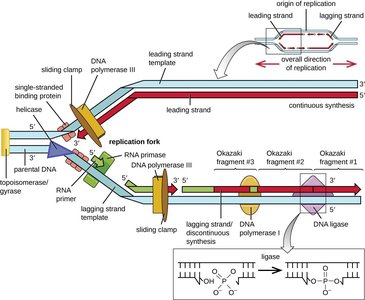
DNA replication is the process by which a cell duplicates its DNA before cell division. It is semiconservative, meaning each new DNA molecule consists of one parental and one new strand. Replication is highly accurate due to proofreading by DNA polymerase.
Initiation: Helicase unwinds the DNA, and primase synthesizes RNA primers.
Elongation: DNA polymerase adds nucleotides in the 5' to 3' direction.
Leading strand: Synthesized continuously.
Lagging strand: Synthesized discontinuously as Okazaki fragments, later joined by DNA ligase.
Topoisomerase/gyrase: Relieves supercoiling ahead of the replication fork.
Energy for DNA Replication
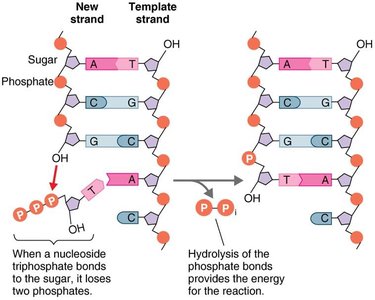
The energy required for DNA synthesis comes from the hydrolysis of nucleoside triphosphates (e.g., ATP, GTP). When a nucleotide is added, two phosphates are released, providing the energy for the reaction.
Bacterial DNA Replication
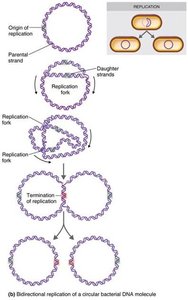
Most bacterial DNA replication is bidirectional, starting from a single origin of replication and proceeding in both directions until the entire molecule is copied. Each daughter cell receives one complete DNA molecule.
Gene Expression: Transcription and Translation
Transcription
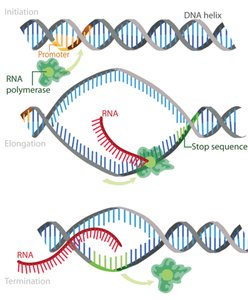
Transcription is the synthesis of RNA from a DNA template. In prokaryotes, this process occurs in the cytoplasm and involves the following steps:
Initiation: RNA polymerase binds to the promoter region.
Elongation: RNA polymerase synthesizes RNA in the 5' to 3' direction.
Termination: Transcription stops at the terminator sequence.
Types of RNA
Messenger RNA (mRNA): Carries genetic information from DNA to ribosomes.
Ribosomal RNA (rRNA): Forms the core of ribosome's structure and catalyzes protein synthesis.
Transfer RNA (tRNA): Brings amino acids to the ribosome during translation.
Translation
Translation is the process by which the sequence of codons in mRNA is used to assemble amino acids into a polypeptide chain (protein). Each codon (three nucleotides) specifies an amino acid. Translation begins at the start codon (AUG) and ends at a stop codon (UAA, UAG, UGA).
tRNA: Matches amino acids to codons in mRNA via its anticodon.
Ribosome: Site of protein synthesis.
Peptide bonds: Link amino acids together.
Gene Expression in Prokaryotes vs. Eukaryotes
In prokaryotes, transcription and translation are coupled (translation can begin before transcription ends).
In eukaryotes, transcription occurs in the nucleus and translation in the cytoplasm. Eukaryotic genes contain introns (non-coding regions) that are removed by splicing.
Regulation of Gene Expression
Operons and Gene Regulation
Gene expression in bacteria is regulated at the transcriptional level, often through operons—clusters of genes under the control of a single promoter and operator.
Inducible operon: Usually off; turned on by an inducer (e.g., lac operon).
Repressible operon: Usually on; turned off by a corepressor (e.g., trp operon).
Catabolite repression: Inhibits the use of alternative carbon sources when glucose is present; mediated by cAMP and CAP.
Epigenetic and Post-Transcriptional Control
Epigenetic control: Methylation of DNA can turn genes off without changing the sequence.
Riboswitches and microRNAs: Regulate gene expression post-transcriptionally by affecting mRNA stability or translation.
Mutations and Genetic Variation
Types of Mutations
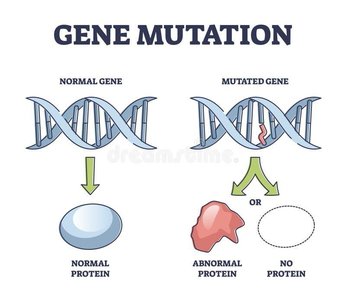
Mutations are permanent changes in the DNA sequence. They can be spontaneous or induced by mutagens (chemicals, radiation).
Base substitution (point mutation): One base is replaced by another.
Missense mutation: Results in a different amino acid.
Nonsense mutation: Results in a stop codon.
Frameshift mutation: Insertion or deletion of bases shifts the reading frame.
Mutagenic Agents and DNA Repair
Chemical mutagens: Nitrous acid, nucleoside analogs.
Radiation: Ionizing (X-rays, gamma rays) and non-ionizing (UV light) can cause DNA damage.
DNA repair mechanisms: Photolyase (repairs thymine dimers), nucleotide excision repair.
Mutation Rate and Detection
Spontaneous mutation rate is low due to proofreading and repair systems.
Mutagens increase mutation rate significantly.
Direct selection: Identifies mutants by their ability to grow in selective conditions.
Indirect selection: Identifies mutants by their inability to grow or perform a function (e.g., auxotrophs).
Ames test: Detects mutagenic potential of chemicals by measuring mutation reversal in bacteria.
Genetic Transfer and Recombination in Bacteria
Horizontal and Vertical Gene Transfer
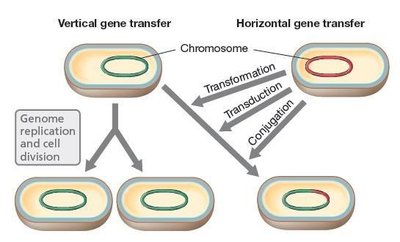
Genetic information can be transferred vertically (parent to offspring) or horizontally (between cells of the same generation), contributing to genetic diversity.
Vertical gene transfer: Transmission of genes during reproduction.
Horizontal gene transfer: Includes transformation, conjugation, and transduction.
Mechanisms of Genetic Transfer
Transformation: Uptake of naked DNA from the environment.
Conjugation: Transfer of plasmids via direct cell-to-cell contact (sex pili).
Transduction: Transfer of DNA by bacteriophages (viruses that infect bacteria).
Plasmids and Transposons
Plasmids: Small, self-replicating DNA molecules that can carry genes for antibiotic resistance, metabolism, or virulence.
Transposons: "Jumping genes" that can move within and between DNA molecules, often carrying antibiotic resistance genes.
Genetic Variation and Evolution
Mutations and genetic recombination generate diversity, which is essential for evolution. Natural selection acts on this diversity, favoring traits that enhance survival in specific environments.
