 Back
Back8 Microbial Genetics: Structure, Function, and Regulation of Genetic Material
Study Guide - Smart Notes
 Tailored notes based on your materials, expanded with key definitions, examples, and context.
Microbial Genetics
Introduction to Genetics
Genetics is the science of heredity, focusing on how genetic information is stored, expressed, and transmitted in microorganisms. Understanding microbial genetics is essential for grasping how bacteria adapt, evolve, and interact with their environment, including their roles in disease and biotechnology.
Genetics: The study of genes, how they carry information, how information is expressed, and how genes are replicated.
Genome: All the genetic information in a cell.
Chromosome: Structures containing DNA that physically carry hereditary information; chromosomes contain genes.
Gene: Segments of DNA that encode functional products, usually proteins.
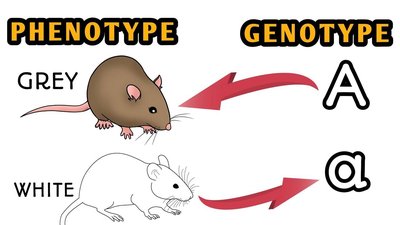
Genotype: The genetic makeup of an organism; the set of genes it carries.
Phenotype: The expression of the genes; the observable traits.
Genomics: The sequencing and characterization of genomes.
The Central Dogma of Molecular Biology
The central dogma describes the flow of genetic information within a biological system: DNA is transcribed into RNA, which is then translated into protein. This process is fundamental to gene expression and cellular function.
DNA → RNA → Protein: The sequence of events for gene expression.
Genetic code: The set of rules by which information encoded in DNA or RNA sequences is translated into proteins by living cells.

Genotype and Phenotype
The genotype refers to the genetic constitution of an organism, while the phenotype is the observable expression of those genes. Mutations or changes in the genotype can lead to changes in the phenotype.
Genotype: The alleles present in an organism.
Phenotype: The physical or biochemical characteristics that result from gene expression.
Structure and Function of Genetic Material
DNA Structure
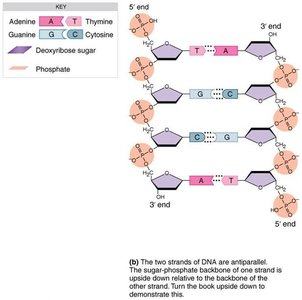
DNA is a double helix composed of two antiparallel strands of nucleotides. The backbone consists of deoxyribose-phosphate, and the strands are held together by hydrogen bonds between complementary bases (A-T and C-G).
Antiparallel strands: The two DNA strands run in opposite directions (5' to 3' and 3' to 5').
Base pairing: Adenine pairs with thymine, and cytosine pairs with guanine.
Prokaryotic Chromosomes and Plasmids
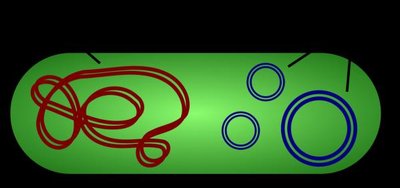
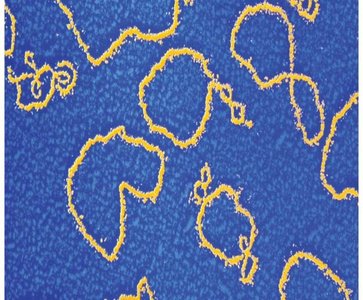
Bacteria typically have a single, circular chromosome that is highly supercoiled to fit within the cell. Plasmids are small, circular DNA molecules that exist independently of the chromosome and often carry genes beneficial for survival, such as antibiotic resistance.
Chromosome: Contains essential genes for survival.
Plasmid: May carry genes for antibiotic resistance, virulence factors, or metabolic pathways.
DNA Replication
Mechanism of DNA Replication
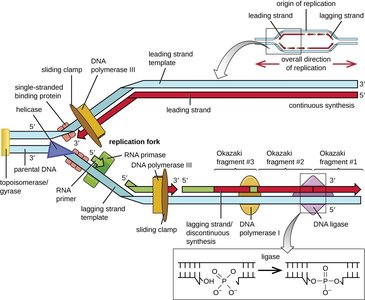
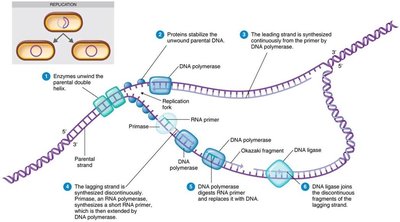
DNA replication is the process by which a cell duplicates its DNA before cell division. It is semiconservative, meaning each new DNA molecule consists of one parental and one newly synthesized strand. Replication is highly accurate due to proofreading by DNA polymerase.
Initiation: Begins at the origin of replication.
Enzymes involved: Helicase unwinds DNA, primase synthesizes RNA primers, DNA polymerase adds nucleotides, ligase joins Okazaki fragments.
Leading strand: Synthesized continuously.
Lagging strand: Synthesized discontinuously as Okazaki fragments.
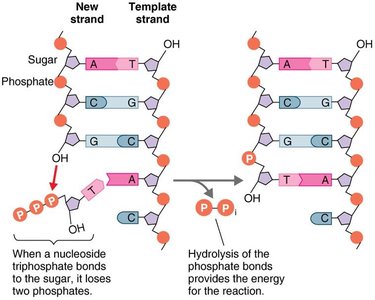
Energy source: Hydrolysis of nucleoside triphosphates provides energy for DNA synthesis.
Bacterial DNA Replication
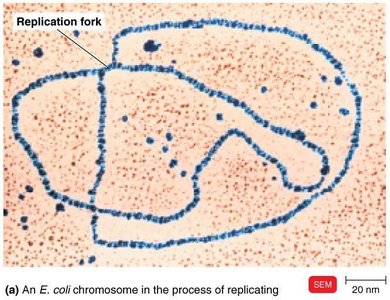
Most bacterial DNA replication is bidirectional, starting from a single origin and proceeding in both directions around the circular chromosome. Each daughter cell receives one complete copy of the DNA molecule.
Bidirectional replication: Increases efficiency and speed of DNA synthesis.
Proofreading: DNA polymerase corrects errors, ensuring high fidelity.
Gene Expression: Transcription and Translation
Transcription
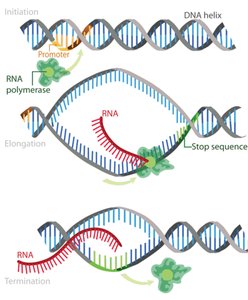
Transcription is the synthesis of a complementary mRNA strand from a DNA template. In prokaryotes, transcription occurs in the cytoplasm and is often coupled with translation.
Initiation: RNA polymerase binds to the promoter region.
Elongation: RNA polymerase synthesizes RNA in the 5' to 3' direction.
Termination: Transcription stops at the terminator sequence.
Translation
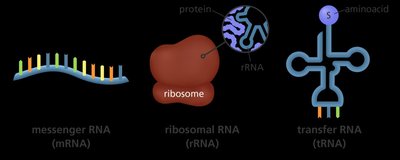
Translation is the process by which the sequence of codons in mRNA is used to assemble amino acids into a polypeptide chain, forming a protein. This process occurs at the ribosome and involves mRNA, tRNA, and rRNA.
Codons: Groups of three nucleotides in mRNA that specify amino acids.
Start codon: AUG (methionine).
Stop codons: UAA, UAG, UGA (signal termination of translation).
tRNA: Brings amino acids to the ribosome and matches them to the mRNA codon via its anticodon.
Peptide bonds: Link amino acids together to form proteins.
Regulation of Gene Expression
Operons and Gene Regulation
Gene expression in bacteria is tightly regulated, often at the level of transcription. Operons are clusters of genes under the control of a single promoter and operator, allowing coordinated expression.
Inducible operon: Usually off; turned on by an inducer (e.g., lac operon).
Repressible operon: Usually on; turned off by a corepressor (e.g., trp operon).
Catabolite repression: Inhibits the use of alternative carbon sources when glucose is present.
Type | Default State | Regulation | Example |
|---|---|---|---|
Inducible | Off | Turned on by inducer | Lac operon |
Repressible | On | Turned off by corepressor | Trp operon |
Mutations and Genetic Variation
Types of Mutations
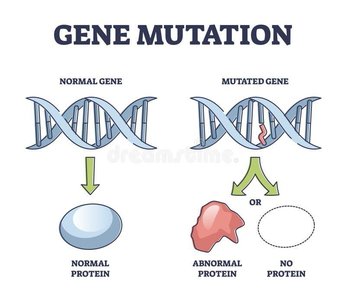
Mutations are permanent changes in the DNA sequence. They can be spontaneous or induced by mutagens and may have neutral, beneficial, or harmful effects.
Base substitution (point mutation): One base is replaced by another.
Missense mutation: Results in a different amino acid.
Nonsense mutation: Results in a stop codon.
Frameshift mutation: Insertion or deletion of bases shifts the reading frame.
Mutagens and DNA Repair
Mutagens are agents that cause mutations, such as chemicals or radiation. Cells have repair mechanisms, including proofreading by DNA polymerase and excision repair, to correct errors and maintain genetic stability.
Photolyase: Repairs UV-induced thymine dimers.
Nucleotide excision repair: Removes and replaces damaged DNA segments.
Genetic Transfer and Recombination
Horizontal and Vertical Gene Transfer
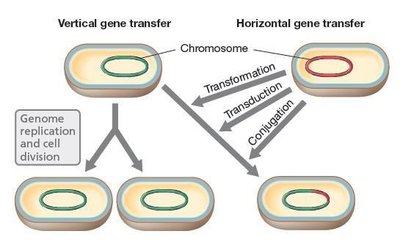
Genetic information can be transferred vertically (from parent to offspring) or horizontally (between cells of the same generation). Horizontal gene transfer increases genetic diversity and can spread traits such as antibiotic resistance.
Vertical gene transfer: Transmission of genes from parent to offspring during cell division.
Horizontal gene transfer: Transfer of genes between cells via transformation, transduction, or conjugation.
Plasmids and Transposons
Plasmids are small, self-replicating DNA molecules that can carry genes for antibiotic resistance or other traits. Transposons are mobile genetic elements that can move within and between DNA molecules, facilitating genetic diversity and the spread of resistance genes.
Conjugative plasmid: Carries genes for sex pili and plasmid transfer.
Dissimilation plasmid: Encodes enzymes for the catabolism of unusual compounds.
Resistance factors (R factors): Carry antibiotic resistance genes.
Transposons: "Jumping genes" that move within the genome.
Mechanisms of Genetic Recombination
Transformation: Uptake of naked DNA from the environment.
Conjugation: Direct transfer of DNA between bacteria via sex pili.
Transduction: Transfer of DNA by bacteriophages (viruses that infect bacteria).
Summary Table: Key Terms and Concepts
Term | Definition |
|---|---|
Genotype | Genetic makeup of an organism |
Phenotype | Observable traits |
Mutation | Permanent change in DNA sequence |
Plasmid | Small, circular DNA molecule in bacteria |
Operon | Cluster of genes under a single promoter |
Transposon | Mobile genetic element |
Transformation | Uptake of naked DNA |
Conjugation | DNA transfer via cell-to-cell contact |
Transduction | DNA transfer by bacteriophage |
