 Back
Microbial Genetics: Structure, Function, and Regulation
Study Guide - Smart Notes
 Tailored notes based on your materials, expanded with key definitions, examples, and context.
Genetics in Microbiology
Introduction to Genetics
Genetics is the study of genes, their functions, and how variations arise in genomes. The genome is the entire collection of genetic material in a cell or virus, serving as an instruction manual that determines all possible features of an organism.
Genotype: The genetic makeup of an organism; the set of genes it carries.
Phenotype: The observable physical and physiological traits of an organism, determined by its genotype.
Relationship: The genotype influences the phenotype by dictating which proteins are produced.
Example: The presence or absence of a gene for antibiotic resistance determines whether a bacterium can survive in the presence of antibiotics.
Organization of Genetic Material
Prokaryotic vs. Eukaryotic Genomes
Genomes are organized differently in prokaryotes and eukaryotes, affecting complexity and gene regulation.
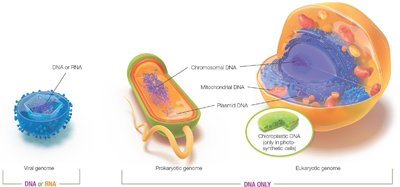
Prokaryotic genomes: Usually consist of a single circular chromosome located in the nucleoid region, with additional DNA in plasmids.
Eukaryotic genomes: Composed of multiple linear chromosomes housed in the nucleus, with DNA also present in mitochondria and chloroplasts.
Chromosomes: Packaged strands of DNA associated with organizational proteins (histones in eukaryotes, histone-like proteins in prokaryotes).
Plasmids: Extra-chromosomal DNA elements that often confer survival advantages, such as antibiotic resistance.
Factor | Prokaryotic Genomes | Eukaryotic Genomes |
|---|---|---|
Complexity | Simple | More complex |
Genome includes | Chromosomal DNA, plasmids | Chromosomal DNA, plasmids, mitochondrial/chloroplast DNA |
Chromosomes | Few (usually one), circular | Many, linear |
Location | Nucleoid region | Nucleus |
Organizational proteins | Histone-like | Histones |
Structure and Function of Nucleic Acids
DNA Structure
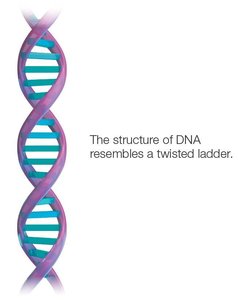
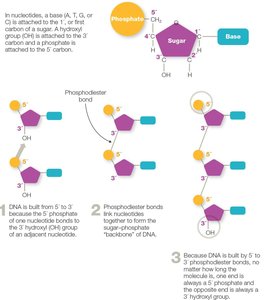
DNA is a double-stranded molecule forming a double helix, resembling a twisted ladder. It is composed of nucleotides, each with a phosphate group, a deoxyribose sugar, and a nitrogenous base (A, T, G, C).
Pyrimidines: Thymine (T), Cytosine (C)
Purines: Adenine (A), Guanine (G)
Base pairing: A pairs with T, G pairs with C via hydrogen bonds.
Phosphodiester bonds: Link the sugar-phosphate backbone, giving DNA its 5’ to 3’ directionality.
Antiparallel arrangement: One strand runs 5’ to 3’, the other 3’ to 5’.
RNA Structure
RNA is typically single-stranded and composed of ribonucleotides (phosphate, ribose sugar, nitrogen base). Uracil (U) replaces thymine (T) in RNA. RNA can fold into complex structures and exists in several forms:
Messenger RNA (mRNA): Carries genetic code from DNA to ribosomes.
Transfer RNA (tRNA): Brings amino acids to ribosomes during translation.
Ribosomal RNA (rRNA): Forms the core of ribosome structure and catalyzes protein synthesis.
Central Dogma of Molecular Biology
Flow of Genetic Information
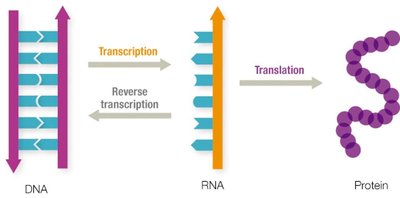
The central dogma describes the flow of genetic information: DNA is transcribed into RNA, which is then translated into protein. Some viruses and cells can reverse this flow via reverse transcription (RNA to DNA).
DNA Replication
Overview and Enzymes
DNA replication is the process by which a cell copies its genome before division. It is highly accurate due to complementary base pairing and proofreading enzymes.
Key enzymes:
Helicase: Unwinds DNA helix
Primase: Synthesizes RNA primers
DNA polymerase III: Main enzyme for DNA synthesis
DNA polymerase I: Replaces RNA primers with DNA
Ligase: Seals nicks in the sugar-phosphate backbone
Gyrase/Topoisomerase: Relieves torsional stress
Replication Process
Begins at the origin of replication, forming a bubble with two replication forks.
Replication is semiconservative: each new DNA molecule contains one parent and one daughter strand.
Leading strand: Synthesized continuously toward the replication fork.
Lagging strand: Synthesized discontinuously away from the fork in Okazaki fragments, later joined by ligase.
Prokaryotic vs. Eukaryotic Replication
Prokaryotes: Single origin of replication, faster process.
Eukaryotes: Multiple origins of replication, more complex machinery, slower process.
Protein Synthesis (Gene Expression)
Transcription
Transcription is the synthesis of RNA from a DNA template, occurring in the nucleus (eukaryotes) or cytoplasm (prokaryotes). It involves three steps:
Initiation: RNA polymerase binds to the promoter and unwinds DNA.
Elongation: RNA polymerase adds complementary ribonucleotides.
Termination: RNA polymerase reaches a termination sequence and releases the RNA transcript.
Translation
Translation is the process by which ribosomes decode mRNA to build proteins. It occurs in three steps:
Initiation: Ribosome assembles around the start codon of mRNA.
Elongation: tRNAs bring amino acids to the ribosome, which are joined to form a polypeptide.
Termination: Ribosome reaches a stop codon and releases the completed protein.
In prokaryotes, translation can begin before transcription is complete (coupled transcription-translation).
Genetic Code
64 codons (triplets of nucleotides) encode 20 standard amino acids, 1 start signal, and 3 stop signals.
The code is redundant: multiple codons can specify the same amino acid.
Post-Translational Modifications
Proteins may require trimming or addition of organic/inorganic groups (e.g., sugars, phosphates) to become functional.
Regulation of Gene Expression
Constitutive vs. Facultative Genes
Constitutive genes: Continuously expressed (housekeeping genes).
Facultative genes: Expressed only in response to environmental changes.
Operons
Operons are clusters of genes under the control of a single promoter and regulatory elements, common in prokaryotes.
Inducible operons: Off by default, activated by specific conditions (e.g., lac operon).
Repressible operons: On by default, can be turned off (e.g., arg operon).
Epigenetic Regulation
Epigenetic changes (e.g., DNA methylation) can silence genes without altering the DNA sequence.
Mutations and DNA Repair
Types of Mutations
Substitution: One nucleotide is replaced by another.
Insertion: Addition of one or more nucleotides.
Deletion: Removal of one or more nucleotides.
Mutation Effects
Silent: No change in amino acid sequence.
Missense: Changes one amino acid.
Nonsense: Introduces a stop codon, truncating the protein.
Frameshift: Insertion/deletion not in multiples of three, altering the reading frame.
Sources of Mutations
Spontaneous: Occur naturally during DNA replication.
Induced: Caused by mutagens (chemical, physical, or biological agents).
DNA Repair Mechanisms
Proofreading: DNA polymerases correct errors during replication.
Excision repair: Enzymes remove damaged DNA, DNA polymerase fills the gap, and ligase seals the backbone.
Plasmids and Horizontal Gene Transfer
Plasmids
Small, circular DNA molecules that replicate independently of the chromosome.
Can carry genes for antibiotic resistance (R plasmids).
Conjugation
Transfer of plasmids between bacteria via a pilus (bridge).
High-frequency recombination (Hfr) strains can transfer chromosomal genes.
Additional info: Horizontal gene transfer is a major driver of genetic diversity and evolution in prokaryotes, contributing to the spread of antibiotic resistance.
