 Back
Chapter 8
Study Guide - Smart Notes
 Tailored notes based on your materials, expanded with key definitions, examples, and context.
Microbial Genetics
Structure and Function of Genetic Material
Microbial genetics explores the molecular basis of heredity in microorganisms, focusing on the structure and function of DNA, chromosomes, genes, and genomes. Understanding these elements is fundamental to studying how genetic information is stored, expressed, and transferred.
Chromosomes: Structures containing DNA that physically carry hereditary information; chromosomes contain genes.
Genes: Segments of DNA that encode functional products, usually proteins.
Genome: All the genetic information in a cell.
Genomics: Molecular study/sequencing and characterization of genomes.
Genotype: The genetic makeup of an organism.
Phenotype: The expression of the genes, observable traits.
Bacterial Chromosomes: Typically a single circular chromosome made of DNA and associated proteins. Example: E. coli chromosome contains 4.6 million base pairs, highly supercoiled.
Short Tandem Repeats (STRs): Noncoding regions with repeating sequences (2-5 base pairs/repeat).
Structure of DNA
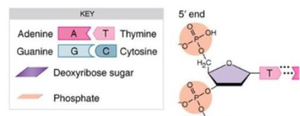
DNA is a double helix composed of two antiparallel strands. Each nucleotide consists of a deoxyribose sugar, phosphate group, and a nitrogenous base (adenine, thymine, cytosine, guanine). The order of these bases forms the genetic instructions.
Strands are held together by hydrogen bonds: A-T and C-G.
Strands are antiparallel, oriented in opposite directions.
Complementary strands allow each to serve as a template for synthesis.
DNA Replication
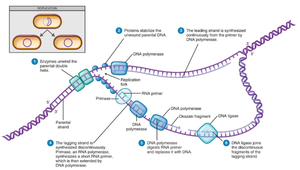
DNA replication is the process by which a cell duplicates its DNA, ensuring genetic information is passed to offspring. It is semiconservative, meaning each new DNA molecule contains one old and one new strand.
Enzymes topoisomerase and gyrase relax the strands.
Helicase separates the strands, creating a replication fork.
DNA polymerase adds nucleotides in the 5'→3' direction, only to the 3' end.
Leading strand synthesized continuously; lagging strand synthesized discontinuously (Okazaki fragments).
RNA primers initiate synthesis; DNA ligase joins Okazaki fragments.
Replication is bidirectional and highly accurate due to proofreading by DNA polymerase.
Gene Expression: RNA and Protein Synthesis
Types of RNA
RNA is essential for protein synthesis and gene expression. It is a single-stranded polymer of ribonucleotides, containing ribose sugar and uracil instead of thymine.
Ribosomal RNA (rRNA): Integral part of ribosomes.
Transfer RNA (tRNA): Transports amino acids during protein synthesis.
Messenger RNA (mRNA): Carries coded information from DNA to ribosomes.
Transcription (DNA to RNA)
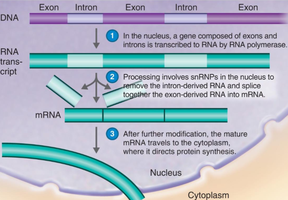
Transcription is the synthesis of a complementary mRNA strand from a DNA template. It occurs in three stages:
Initiation: RNA polymerase binds to the promoter sequence on DNA.
Elongation: RNA polymerase synthesizes mRNA in the 5'→3' direction.
Termination: Transcription stops at the terminator sequence.
In prokaryotes, transcription and translation occur in the cytoplasm, allowing translation to begin before transcription is complete. In eukaryotes, transcription occurs in the nucleus, and translation in the cytoplasm. Eukaryotic genes contain exons (coding regions) and introns (noncoding regions); introns are removed by snRNPs, and exons are spliced together.
Translation (RNA to Protein)
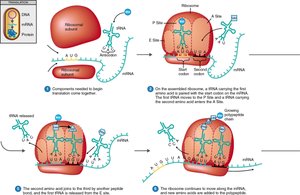
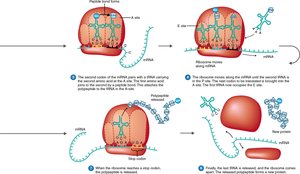
Translation is the process by which mRNA is decoded to synthesize proteins. It involves ribosomes, tRNA, and mRNA, and occurs in three stages:
Initiation: Ribosomal subunits assemble at the start codon (AUG), tRNA brings methionine.
Elongation: tRNA brings amino acids to the ribosome, peptide bonds form, ribosome moves along mRNA.
Termination: Translation ends at a stop codon, ribosome disassembles, and the new protein is released.
The genetic code is degenerate, meaning multiple codons can code for the same amino acid, reducing mutation impact. Codons are read sequentially, and tRNA anticodons pair with mRNA codons.
Regulation of Bacterial Gene Expression
Gene Regulation Mechanisms
Gene expression is regulated to conserve energy and resources. Some genes are constitutive (always expressed), while others are inducible or repressible.
Repression: Inhibits gene expression, mediated by repressors.
Induction: Turns on gene expression in response to an inducer.
Operon Model
An operon consists of promoter, operator, and structural genes. It regulates gene expression in bacteria.
Inducible operon: Transcription occurs only when an inducer is present (e.g., lac operon).
Repressible operon: Transcription occurs until a corepressor turns it off (e.g., trp operon).
Mutations and Genetic Variation
Types of Mutations
Mutations are permanent changes in DNA sequence. They can be neutral, beneficial, or harmful.
Base substitution (point mutation): Single nucleotide replaced.
Missense mutation: Changes amino acid.
Nonsense mutation: Creates a stop codon.
Silent mutation: No change in protein activity.
Frameshift mutation: Insertion/deletion alters reading frame.
Mutagens and DNA Repair
Mutagens are physical or chemical agents causing mutations. Examples include nucleoside analogs and radiation (ionizing and nonionizing). Bacteria repair DNA damage via nucleotide excision repair, DNA polymerase, and DNA ligase.
Genetic Recombination and Horizontal Gene Transfer
Genetic Recombination
Genetic recombination is the exchange of genes between DNA molecules, increasing genetic diversity. It occurs via crossing over, vertical gene transfer (parent to offspring), and horizontal gene transfer (between cells of the same generation).
Horizontal gene transfer mechanisms: Conjugation, transformation, transduction.
Plasmids and Transposons
Plasmids and transposons are mobile genetic elements that can move within or between cells.
Plasmids: Self-replicating circular DNA, may carry genes for antibiotic resistance or toxin production.
Transposons: "Jumping genes" that move from one DNA region to another.
Transformation, Conjugation, and Transduction
Transformation: Uptake of "naked DNA" from the environment.
Conjugation: Direct transfer of plasmids via cell-to-cell contact (F factor).
Transduction: DNA transfer via bacteriophage (virus).
Key Equations and Concepts
Central Dogma:
DNA Replication Direction:
Genetic Code:
