 Back
BackMicrobial Genetics: Structure, Function, and Replication of Genomes
Study Guide - Smart Notes
 Tailored notes based on your materials, expanded with key definitions, examples, and context.
Microbial Genetics: Structure, Function, and Replication of Genomes
Genomes of Prokaryotes and Eukaryotes
The genome is the complete set of genetic material in a cell or virus, including both genes and non-coding sequences. Understanding the differences between prokaryotic and eukaryotic genomes is fundamental to microbiology.
Prokaryotes (Bacteria and Archaea): Usually have a single, circular chromosome and may contain plasmids. Most are haploid.
Eukaryotes: Possess multiple, linear chromosomes located in the nucleus, and may also have plasmids in some fungi, algae, and protozoa. Most are diploid.
Plasmids: Small, circular DNA molecules separate from the chromosome, found in both prokaryotes and some eukaryotes.
Histones: Proteins used for DNA packaging; present in eukaryotes and archaea, but not in bacteria.
Example: Bacterial cells may contain resistance plasmids, while yeast cells can have multiple copies of a 2μ plasmid.
Structure of DNA and Its Role as Genetic Material
DNA is the hereditary material in most organisms, structured to ensure stability and accurate transmission of genetic information.
Nucleotides: Building blocks of DNA, each composed of a phosphate group, a pentose sugar (deoxyribose), and a nitrogenous base (A, T, G, C).
Double Helix: DNA consists of two antiparallel strands forming a helical structure, with complementary base pairing (A-T, G-C).
Antiparallel Orientation: One strand runs 5′ → 3′, the other 3′ → 5′.
Hydrogen Bonds: Hold the base pairs together, ensuring specificity and stability.
Key Point: The double helix and complementary base pairing allow DNA to be copied precisely during replication.
Prokaryotic Chromosomes and Plasmids
Prokaryotic cells organize their genetic material in chromosomes and plasmids, each serving distinct functions.
Chromosomes: Usually single, circular, and located in the nucleoid region (not membrane-bound).
Plasmids: Replicate independently, carry genes for conjugation, resistance, toxins, or virulence, and are not essential for survival.
Types of Plasmids:
Fertility (F) Plasmids: Enable DNA transfer via conjugation.
Resistance (R) Plasmids: Provide antibiotic or heavy metal resistance.
Bacteriocin Plasmids: Encode toxins to kill competing bacteria.
Virulence Plasmids: Confer pathogenic traits.
Example: E. coli can transfer resistance genes to other bacteria via conjugation using a pilus.
Eukaryotic Chromosomes and Extranuclear DNA
Eukaryotic cells have complex genome organization, including nuclear and extranuclear chromosomes.
Nuclear Chromosomes: Multiple, linear, diploid, packaged with histones into nucleosomes and chromatin.
Extranuclear DNA: Found in mitochondria (circular) and chloroplasts (linear), resembling prokaryotic chromosomes.
Chromatin Types:
Euchromatin: Loosely packed, active genes.
Heterochromatin: Tightly packed, inactive genes.
Example: Mitochondrial DNA codes for a small fraction of mitochondrial proteins; most are encoded by nuclear DNA.
DNA Replication: Semiconservative Process
DNA replication is the process by which cells duplicate their genomes before cell division. It is semiconservative, meaning each new DNA molecule contains one parental and one new strand.
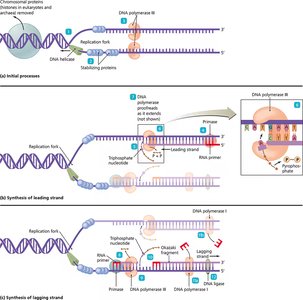
Initiation: DNA helicase unwinds the double helix, forming a replication fork.
Elongation: DNA polymerase III synthesizes new DNA in the 5′ → 3′ direction, using free nucleotides.
Primase: Synthesizes short RNA primers to provide a starting point for DNA polymerase.
Proofreading: DNA polymerase III corrects errors during synthesis.
Energy Source: Provided by the removal of two phosphate groups from nucleotides.
Leading vs. Lagging Strand Synthesis
DNA replication involves simultaneous synthesis of two strands, but their mechanisms differ due to antiparallel orientation.
Leading Strand: Synthesized continuously toward the replication fork.
Lagging Strand: Synthesized discontinuously away from the fork in short segments called Okazaki fragments.
Okazaki Fragments: Joined by DNA ligase to form a continuous strand.
DNA Polymerase I: Removes RNA primers and replaces them with DNA.
Key Point: The lagging strand requires multiple primers and is built in fragments, while the leading strand is synthesized in one piece.
DNA Methylation and Its Functions
Methylation is the addition of methyl groups to DNA bases, affecting gene expression, replication, and protection against viruses.
Gene Regulation: Methylated genes may be turned off or on.
Replication Initiation: Methylation signals replication origins.
Protection: Helps distinguish bacterial DNA from viral DNA.
DNA Repair: Guides repair mechanisms.
Example: In bacteria, adenine is commonly methylated; in eukaryotes, cytosine is methylated.
Replication in Eukaryotes vs. Prokaryotes
While the basic mechanisms of DNA replication are conserved, there are important differences between prokaryotes and eukaryotes.
Eukaryotes: Use multiple DNA polymerases, have many origins of replication per chromosome, and Okazaki fragments are shorter (100–400 nucleotides).
Prokaryotes: Typically have a single origin of replication and longer Okazaki fragments (1000–2000 nucleotides).
Chromosome Separation: Eukaryotes use mitotic spindle during mitosis.
Key Point: Eukaryotic DNA replication is more complex due to larger genome size and chromatin structure.
Central Dogma: DNA → RNA → Protein
The central dogma describes the flow of genetic information: DNA is transcribed into RNA, which is translated into protein.
Transcription: Synthesis of RNA from DNA template; occurs in cytosol (prokaryotes) or nucleus (eukaryotes).
Translation: Synthesis of proteins from mRNA; occurs at ribosomes.
RNA Types: mRNA (messenger), tRNA (transfer), rRNA (ribosomal), regulatory RNA, ribozymes.
Genetic Code: Triplet codons specify amino acids; AUG is the start codon.
Example: The lac operon in E. coli is regulated based on environmental conditions.
Gene Regulation and Expression
Cells regulate gene expression to conserve energy and respond to environmental changes.
Constitutive Genes: Always expressed.
Regulated Genes: Expressed only when needed.
Quorum Sensing: Bacteria coordinate gene expression based on population density.
Key Point: Gene regulation is essential for cellular adaptation and efficiency.
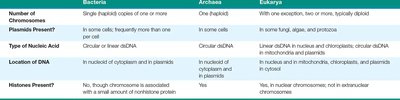
Summary Table: Comparison of Genomes in Bacteria, Archaea, and Eukarya
Feature | Bacteria | Archaea | Eukarya |
|---|---|---|---|
Number of Chromosomes | Single/haploid copies of one or more | One haploid | Two or more, typically diploid |
Plasmids Present? | In some cells, frequently more than one per cell | In some cells | In some fungi, algae, and protozoa |
Type of Nucleic Acid | Circular or linear dsDNA | Circular dsDNA | Linear nuclear chromosomes, circular dsDNA in mitochondria/chloroplasts |
Location of DNA | In nucleoid of cytoplasm and in plasmids | In nucleoid of cytoplasm and in plasmids | In nucleus and in mitochondria, chloroplasts, and plasmids |
Histones Present? | No, though chromosome is associated with a small amount of nonhistone protein | Yes | Yes, in nuclear chromosomes, not in extranuclear chromosomes |
