Back
BackMicrobial Genetics: Structure, Function, and Transfer of Genetic Information
Study Guide - Smart Notes
 Tailored notes based on your materials, expanded with key definitions, examples, and context.
Microbial Genetics
Introduction to Genetics
Genetics is the study of genes, how they carry information, how this information is expressed, and how genes are replicated. In microorganisms, genetics is fundamental to understanding cellular function, adaptation, and evolution.
Gene: A segment of DNA that encodes a functional product, usually a protein.
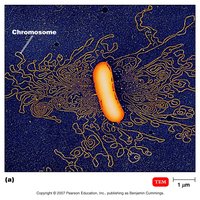
Genome: All of the genetic material in a cell.
Genomics: The molecular study of genomes.
Genotype: The genetic makeup of an organism.
Phenotype: The physical expression of the genotype.
Flow of Genetic Information
Central Dogma of Molecular Biology
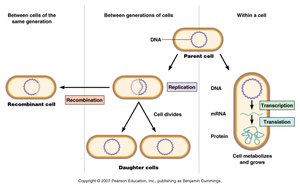
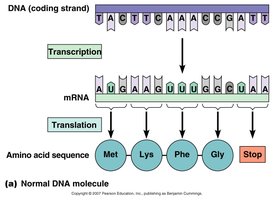
The flow of genetic information in cells follows the central dogma: DNA is replicated, transcribed into RNA, and translated into protein. This process ensures the continuity and expression of genetic information.
Replication: DNA is copied to produce identical DNA molecules for cell division.
Transcription: DNA is transcribed to produce RNA (mRNA, tRNA, rRNA).
Translation: mRNA is translated into proteins, which perform cellular functions.
Structure of DNA
DNA Composition and Structure
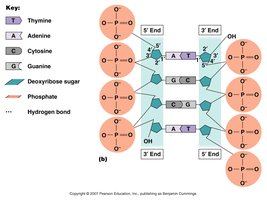
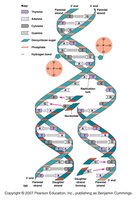
DNA is a polymer of nucleotides, each consisting of a deoxyribose sugar, a phosphate group, and a nitrogenous base (adenine, thymine, cytosine, or guanine). The DNA molecule forms a double helix, with two antiparallel strands held together by hydrogen bonds between complementary bases (A-T and C-G).
Backbone: Composed of alternating deoxyribose and phosphate groups.
Base Pairing: Adenine pairs with thymine (A-T), and cytosine pairs with guanine (C-G).
Antiparallel Strands: The two DNA strands run in opposite directions (5' to 3' and 3' to 5').
DNA Replication
Mechanism of DNA Replication
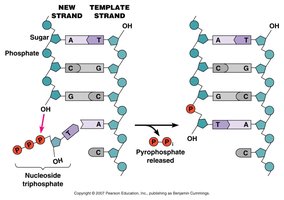
DNA replication is the process by which a cell duplicates its DNA before cell division. It is semiconservative, meaning each new DNA molecule consists of one original and one new strand. Replication proceeds in the 5' to 3' direction and involves several key enzymes.
Initiation: Begins at the origin of replication with the help of primase, which synthesizes an RNA primer.
Elongation: DNA polymerase adds nucleotides to the growing DNA strand.
Leading Strand: Synthesized continuously.
Lagging Strand: Synthesized discontinuously as Okazaki fragments, which are later joined by DNA ligase.
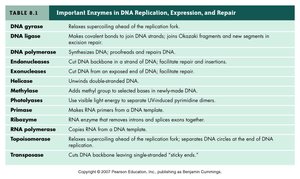
Enzyme Involvement: Multiple enzymes coordinate the process (see table below).
Enzyme | Function |
|---|---|
DNA gyrase | Relaxes supercoiling ahead of the replication fork |
DNA ligase | Makes covalent bonds to join DNA strands; joins Okazaki fragments and new segments in excision repair |
DNA polymerase | Synthesizes DNA; proofreads and repairs DNA |
Helicase | Unwinds double-stranded DNA |
Primase | Makes RNA primers from a DNA template |
Topoisomerase | Relaxes supercoiling ahead of the replication fork; separates DNA circles at the end of DNA replication |
Exonucleases/Endonucleases | Cut DNA backbone in a strand of DNA; facilitate repair and insertions |
Transcription
Process of Transcription
Transcription is the synthesis of RNA from a DNA template. It is catalyzed by RNA polymerase, which binds to the promoter region of DNA and synthesizes RNA in the 5' to 3' direction until it reaches a terminator sequence.
mRNA: Carries genetic information from DNA to ribosomes for protein synthesis.
tRNA: Transfers specific amino acids to the ribosome during translation.
rRNA: Forms the core of ribosome's structure and catalyzes protein synthesis.
Translation
Mechanism of Translation
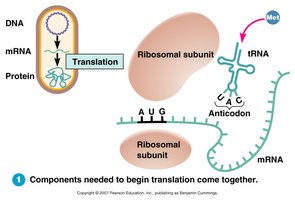
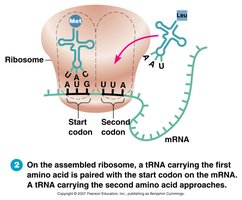
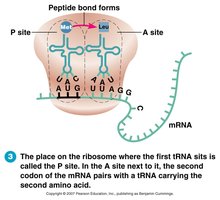
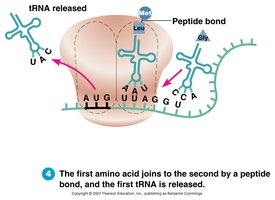
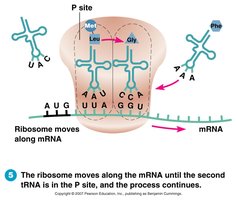
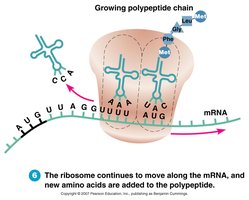
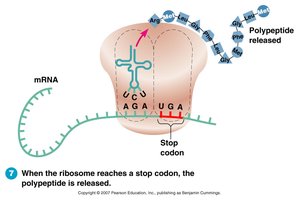
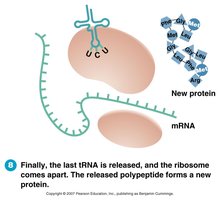
Translation is the process by which the genetic code carried by mRNA is decoded to produce a specific polypeptide. It occurs in the ribosome and involves mRNA, tRNA, and rRNA.
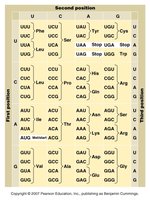
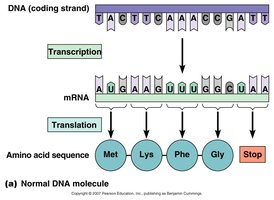
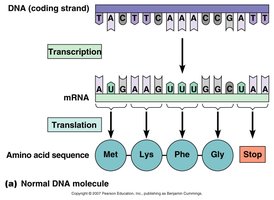
Codons: mRNA is read in sets of three nucleotides (codons), each specifying an amino acid.
Start Codon: AUG (methionine) signals the start of translation.
Stop Codons: UAA, UAG, UGA signal the end of translation.
tRNA: Each tRNA has an anticodon that pairs with the mRNA codon and carries the corresponding amino acid.
Regulation of Bacterial Gene Expression
Control of Gene Expression
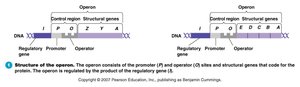
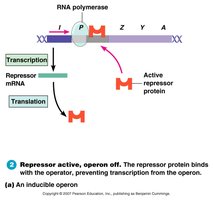
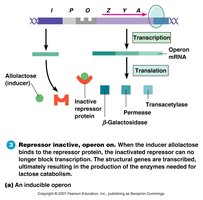
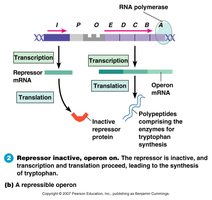
Bacteria regulate gene expression to conserve energy and resources. Some enzymes are constitutively expressed, while others are regulated by repressors or inducers.
Constitutive Enzymes: Expressed at a fixed rate.
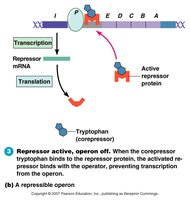
Repressible Enzymes: Transcription is blocked by a repressor; default state is "on" unless repressed.
Inducible Enzymes: Synthesized only in the presence of an inducer; default state is "off" unless induced.
Mutations
Types and Effects of Mutations
A mutation is a change in the genetic material. Mutations can be neutral, beneficial, or harmful. They may occur spontaneously or be induced by mutagens.
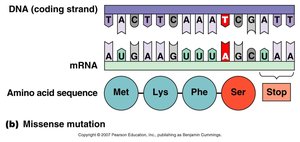
Base Substitution (Point Mutation): Change in one base pair, which may result in a missense or nonsense mutation.
Missense Mutation: Results in a different amino acid.
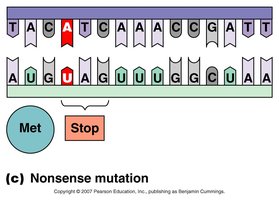
Nonsense Mutation: Results in a stop codon, terminating translation prematurely.
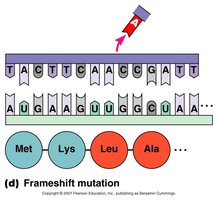
Frameshift Mutation: Insertion or deletion of nucleotides shifts the reading frame, altering downstream amino acids.
Genetic Transfer and Recombination
Mechanisms of Genetic Exchange
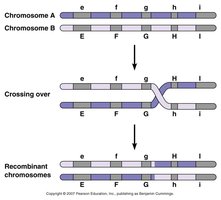
Genetic recombination is the exchange of genes between two DNA molecules, creating new combinations of genes. Bacteria can transfer genes vertically (to offspring) or horizontally (to other cells of the same generation).
Vertical Gene Transfer: Occurs during reproduction between generations of cells.
Horizontal Gene Transfer: Transfer of genes between cells of the same generation, including transformation, conjugation, and transduction.
Transformation
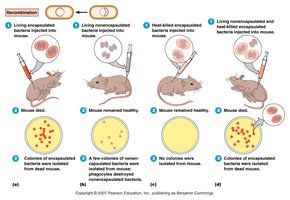
Transformation is the uptake of naked DNA fragments from the environment by a bacterial cell, leading to genetic change.
Conjugation
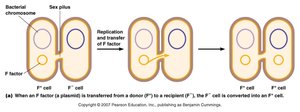
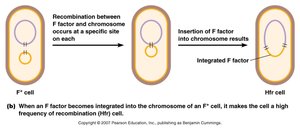
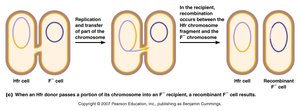
Conjugation is the transfer of genetic material between bacterial cells via direct contact, usually mediated by a plasmid and a sex pilus. It requires donor and recipient cells of opposite mating types.
Conjugative Plasmid: Carries genes for sex pili and plasmid transfer.
Dissimilation Plasmids: Encode enzymes for catabolism of unusual compounds.
Transduction
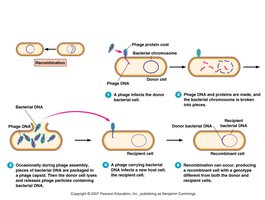
Transduction is the transfer of bacterial DNA from a donor to a recipient cell via a bacteriophage (phage). This process can result in genetic recombination in the recipient cell.
Transposons
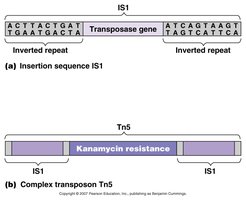
Transposons are segments of DNA that can move from one region of DNA to another. They contain insertion sequences for cutting and resealing DNA and may carry additional genes, such as antibiotic resistance.