Back
BackMicrobial Genetics: Structure, Function, and Transfer of Genetic Material
Study Guide - Smart Notes
 Tailored notes based on your materials, expanded with key definitions, examples, and context.
Microbial Genetics
Introduction to Genetics
Genetics is the study of inheritance and inheritable traits as expressed in an organism's genetic material. In microbiology, understanding genetics is crucial for exploring how microorganisms function, adapt, and evolve.
DNA (Deoxyribonucleic Acid): Encodes genetic instructions for development and functioning of all living organisms and many viruses.
Genome: The entire genetic complement of an organism, including genes and nucleotide sequences.
Structure of DNA
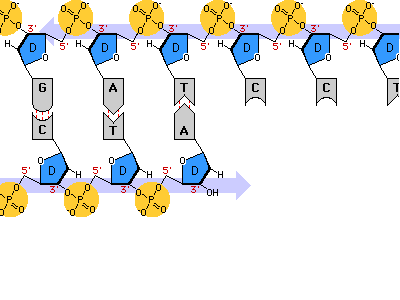
DNA is a double-stranded molecule resembling a twisted ladder. The sides are composed of covalently bonded pentose sugars and phosphate groups (phosphodiester bonds), while the rungs are pairs of nitrogenous bases.
Nitrogenous Bases: Adenine (A), Thymine (T), Guanine (G), Cytosine (C)
Base Pairing: A pairs with T (or U in RNA), G pairs with C
Antiparallel Strands: One strand runs 5' to 3', the other 3' to 5'
Prokaryotic and Eukaryotic Genomes
Microbial genomes vary between prokaryotes and eukaryotes in structure, organization, and packaging.
Prokaryotes: Typically have a single, circular chromosome located in the nucleoid; may contain plasmids.
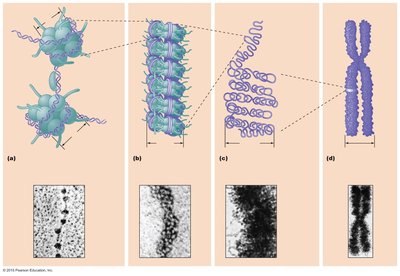
Eukaryotes: Have multiple, linear chromosomes within a nucleus; DNA is packaged with histones into chromatin.
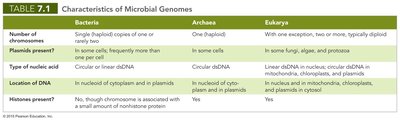
Characteristic | Bacteria | Archaea | Eukarya |
|---|---|---|---|
Number of chromosomes | Single (haploid) | One (haploid) | Two or more (diploid) |
Plasmids present? | In some cells | In some cells | In some fungi, algae, and protozoa |
Type of nucleic acid | Circular or linear dsDNA | Circular dsDNA | Linear dsDNA in nucleus; circular dsDNA in organelles |
Location of DNA | Nucleoid and plasmids | Nucleoid and plasmids | Nucleus, mitochondria, chloroplasts, and plasmids |
Histones present? | No (except some association) | Yes | Yes |
DNA Replication
Semiconservative Replication
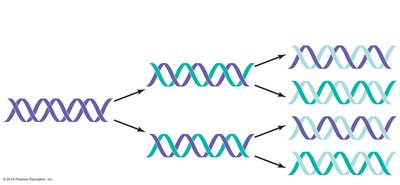
DNA replication is semiconservative: each new DNA molecule consists of one original (parental) strand and one newly synthesized (daughter) strand.
Process: Requires DNA polymerase, nucleotides, and energy (from triphosphate nucleotides).
Direction: New DNA is synthesized in the 5' to 3' direction.
Replication in Prokaryotes vs. Eukaryotes
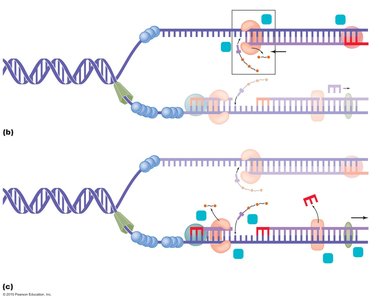
Prokaryotes: Single origin of replication, bidirectional, leading and lagging strands (Okazaki fragments on lagging strand).
Eukaryotes: Multiple origins, shorter Okazaki fragments, more DNA polymerases.
Gene Expression: Transcription and Translation
Central Dogma of Genetics
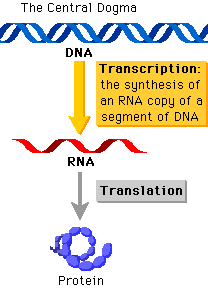
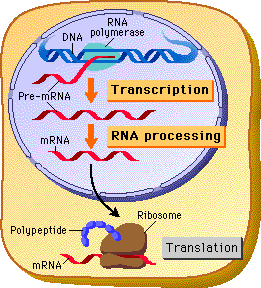
The central dogma describes the flow of genetic information: DNA is transcribed into RNA, which is then translated into protein.
Transcription
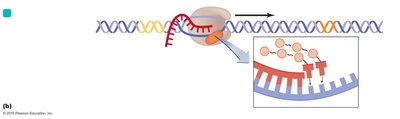
Transcription is the synthesis of RNA from a DNA template. It involves three main steps: initiation, elongation, and termination.
Types of RNA: mRNA (messenger), rRNA (ribosomal), tRNA (transfer), RNA primers, regulatory RNA
Enzyme: RNA polymerase synthesizes RNA without a primer.
Transcription in Prokaryotes vs. Eukaryotes
Prokaryotes: Transcription and translation are coupled in the cytoplasm.
Eukaryotes: Transcription occurs in the nucleus; mRNA is processed (capping, polyadenylation, splicing) before export to the cytoplasm for translation.
Translation
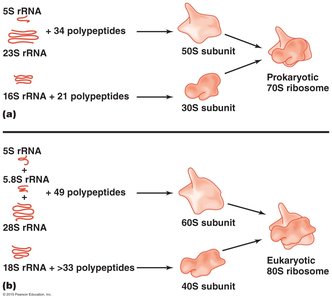
Translation is the process by which ribosomes synthesize polypeptides using the genetic information encoded in mRNA.
Participants: mRNA, tRNA, ribosomes (rRNA and proteins)
Stages: Initiation, elongation, termination
Energy: GTP is required for initiation and elongation
Regulation of Genetic Expression
Gene Regulation in Bacteria
Bacteria regulate gene expression to adapt to environmental changes and conserve energy. Genes may be organized into operons, which are groups of genes regulated together.
Inducible Operons: Activated by inducers (e.g., lactose operon)
Repressible Operons: Deactivated by repressors (e.g., tryptophan operon)
Genetic Mutation and DNA Repair
Types of Mutations
Point Mutations: Affect a single base pair (substitutions, insertions, deletions)
Frameshift Mutations: Insertions or deletions that shift the reading frame
Mutagens such as radiation and chemicals can increase mutation rates. Most mutations are deleterious, but some may confer advantages.
DNA Repair Mechanisms
Light Repair: Uses visible light to repair thymine dimers
Dark Repair: Enzymatic repair independent of light
Genetic Recombination and Horizontal Gene Transfer
Genetic Recombination
Genetic recombination involves the exchange of nucleotide sequences between DNA molecules, creating genetic diversity.
Horizontal Gene Transfer in Bacteria
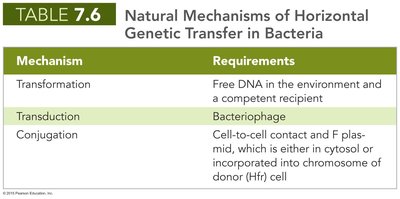
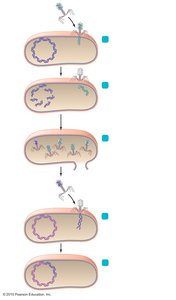
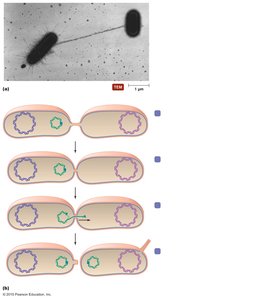
Horizontal gene transfer allows bacteria to acquire new genetic traits from other cells, not just from parent to offspring. There are three main mechanisms:
Mechanism | Requirements |
|---|---|
Transformation | Free DNA in the environment and a competent recipient |
Transduction | Bacteriophage (virus) |
Conjugation | Cell-to-cell contact and F plasmid |
Transposons and Transposition
Transposons (Jumping Genes)
Transposons are DNA segments that can move from one location to another within a genome, causing mutations and genetic variation.
Insertion Sequences: Simplest transposons, containing only the gene for transposase and inverted repeats.
Complex Transposons: Carry additional genes, such as antibiotic resistance.