Back
Microbial Genetics: Structure, Function, Mutation, and Genetic Transfer
Study Guide - Smart Notes
 Tailored notes based on your materials, expanded with key definitions, examples, and context.
Microbial Genetics
Structure and Replication of Genomes
Microbial genetics explores the molecular mechanisms by which microorganisms inherit traits, focusing on the structure, replication, and function of their genetic material. The genome consists of DNA (and sometimes RNA), which encodes all the information necessary for cellular function and inheritance.
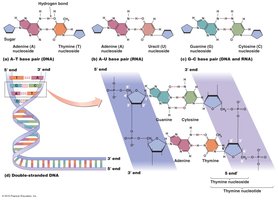
Nucleotides are the building blocks of nucleic acids, composed of a 5-carbon sugar (deoxyribose in DNA, ribose in RNA), a phosphate group, and a nitrogenous base.
DNA contains adenine (A), cytosine (C), guanine (G), and thymine (T); RNA contains uracil (U) instead of thymine.
DNA is typically double-stranded, with complementary base pairing (A-T, C-G) held together by hydrogen bonds, forming a double helix.
Genetics is the study of inheritance and inheritable traits as expressed in an organism's genetic material.
A gene is a sequence of nucleotides that codes for a polypeptide or RNA molecule.
The genome is the entire genetic complement of an organism, including all genes and nucleotide sequences.
Prokaryotic vs. Eukaryotic Genomes
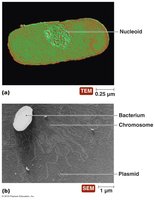
Prokaryotes usually have one (sometimes two) circular chromosomes located in the nucleoid and are haploid.
Many prokaryotes also contain plasmids—small, circular DNA molecules that replicate independently and may carry genes for fertility, resistance, bacteriocins, or virulence.
Eukaryotes have multiple, linear chromosomes located in the nucleus, wrapped around histone proteins to form nucleosomes and chromatin. Eukaryotic cells are often diploid.
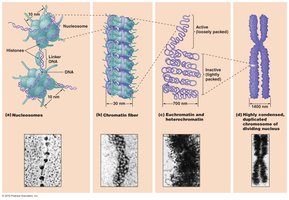
Extranuclear DNA exists in mitochondria and chloroplasts (circular, prokaryote-like) and sometimes as plasmids in fungi, algae, and protozoa.
DNA Replication
DNA replication is semiconservative: each new DNA molecule consists of one original (parental) strand and one newly synthesized (daughter) strand.
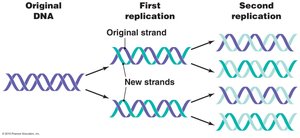
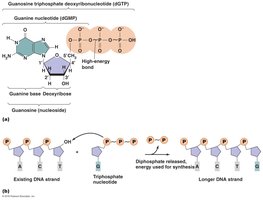
Replication requires triphosphate deoxyribonucleotides, which serve as both monomers and energy sources.
Replication begins at the origin, where DNA helicase unwinds the double helix, forming a replication bubble and forks.
DNA polymerase synthesizes new DNA in the 5′ to 3′ direction. The leading strand is synthesized continuously, while the lagging strand is synthesized discontinuously in Okazaki fragments, later joined by DNA ligase.
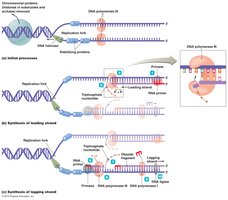
Bacterial DNA replication is bidirectional, proceeding in both directions from the origin.
Enzymes such as gyrases and topoisomerases relieve supercoiling tension.
DNA methylation regulates gene expression, replication initiation, protection, and repair.
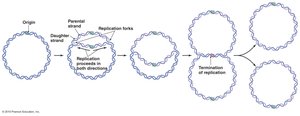
Eukaryotic replication involves multiple origins, four DNA polymerases, and shorter Okazaki fragments. Only cytosine bases are methylated in plants and animals.
Gene Function
Gene function is the process by which genetic information is expressed as cellular traits. The genotype (genetic makeup) determines the phenotype (observable traits), but not all genes are expressed at all times.
Protein synthesis is essential for cell growth, metabolism, and regulation, following the central dogma: DNA → RNA → protein.
Protein synthesis involves two main steps: transcription (DNA to mRNA) and translation (mRNA to polypeptide).
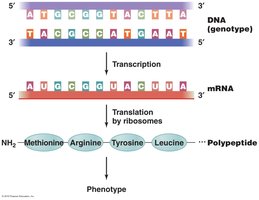
Five types of RNA are transcribed: RNA primers, mRNA, rRNA, tRNA, and regulatory RNA.
Transcription
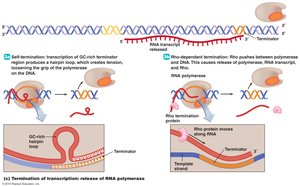
Occurs in three phases: initiation (RNA polymerase binds promoter), elongation (RNA polymerase synthesizes RNA), and termination (transcription stops at a terminator sequence).
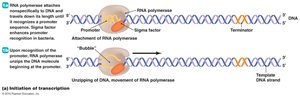
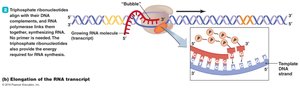
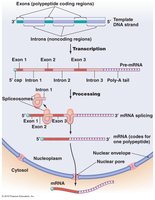
In eukaryotes, transcription occurs in the nucleus and involves mRNA processing: capping, polyadenylation, and splicing (removal of introns).
Translation
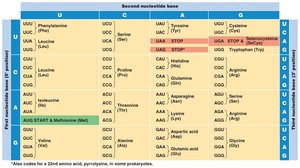
The genetic code is a set of rules linking nucleotide triplets (codons) to amino acids. There are 64 codons, including 3 stop codons.
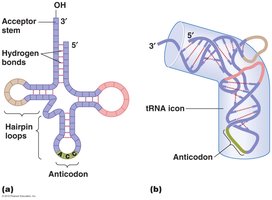
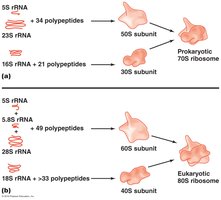
Translation requires mRNA, tRNA (with anticodon and amino acid), and ribosomes (70S in prokaryotes, 80S in eukaryotes).
Antimicrobial drugs can target differences between prokaryotic and eukaryotic ribosomes.
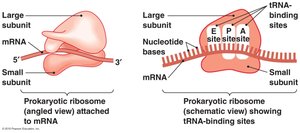
Ribosomes have binding sites for mRNA and tRNA (A, P, E sites).
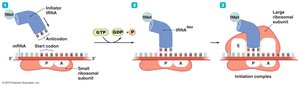
Translation occurs in three phases: initiation (assembly of ribosome on mRNA), elongation (polypeptide chain growth), and termination (release at stop codon).
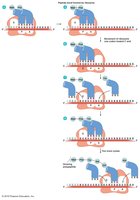
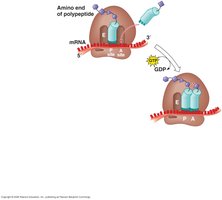
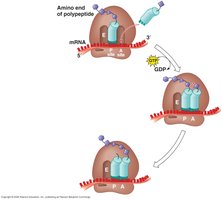
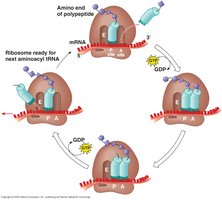
Polyribosomes allow multiple ribosomes to translate a single mRNA simultaneously.
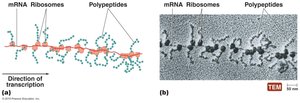
Termination occurs when a stop codon is reached, releasing the polypeptide.
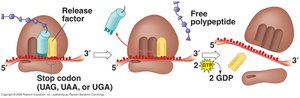
Eukaryotic translation differs in initiation, the first amino acid, and the location of synthesis (can occur into the rough ER).
Comparison of Genetic Processes
Process | Purpose | Beginning Point | Ending Point (Termination) |
|---|---|---|---|
Replication | To duplicate the cell's genome | Origin | Origin or end of a linear DNA molecule |
Transcription | To synthesize RNA | Promoter | Terminator |
Translation | To synthesize polypeptides | AUG start codon | UAA, UAG, or UGA stop codons |

Gene Regulation
Some genes are always expressed; others are regulated to conserve energy.
Quorum sensing allows bacteria to coordinate gene expression based on population density.
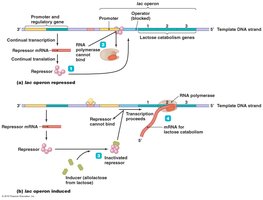
Operons are clusters of genes under control of a single promoter and operator, allowing coordinated regulation.
Inducible operons (e.g., lac operon) are activated by inducers; repressible operons (e.g., trp operon) are deactivated by repressors.
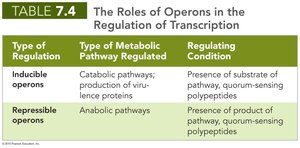
Type of Regulation | Type of Metabolic Pathway Regulated | Regulating Condition |
|---|---|---|
Inducible operons | Catabolic pathways; production of virulence proteins | Presence of substrate of pathway, quorum-sensing polypeptides |
Repressible operons | Anabolic pathways | Presence of product of pathway, quorum-sensing polypeptides |
Regulatory RNAs (e.g., microRNAs, siRNAs, riboswitches) can also control gene expression post-transcriptionally.
Mutation of Genes
Mutations are changes in the nucleotide sequence of DNA, which can affect gene function and phenotype. Most mutations are harmful, but some may confer advantages.
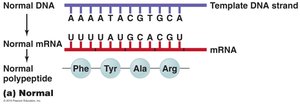
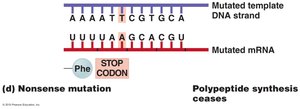
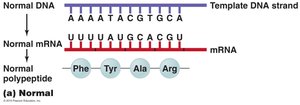
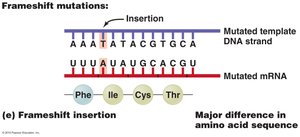
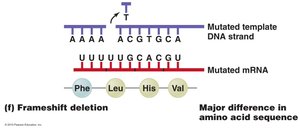
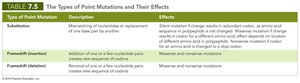
Point mutations affect a single nucleotide pair and include substitutions (silent, missense, nonsense) and frameshift mutations (insertions, deletions).
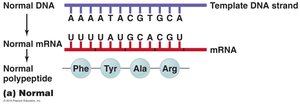
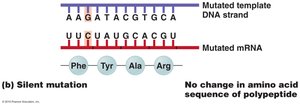
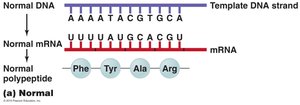
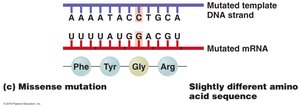
Type of Point Mutation | Description | Effects |
|---|---|---|
Substitution | Replacement of one base pair by another | Silent, missense, or nonsense mutations |
Frameshift (insertion) | Addition of one or a few nucleotide pairs | Major difference in amino acid sequence |
Frameshift (deletion) | Removal of one or a few nucleotide pairs | Major difference in amino acid sequence |
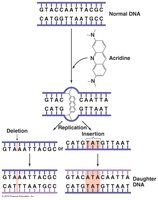
Mutations can occur spontaneously or be induced by mutagens (radiation, chemicals).
Cells have repair mechanisms, but mutagens increase mutation rates.
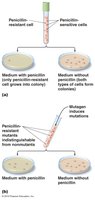
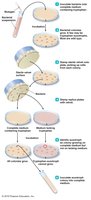
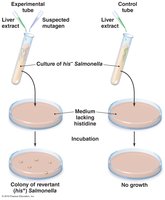
Mutants can be identified by positive selection, negative (indirect) selection, or the Ames test (for mutagenicity/carcinogenicity).
Genetic Recombination and Transfer
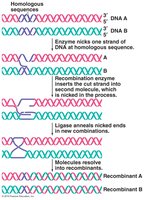
Genetic recombination is the exchange of nucleotide sequences between DNA molecules, resulting in new genetic combinations (recombinants). Microbes can exchange genes vertically (to offspring) or horizontally (between cells).
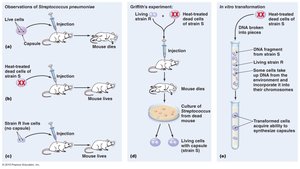
Transformation: Uptake of free DNA from the environment by competent cells (e.g., Griffith's experiment with Streptococcus pneumoniae).
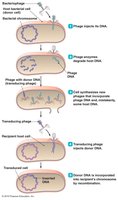
Transduction: Transfer of DNA via bacteriophages (viruses that infect bacteria). Can be generalized (random DNA) or specialized (specific genes, often toxins).
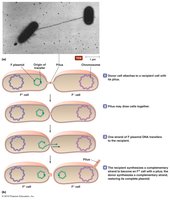
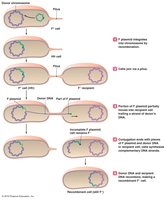
Conjugation: Direct transfer of DNA between cells via physical contact (sex pilus), mediated by F plasmids. Can occur between different species and even between bacteria and eukaryotes.
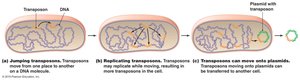
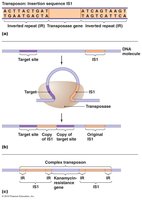
Transposons: Segments of DNA that can move within and between DNA molecules, causing mutations and gene rearrangements. Simplest are insertion sequences; complex transposons may carry additional genes (e.g., antibiotic resistance).