 Back
slides 10 - Microbial Genetics: Structure, Mutation, and Gene Transfer
Study Guide - Smart Notes
 Tailored notes based on your materials, expanded with key definitions, examples, and context.
slides 10 - Microbial Genetics
Introduction to Microbial Genetics
Microbial genetics is the study of the mechanisms of heritable information in microorganisms, focusing on the structure, function, and transfer of genetic material. Understanding microbial genetics is essential for grasping how bacteria adapt, evolve, and acquire new traits, including antibiotic resistance and pathogenicity.
Genome: The complete set of genetic material in an organism.
Housekeeping gene: A gene required for the maintenance of basic cellular function, expressed in all cells of an organism.
Plasmid: Small, circular DNA molecules found in prokaryotes, often carrying genes beneficial for survival but not essential for basic metabolism.
Structure of DNA and RNA
DNA Structure
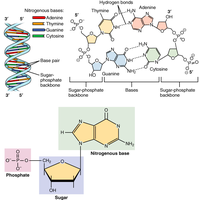
DNA is a double-stranded molecule composed of nucleotides, each consisting of a phosphate group, deoxyribose sugar, and a nitrogenous base. The four bases are adenine (A), cytosine (C), guanine (G), and thymine (T). DNA strands are held together by complementary base pairing: A pairs with T, and G pairs with C.
Double helix: The two strands twist around each other, forming a helical structure.
Sugar-phosphate backbone: The sides of the DNA ladder are formed by alternating sugars and phosphates.
RNA Structure
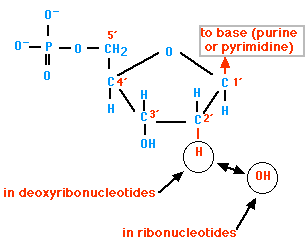
RNA is typically single-stranded and contains ribose sugar instead of deoxyribose. The base uracil (U) replaces thymine.
Types of RNA: mRNA (messenger), tRNA (transfer), rRNA (ribosomal).
Key differences from DNA: Ribose sugar, uracil instead of thymine, usually single-stranded.
DNA Replication
Mechanism of Replication
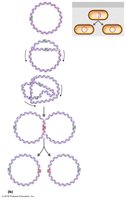
DNA replication is the process by which a cell duplicates its DNA before cell division. It begins at the origin of replication (ORI) and proceeds bidirectionally.
DNA polymerase: The enzyme responsible for synthesizing new DNA strands using the original strand as a template.
Proofreading: DNA polymerase has proofreading ability, reducing the error rate during replication.
Semiconservative replication: Each new DNA molecule consists of one parental and one newly synthesized strand.
Gene Expression: Transcription and Translation
Transcription
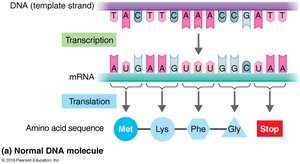
Transcription is the synthesis of mRNA from a DNA template. RNA polymerase reads the DNA strand and synthesizes a complementary mRNA strand.
Base pairing in RNA: A pairs with U, C pairs with G.
mRNA: Temporary copy of genetic information used for protein synthesis.
Translation
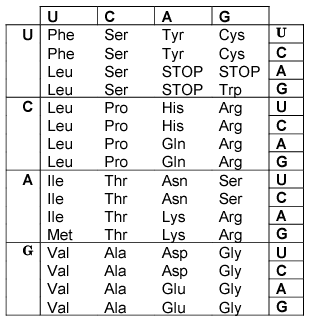
Translation is the process by which ribosomes synthesize proteins using the sequence of codons in mRNA. Each codon (three nucleotides) specifies an amino acid.
Genetic code: Universal code that translates nucleotide sequences into amino acids.
Start codon: AUG (methionine) initiates translation.
Stop codons: UAA, UAG, UGA signal termination of translation.
Mutations and Their Effects
Types of Mutations
Mutations are permanent changes in the DNA sequence. They can be spontaneous or induced by mutagens.
Point mutations: Change in a single nucleotide.
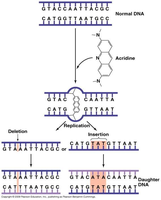
Frameshift mutations: Insertion or deletion of nucleotides that shifts the reading frame.
Point Mutations
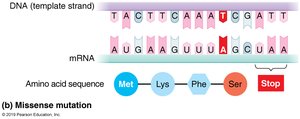
Missense mutation: Alters a codon, resulting in a different amino acid.
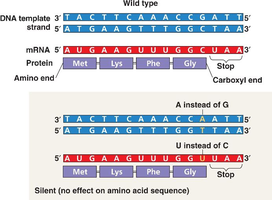
Silent mutation: Alters a codon but does not change the amino acid due to redundancy in the genetic code.
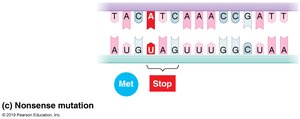
Nonsense mutation: Changes a codon to a stop codon, resulting in a truncated protein.
Frameshift Mutations
Frameshift mutations result from insertions or deletions that alter the reading frame, usually producing nonfunctional proteins. 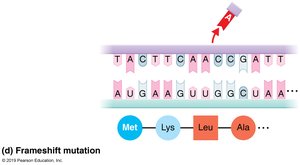
Causes of Mutations
Spontaneous mutations: Occur naturally during DNA replication.
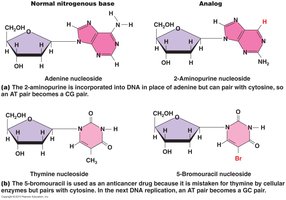
Chemical mutagens: Nucleotide analogs, nucleotide modifiers, and chemicals that distort DNA structure.
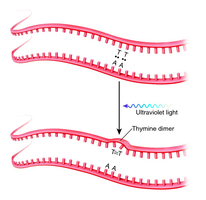
Irradiation: Ionizing radiation (X-rays, gamma rays) and UV light can damage DNA.
DNA Repair Mechanisms
Repair of DNA Damage
Cells possess mechanisms to repair DNA damage, such as light repair (photoreactivation) and excision (dark) repair. These processes restore the correct DNA sequence and maintain genetic stability.
Light repair: Enzymes break abnormal bonds (e.g., thymine dimers) formed by UV light.
Excision repair: Damaged DNA is removed and replaced with the correct sequence.
Genetic Recombination and Horizontal Gene Transfer
Mechanisms of Horizontal Gene Transfer
Horizontal gene transfer allows bacteria to acquire new genetic material from other organisms, contributing to genetic diversity and adaptation.
Transformation: Uptake of naked DNA from the environment by competent cells.
Conjugation: Direct transfer of DNA between bacteria via cell-to-cell contact, often involving plasmids and pili.
Transduction: Transfer of bacterial DNA by bacteriophages (viruses that infect bacteria).
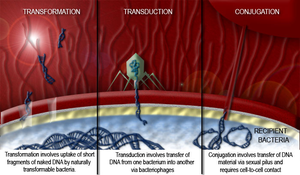
Transformation
Transformation involves the uptake of free DNA from lysed cells. Some bacteria are naturally competent, possessing specialized structures (e.g., Com pili) for DNA uptake. 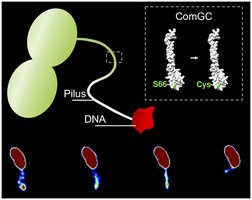
Conjugation
Conjugation requires direct contact between donor and recipient cells. The donor cell possesses an F plasmid (fertility factor) or integrates it into the chromosome (Hfr cell), enabling the transfer of genetic material.
F+ cell: Contains F plasmid, can transfer it to F- cells.
Hfr cell: F factor integrated into chromosome, can transfer chromosomal genes.
Transduction
Transduction is mediated by bacteriophages, which can accidentally package host DNA and transfer it to new bacterial cells.
Significance of Horizontal Gene Transfer
Horizontal gene transfer can lead to the spread of antibiotic resistance, virulence factors, and metabolic capabilities. Clusters of genes associated with pathogenicity are known as pathogenicity islands.
Summary Table: Types of Mutations
Mutation Type | Description | Effect on Protein |
|---|---|---|
Missense | Single nucleotide change results in a different amino acid | Altered protein function, possible loss of function |
Silent | Single nucleotide change does not alter amino acid | No effect on protein |
Nonsense | Single nucleotide change creates a stop codon | Shortened, nonfunctional protein |
Frameshift | Insertion or deletion shifts reading frame | Usually nonfunctional protein |
Key Vocabulary
Origin of replication (ORI): Site where DNA replication begins.
DNA polymerase: Enzyme that synthesizes DNA.
RNA polymerase: Enzyme that synthesizes RNA from DNA.
Mutation: Permanent change in DNA sequence.
Mutagen: Agent that increases mutation rate.
Horizontal gene transfer: Transfer of genes between organisms other than by descent.
Vertical gene transfer: Transmission of genes from parent to offspring.
Competence: Ability of a cell to take up DNA from the environment.
