 Back
BackMicrobial Genetics: Structure, Replication, and Expression of Bacterial Genomes
Study Guide - Smart Notes
 Tailored notes based on your materials, expanded with key definitions, examples, and context.
Microbial Genetics: Key Concepts
Definitions and Fundamental Terms
Microbial genetics is the study of how genetic information is stored, expressed, and transmitted in microorganisms. Understanding these concepts is essential for exploring microbial diversity, adaptation, and biotechnology.
Genetics: The study of genes, their functions, and inheritance.
Genome: All genetic material in a cell, including both coding and noncoding regions.
Chromosome: DNA-containing structure that carries hereditary information; bacteria typically have a single circular chromosome.
Gene: Segment of DNA encoding a functional product, usually a protein.
Genotype: The genetic makeup of an organism.
Phenotype: The observable expression of genes.
Genomics: Sequencing and molecular characterization of genomes.
Genetic code: Rules for converting nucleotide sequences into amino acid sequences in proteins.
Central Dogma: The flow of genetic information follows the sequence: DNA → RNA → Protein.

Bacterial Chromosomes and Genome Organization
Structure and Compaction of Bacterial Chromosomes
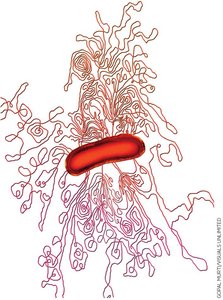
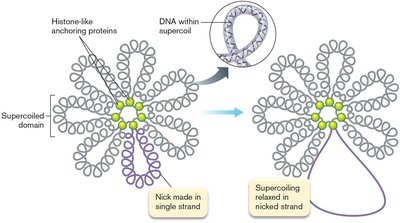
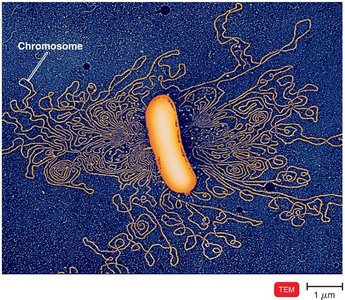
Bacterial chromosomes are highly compacted to fit within the cell, forming a region called the nucleoid. This compaction is achieved through supercoiling and the action of DNA-binding proteins.
Bacteria usually possess a single, circular chromosome.
Example: E. coli chromosome contains 4.6 million base pairs, supercoiled for efficient packing.
Genome includes protein-coding genes and noncoding regions (e.g., short tandem repeats).
DNA is organized into loops/domains anchored by histone-like proteins.
DNA Supercoiling
Supercoiling is a critical mechanism for compacting DNA and facilitating its accessibility for replication and transcription.
Positive supercoils: DNA is overwound.
Negative supercoils: DNA is underwound; most bacteria and eukaryotes possess negatively supercoiled DNA, which is easier to separate for replication.
Archaea in extreme environments may maintain positive supercoiling for DNA protection.

Chromosomes vs. Plasmids
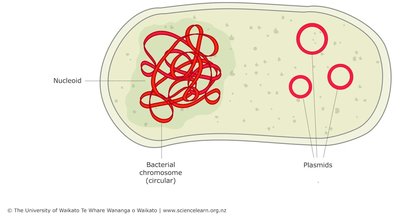
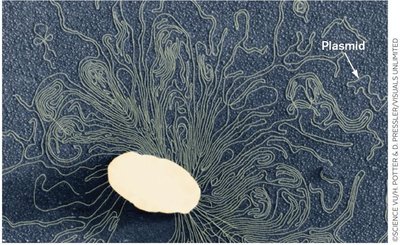
Bacterial cells may contain both chromosomes and plasmids, which differ in structure, function, and genetic content.
Chromosome: Usually one per cell, contains essential genes, circular.
Plasmid: Small, circular DNA molecules, carry accessory genes (e.g., antibiotic resistance), can be multiple per cell.
DNA Structure and Replication
DNA Structure
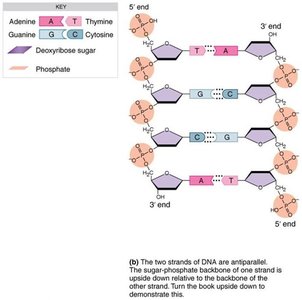
DNA is a double helix composed of two antiparallel strands held together by hydrogen bonds between complementary bases.
Backbone: Deoxyribose sugar and phosphate.
Bases: Adenine (A), Thymine (T), Guanine (G), Cytosine (C).
A pairs with T (2 hydrogen bonds), G pairs with C (3 hydrogen bonds).
Strands are antiparallel: one runs 5'→3', the other 3'→5'.
DNA Replication Process
DNA replication is a highly regulated, accurate process that ensures genetic information is faithfully transmitted to daughter cells.
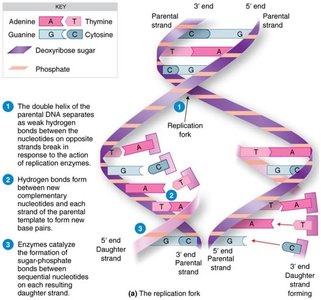
Replication is semiconservative: each new DNA molecule contains one parental and one daughter strand.
Key steps:
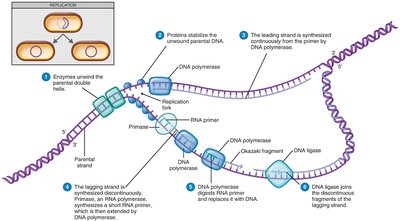
Unwinding: Helicase separates strands; topoisomerase/gyrase relax supercoiling.
Priming: Primase synthesizes RNA primers.
Elongation: DNA polymerase adds nucleotides in the 5'→3' direction.
Leading strand: Synthesized continuously.
Lagging strand: Synthesized discontinuously as Okazaki fragments, joined by DNA ligase.
Proofreading: DNA polymerase corrects errors.
Energy Requirements for DNA Replication
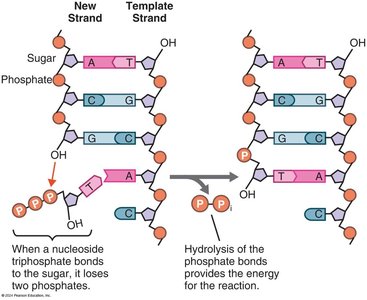
Replication requires energy, supplied by the hydrolysis of nucleoside triphosphates.
Each nucleotide added releases two phosphates, providing energy for bond formation.
Bidirectional Replication in Bacteria
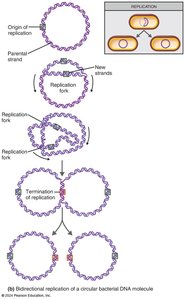
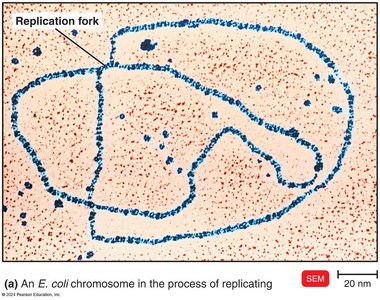
Bacterial DNA replication is typically bidirectional, starting at a single origin and proceeding in both directions around the circular chromosome.
Each daughter cell receives one complete copy of the chromosome.
Replication is highly accurate due to proofreading.
Transcription and Translation: Gene Expression
Transcription in Prokaryotes
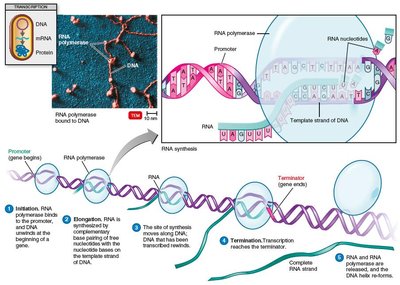
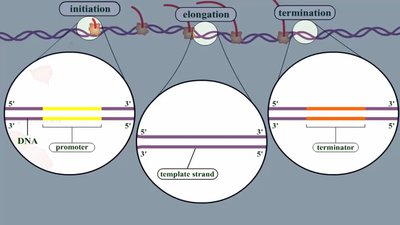
Transcription is the synthesis of a complementary mRNA strand from a DNA template, enabling gene expression.
Initiation: RNA polymerase binds to the promoter region.
Elongation: RNA polymerase synthesizes mRNA in the 5'→3' direction.
Termination: Transcription stops at the terminator sequence.
Translation and the Genetic Code
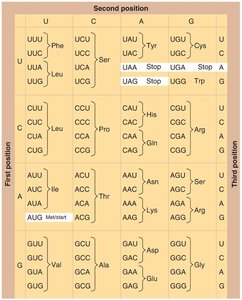
Translation converts mRNA into a protein, using the genetic code to specify amino acid sequences.
Codons: Groups of three mRNA nucleotides; 64 codons (61 sense, 3 stop).
Start codon: AUG (methionine).
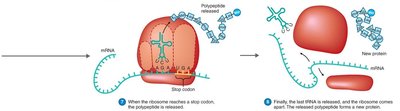
Stop codons: UAA, UAG, UGA.
Degeneracy: Multiple codons can code for the same amino acid.
Mechanism of Translation
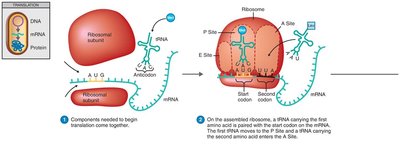
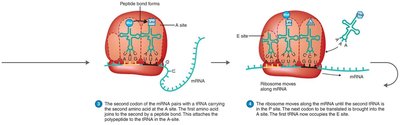
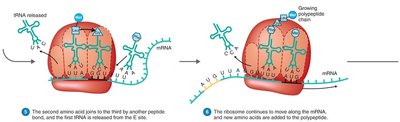
Translation occurs at the ribosome, where tRNA molecules bring amino acids corresponding to mRNA codons.
tRNA anticodon pairs with mRNA codon.
Amino acids are joined by peptide bonds.
Translation proceeds from start to stop codon.
Summary Table: Chromosomes vs. Plasmids
Feature | Chromosome | Plasmid |
|---|---|---|
Shape | Usually circular | Always circular |
Replication | Replication fork | Rolling circle |
Contents | Core and some accessory genes | Accessory genes only |
Number per cell | One or two | Zero to several |
Key Enzymes in DNA Replication
Enzyme | Function |
|---|---|
DNA Gyrase | Relaxes supercoiling ahead of replication fork |
DNA Ligase | Joins DNA strands; Okazaki fragments |
DNA Polymerase | Synthesizes DNA; proofreads and repairs |
Helicase | Unwinds double-stranded DNA |
Primase | Makes RNA primers from DNA template |
Conclusion
Understanding the structure, replication, and expression of bacterial genomes is fundamental to microbiology. These processes underpin microbial diversity, adaptation, and the development of biotechnological applications.
