 Back
BackMicrobial Genetics: Structure, Replication, Mutation, and Horizontal Gene Transfer
Study Guide - Smart Notes
 Tailored notes based on your materials, expanded with key definitions, examples, and context.
Microbial Genetics
Structure of DNA
Deoxyribonucleic acid (DNA) is the hereditary material in all living organisms and many viruses. Its structure is a double helix composed of two antiparallel strands held together by hydrogen bonds between complementary nitrogenous bases: adenine (A) pairs with thymine (T), and guanine (G) pairs with cytosine (C). Each nucleotide consists of a phosphate group, a deoxyribose sugar, and a nitrogenous base. The strands have directionality, with a 5' (phosphate) end and a 3' (hydroxyl) end.
Phosphate backbone: Alternating phosphate and deoxyribose sugars form the backbone of each strand.
Base pairing: A-T pairs form two hydrogen bonds; G-C pairs form three hydrogen bonds, contributing to DNA stability.
Genetic code: The sequence of bases encodes genetic information for protein and RNA synthesis.
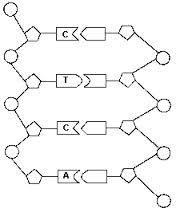
Example: In the provided diagram, the missing bases (top to bottom) are G, A, G, T, following the rules of complementary base pairing.
DNA Replication: Semiconservative Model
DNA replication is the process by which a cell duplicates its DNA before cell division. It is described as semiconservative because each new DNA molecule consists of one original (parental) strand and one newly synthesized strand. This ensures genetic continuity across generations.
Initiation: Replication begins at specific origins where the double helix is unwound.
Elongation: DNA polymerase synthesizes new strands in the 5' to 3' direction, using each parental strand as a template.
Termination: Replication ends when the entire molecule is copied.
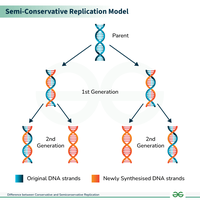
Key Enzymes: Helicase (unwinds DNA), DNA polymerase III (synthesizes new DNA), primase (lays RNA primers), DNA polymerase I (replaces RNA primers), ligase (joins Okazaki fragments), gyrase/topoisomerase (relieves supercoiling).
Leading vs. Lagging Strand: The leading strand is synthesized continuously toward the replication fork, while the lagging strand is synthesized discontinuously in short Okazaki fragments away from the fork.
Plasmids and Horizontal Gene Transfer
Plasmids are small, circular, double-stranded DNA molecules found in bacteria, separate from the chromosomal DNA. They often carry genes for antibiotic resistance (R plasmids), conjugation (F plasmids), virulence, or bacteriocin production. Plasmids can be transferred between cells via horizontal gene transfer, increasing genetic diversity.
F plasmid: Carries genes for conjugation (formation of sex pilus).
R plasmid: Carries antibiotic resistance genes.
Virulence plasmid: Encodes factors that enhance pathogenicity.
Bacteriocin plasmid: Encodes toxins that kill competing bacteria.
Mechanisms of Horizontal Gene Transfer
Horizontal gene transfer (HGT) allows bacteria to acquire new genetic traits from other organisms, not just from parent to offspring. The three main mechanisms are transformation, transduction, and conjugation.
Transformation: Uptake of naked DNA from the environment by competent cells.
Transduction: Transfer of DNA from one bacterium to another via bacteriophages (viruses).
Conjugation: Direct transfer of DNA between bacteria through cell-to-cell contact, usually involving a pilus and an F plasmid.
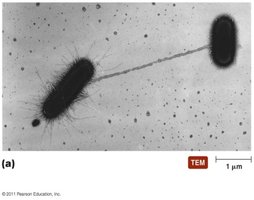
Example: The image shows two bacterial cells connected by a conjugation pilus, facilitating the transfer of genetic material.
Mutations and Genetic Diversity
Mutations are heritable changes in the DNA sequence. They can occur spontaneously or be induced by mutagens (chemical or physical agents). Types of mutations include point mutations (substitution, addition, deletion) and frameshift mutations (addition or deletion of bases that shift the reading frame).
Silent mutation: No change in amino acid sequence.
Missense mutation: Changes one amino acid in the protein.
Nonsense mutation: Creates a premature stop codon.
Frameshift mutation: Alters the reading frame, affecting all downstream codons.
Mutagens: Include base analogs (e.g., 5-bromouracil), nucleotide-altering chemicals (e.g., aflatoxins), and physical agents (ionizing and non-ionizing radiation).
Ames Test for Mutagenesis
The Ames test is a biological assay to assess the mutagenic potential of chemical compounds. It uses mutant strains of Salmonella that cannot synthesize histidine. If a chemical induces mutations that restore the ability to synthesize histidine, colonies will grow on histidine-free medium.
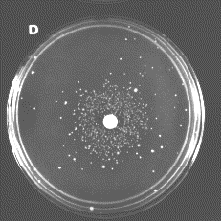
Interpretation: A high number of revertant colonies around the disk indicates that the agent induces mutations. A clear zone near the disk suggests toxicity at high concentrations.
Gene Expression and Regulation
Gene expression involves two main steps: transcription (DNA to RNA) and translation (RNA to protein). Regulation of gene expression allows cells to conserve energy and resources by producing proteins only when needed.
Operons: Clusters of genes under the control of a single promoter and operator. Inducible operons (e.g., lac operon) are usually off but can be turned on; repressible operons (e.g., trp operon) are usually on but can be turned off.
Transcriptional control: Involves regulatory proteins binding to DNA to increase or decrease transcription.
Translational control: Involves regulatory RNAs (e.g., miRNA, siRNA) that can silence mRNA.
Summary Table: Comparison of Horizontal Gene Transfer Mechanisms
Mechanism | DNA Source | Requirement | Example |
|---|---|---|---|
Transformation | Naked DNA from environment | Competent recipient cell | Griffith's experiment with Streptococcus pneumoniae |
Transduction | Bacteriophage-mediated | Phage infection | Generalized and specialized transduction |
Conjugation | Plasmid or chromosomal DNA | Direct cell-to-cell contact (pilus) | F plasmid transfer in E. coli |
Key Terms and Definitions
Genotype: The genetic makeup of an organism.
Phenotype: Observable traits resulting from gene expression.
Auxotroph: A mutant that requires a nutrient not needed by the wild type.
Prototroph: An organism with no additional nutritional requirements.
Wild type: The standard, non-mutant form of an organism.
Additional info: These notes cover the core concepts of microbial genetics, including DNA structure, replication, mutation, gene regulation, and horizontal gene transfer, as outlined in a typical college-level microbiology curriculum.
