 Back
BackMicrobial Genetics, Viral Classification, and Replication Study Guide
Study Guide - Smart Notes
 Tailored notes based on your materials, expanded with key definitions, examples, and context.
Microbial Genetics and Regulation
Regulatory Systems
Microbial cells utilize regulatory systems to control gene expression and adapt to environmental changes. These systems ensure that genes are expressed only when needed, optimizing resource use and survival.
Transcriptional Regulation: Involves mechanisms that control the initiation and rate of transcription, such as promoters, repressors, and activators.
Operons: Groups of genes regulated together, often sharing a single promoter.
Inducible and Repressible Systems: Genes can be turned on (induced) or off (repressed) in response to environmental signals.
Example: The lac operon in Escherichia coli is induced in the presence of lactose.
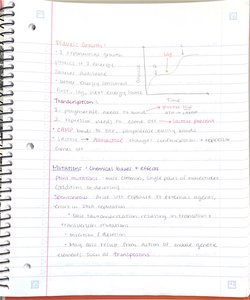
Transcription
Transcription is the process by which RNA is synthesized from a DNA template. It is a key step in gene expression and is tightly regulated in microbial cells.
Promoters: DNA sequences where RNA polymerase binds to initiate transcription.
Regulatory Proteins: Activators and repressors modulate transcription rates.
cAMP and CAP: cAMP binds to CAP, which enhances transcription of certain operons.
Example: The trp operon is repressed when tryptophan is abundant.
Mutations: Chemical Basis and Effects
Mutations are changes in the DNA sequence that can affect microbial function and evolution. They may arise spontaneously or be induced by external agents.
Point Mutations: Single nucleotide changes, including substitutions, insertions, or deletions.
Frameshift Mutations: Insertions or deletions that alter the reading frame of a gene.
Spontaneous Mutations: Occur naturally during DNA replication.
Induced Mutations: Caused by mutagens such as chemicals or radiation.
Transposons: DNA elements that can move within the genome, causing mutations.
DNA Repair and Genetic Exchange
Excision Repair
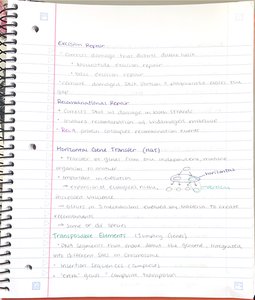
Excision repair mechanisms correct DNA damage by removing and replacing damaged nucleotides. This process is essential for maintaining genetic integrity.
Base Excision Repair: Removes damaged bases and replaces them with correct ones.
Nucleotide Excision Repair: Removes larger DNA lesions, such as thymine dimers.
Enzymes: DNA glycosylases, endonucleases, and DNA polymerases are involved.
Recombinational Repair
Recombinational repair uses homologous DNA sequences to repair breaks or gaps in the genome. It is crucial for fixing double-strand breaks.
Homologous Recombination: Exchange of genetic material between similar DNA molecules.
Example: RecA protein mediates strand exchange in bacteria.
Horizontal Gene Transfer (HGT)
Horizontal gene transfer allows microbes to acquire new genetic material from other organisms, contributing to genetic diversity and adaptation.
Transformation: Uptake of free DNA from the environment.
Conjugation: Direct transfer of DNA between cells via pili.
Transduction: Transfer of DNA by bacteriophages.
Example: Antibiotic resistance genes can spread via HGT.
Transposable Elements
Transposable elements are DNA sequences that can move within the genome, causing mutations and genetic rearrangements.
Insertion Sequences: Simple transposons containing only transposase gene.
Complex Transposons: Carry additional genes, such as antibiotic resistance.
Mechanism: Cut-and-paste or copy-and-paste transposition.
Bacterial Plasmids and Genetic Exchange
Plasmids: Structure and Function
Plasmids are extrachromosomal DNA molecules found in bacteria and some archaea. They often carry genes for antibiotic resistance, virulence, or metabolic functions.
Replication: Plasmids replicate independently of the chromosome.
Types: Conjugative plasmids can transfer between cells; non-conjugative plasmids cannot.
Example: F plasmid in E. coli enables conjugation.
Bacterial Conjugation
Conjugation is a process where genetic material is transferred between bacterial cells through direct contact, usually mediated by a pilus.
Donor Cell: Contains conjugative plasmid (e.g., F plasmid).
Recipient Cell: Receives plasmid DNA.
Mechanism: Pilus formation, plasmid transfer, and replication.
Bacterial Transformation
Transformation involves the uptake of naked DNA from the environment by a bacterial cell, leading to genetic changes.
Competence: Cells must be competent to take up DNA.
Example: Streptococcus pneumoniae can naturally transform.
Bacterial Transduction
Transduction is the transfer of bacterial DNA by bacteriophages. It can be generalized (random DNA) or specialized (specific DNA).
Generalized Transduction: Any gene can be transferred.
Specialized Transduction: Only specific genes near prophage insertion site are transferred.
Classification of Viral Genomes
Types of Viral Genomes
Viruses are classified based on their genome type, which influences their replication strategy and host interactions.
DNA Viruses: Can be single-stranded (ssDNA) or double-stranded (dsDNA).
RNA Viruses: Can be single-stranded (ssRNA) or double-stranded (dsRNA); ssRNA can be positive-sense or negative-sense.
Retroviruses: ssRNA viruses that use reverse transcriptase to synthesize DNA.
Examples: Herpesviruses (dsDNA), Influenza (ssRNA), HIV (retrovirus).
Viral Genome Organization
Viral genomes may be linear or circular, segmented or non-segmented, and encode structural and non-structural proteins.
Segmented Genomes: Multiple pieces of nucleic acid (e.g., Influenza virus).
Non-segmented Genomes: Single continuous nucleic acid (e.g., Poliovirus).
Viral Replication and Bacteriophage Life Cycles
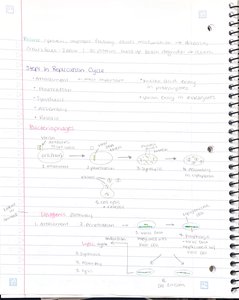
Steps in Viral Replication Cycle
The viral replication cycle consists of several distinct steps, each critical for successful infection and propagation.
Attachment: Virus binds to host cell receptors.
Penetration: Entry of viral genome into host cell.
Replication: Synthesis of viral nucleic acids and proteins.
Assembly: Formation of new viral particles.
Release: Viruses exit the host cell, often causing cell lysis.
Bacteriophage Life Cycles
Bacteriophages can follow lytic or lysogenic cycles, each with distinct outcomes for the host cell.
Lytic Cycle: Phage replicates rapidly, lyses host cell, and releases progeny.
Lysogenic Cycle: Phage genome integrates into host DNA, replicates with host, and can later enter lytic cycle.
Example: Lambda phage can switch between lytic and lysogenic cycles.
Key Equations and Concepts
Mutation Rate Equation:
Growth Curve Phases: Lag, log (exponential), stationary, and death phases.
Additional info: Academic context was added to clarify mechanisms and provide examples for each process, ensuring completeness and self-contained explanations.
