 Back
Microbial Growth and Cell Division: Mechanisms and Regulation
Study Guide - Smart Notes
 Tailored notes based on your materials, expanded with key definitions, examples, and context.
Microbial Growth and Cell Division
Introduction to Microbial Growth
Microbial growth refers to the increase in the number of cells in a population, primarily through cell division. In prokaryotes, this process is most commonly achieved by binary fission, while eukaryotic microorganisms may undergo mitosis or budding. Understanding the mechanisms of microbial growth is fundamental to microbiology, as it underpins population dynamics, pathogenesis, and biotechnological applications.
Prokaryotic Cell Cycle and Binary Fission
Overview of the Bacterial Cell Cycle
The bacterial cell cycle consists of a series of tightly regulated steps that ensure accurate DNA replication and cell division. The main stages include DNA replication, chromosome segregation, divisome formation, and cell elongation. Most bacteria divide by binary fission, producing two genetically identical daughter cells.
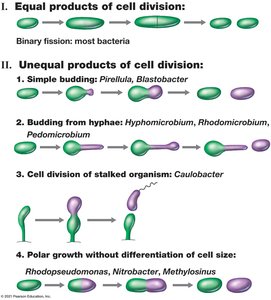
Binary Fission: A symmetrical division process where a single cell splits into two equal daughter cells.
Polar Growth and Budding: Some bacteria grow asymmetrically, producing daughter cells of different sizes or morphologies.
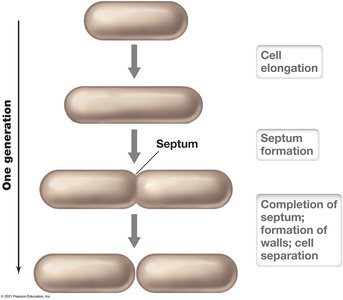
Bacterial Cell Division: Steps and Mechanisms
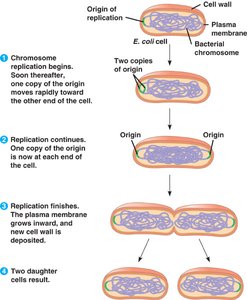
Step 1: DNA Replication – The bacterial chromosome is duplicated, beginning at the origin of replication.
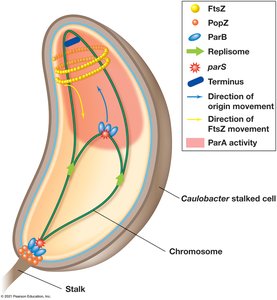
Step 2: Chromosome Segregation – Each copy of the chromosome moves to opposite ends of the cell.
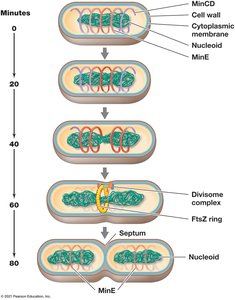
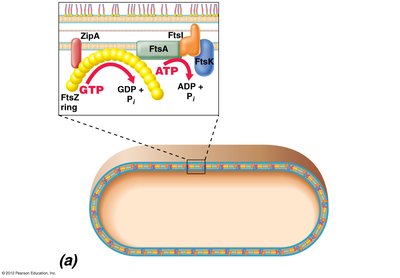
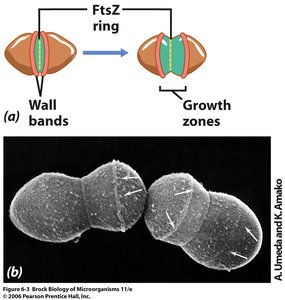
Step 3: Formation of the Divisome – A protein complex (divisome) assembles at the future site of division, with FtsZ protein forming a contractile ring.
Step 4: Cell Elongation and Septum Formation – The cell elongates, and a septum forms, dividing the cytoplasm and cell wall.
Genetic Organization in Bacteria
Bacterial Chromosomes and Plasmids
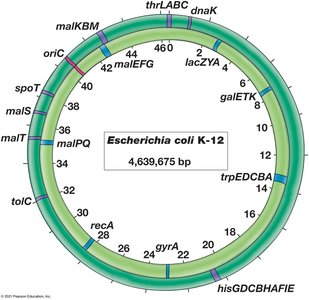
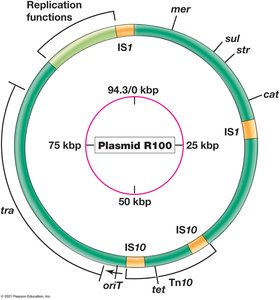
Bacteria typically possess a single, circular chromosome containing essential genetic information. Many also harbor plasmids—small, circular DNA molecules that carry non-essential but often advantageous genes, such as antibiotic resistance.
Chromosome: Contains core genes for survival and reproduction.
Plasmid: May encode traits like drug resistance or metabolic capabilities.
DNA Structure and Packaging
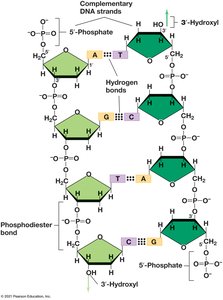
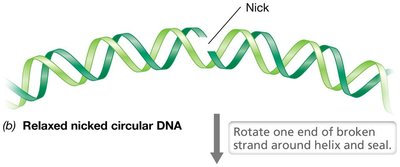
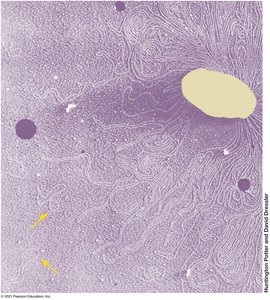
Bacterial DNA is organized as a double-stranded helix and is highly compacted within the nucleoid region. Supercoiling, mediated by DNA gyrase (a type II topoisomerase), is essential for fitting the large chromosome into the small cell volume.
Supercoiling: Introduces twists into the DNA, reducing its effective length.
DNA Gyrase: Enzyme responsible for introducing negative supercoils.
DNA Replication in Bacteria
Replication Mechanisms and Enzymes
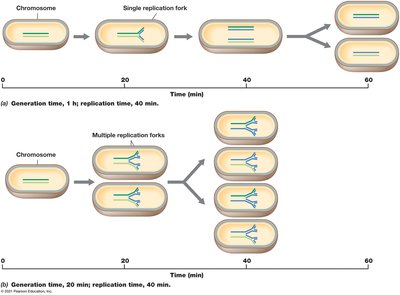
DNA replication in bacteria is semiconservative and bidirectional, starting from a single origin of replication. Multiple enzymes coordinate the process, including DNA polymerase, helicase, primase, and ligase.
Origin of Replication (oriC): Specific site where replication begins.
Replisome: Multiprotein complex that carries out DNA synthesis.
Key Enzymes: DNA gyrase, helicase, primase, DNA polymerase III, DNA polymerase I, DNA ligase.
Events at the Replication Fork
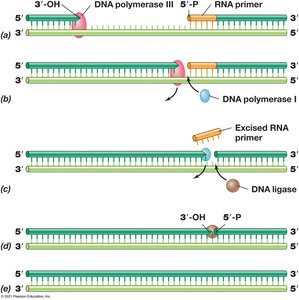
At the replication fork, DNA helicase unwinds the double helix, primase synthesizes RNA primers, and DNA polymerase III extends the new DNA strand. On the lagging strand, Okazaki fragments are joined by DNA ligase after RNA primers are removed by DNA polymerase I.
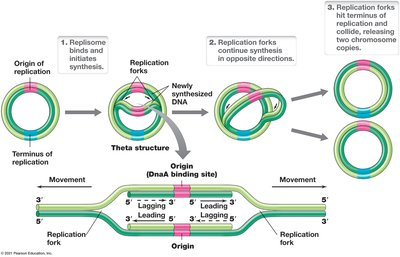
Replication of Circular DNA: Theta Structure
Replication of circular bacterial chromosomes produces a characteristic theta (θ) structure. Replication proceeds bidirectionally until the two replication forks meet at the terminus, releasing two daughter chromosomes.
Cell Division Machinery and Regulation
Divisome and FtsZ Ring
The divisome is a protein complex that orchestrates bacterial cytokinesis. The FtsZ protein polymerizes to form a ring at the future division site, recruiting other proteins (e.g., FtsA, FtsI) to synthesize new cell wall material and constrict the cell.
Min Proteins: Ensure the divisome forms at the cell center.
FtsZ: Tubulin-like protein essential for ring formation and cell division.
FtsI: Penicillin-binding protein involved in peptidoglycan synthesis.
Cell Wall Synthesis and Peptidoglycan Structure
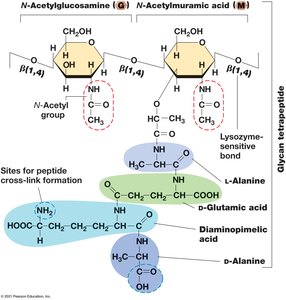
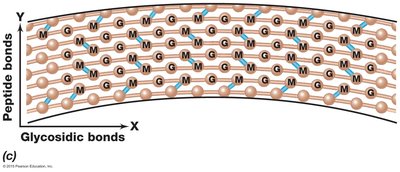
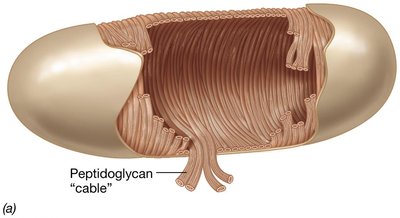
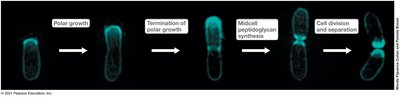
Peptidoglycan is a mesh-like polymer that provides structural integrity to bacterial cell walls. Its synthesis involves the formation of glycan chains cross-linked by peptides. Enzymes such as transpeptidases (FtsI) and transglycosylases are crucial for this process.
Peptidoglycan: Composed of repeating units of N-acetylglucosamine (NAG) and N-acetylmuramic acid (NAM) linked by β(1,4) glycosidic bonds and cross-linked by peptides.
Bactoprenol: Lipid carrier that transports peptidoglycan precursors across the cytoplasmic membrane.
Autolysins: Enzymes that create openings in the cell wall for insertion of new material.
Alternative Modes of Prokaryotic Growth
Polar Growth, Budding, and Stalked Bacteria
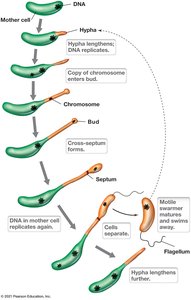
Not all bacteria divide by binary fission. Some exhibit polar growth, budding, or form stalked cells. These alternative modes are important for adaptation and differentiation in various environments.
Simple Budding: New cell forms as a bud from the parent cell (e.g., Pirellula).
Budding from Hyphae: Cells form at the tips of hyphal filaments (e.g., Hyphomicrobium).
Stalked Bacteria: Cells produce a stalk for attachment and asymmetric division (e.g., Caulobacter).
Polar Growth: Cell wall material is inserted at one pole rather than throughout the cell.
Microbial Growth Kinetics
Growth Phases in Batch Culture
When microorganisms are inoculated into a fresh medium, they exhibit a characteristic growth curve with four phases: lag, exponential (log), stationary, and death. The generation (doubling) time is the period required for the population to double in number.
Lag Phase: Adaptation period; cells prepare for active division.
Exponential Phase: Cells divide at a constant, maximum rate.
Stationary Phase: Growth ceases due to nutrient depletion or waste accumulation.
Death Phase: Cells die at an exponential rate.
Exponential Growth Equation:
= final number of cells
= initial number of cells
= number of generations
= generation time
= time of exponential growth
Example: If an E. coli culture starts with 5 cells, grows exponentially for 3 hours with a generation time of 20 minutes, the final cell number is cells.
Batch vs. Continuous Cultures
Batch Culture: Closed system with a fixed volume of medium; used for routine laboratory studies.
Continuous Culture (Chemostat): Open system where fresh medium is continuously supplied, and waste is removed, maintaining cells in exponential phase for extended periods.
Summary Table: Key Enzymes in Bacterial DNA Replication
Enzyme | Function |
|---|---|
DNA gyrase | Relieves supercoiling ahead of replication fork |
Origin-binding protein (DnaA) | Binds origin to initiate replication |
Helicase (DnaB) | Unwinds DNA at replication fork |
Primase (DnaG) | Synthesizes RNA primers |
DNA polymerase III | Main polymerizing enzyme |
DNA polymerase I | Removes RNA primers, fills gaps |
DNA ligase | Seals nicks in DNA |
Tus protein | Terminates replication at Ter sites |
Additional info: These notes integrate core concepts from microbial cell structure, function, and growth, as well as molecular aspects of DNA replication and cell division, as outlined in standard microbiology curricula.
