 Back
BackMicrobial Growth and Cell Division: Structure, Function, and Dynamics
Study Guide - Smart Notes
 Tailored notes based on your materials, expanded with key definitions, examples, and context.
Microbial Growth and Cell Division
Overview of Microbial Growth
Microbial growth refers to the increase in the number of cells within a population, primarily through cell division. The mechanisms and regulation of growth differ between prokaryotes and eukaryotes, but all involve complex processes of DNA replication, chromosome segregation, and cell wall synthesis.
Binary fission is the most common method of cell division in bacteria.
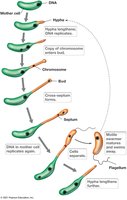
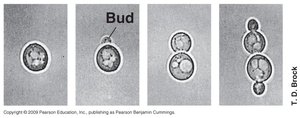
Other mechanisms include budding, polar growth, and division in stalked bacteria.
Growth is measured by the increase in cell number, not cell size.
Eukaryotic Cell Cycle
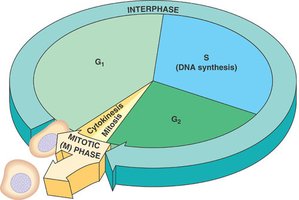
The eukaryotic cell cycle is divided into distinct phases: G1, S (DNA synthesis), G2, and M (mitosis and cytokinesis). This cycle ensures accurate replication and segregation of genetic material.
Interphase includes G1, S, and G2 phases, where the cell grows and DNA is replicated.
Mitotic (M) phase involves mitosis and cytokinesis, resulting in two daughter cells.
Bacterial Cell Cycle and Division
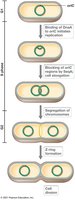
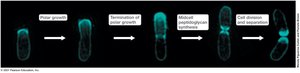
Bacterial cell division is a highly regulated process involving DNA replication, chromosome segregation, and formation of the divisome.
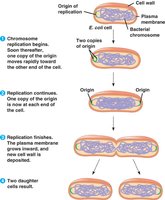
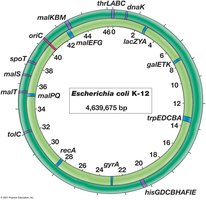
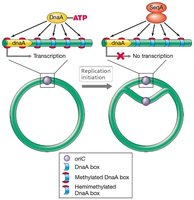
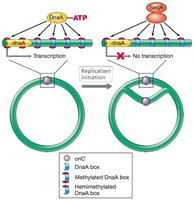
DNA replication initiates at the origin of replication and proceeds bidirectionally.
Chromosome segregation ensures each daughter cell receives a copy of the genome.
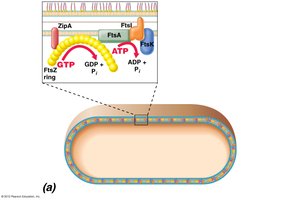
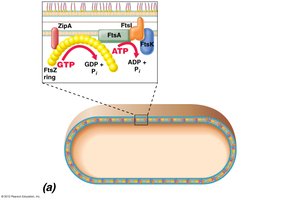
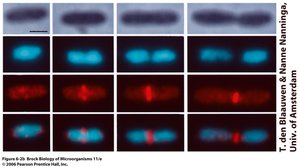
Divisome formation involves proteins such as FtsZ, which forms a ring at the cell center to initiate division.
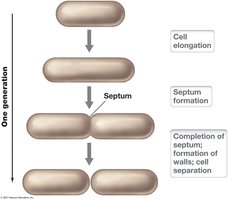
Cell elongation precedes septum formation and cell separation.
Chromosome Structure and Replication
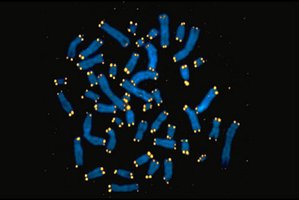
Bacteria typically possess a single, circular chromosome, while eukaryotes have multiple linear chromosomes.
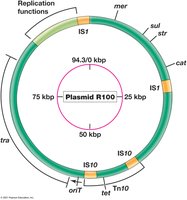
Plasmids are extrachromosomal DNA elements that replicate independently.
DNA is packaged differently in bacteria, archaea, and eukarya, with supercoiling and histone association playing key roles.
DNA Structure
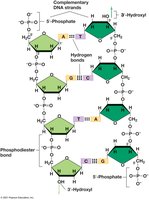
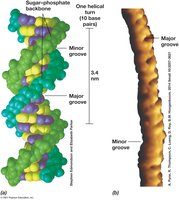
DNA is a double-stranded helix composed of nucleotides linked by phosphodiester bonds. The strands are held together by hydrogen bonds between complementary bases.
Base pairing: Adenine (A) pairs with Thymine (T), and Guanine (G) pairs with Cytosine (C).
Phosphodiester bonds link the 5' phosphate and 3' hydroxyl groups of adjacent nucleotides.
DNA Packaging and Supercoiling
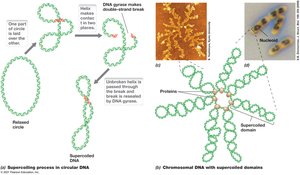
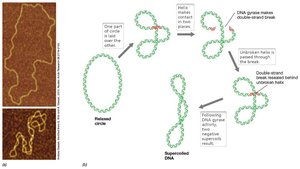
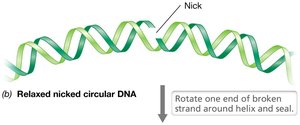
Bacterial DNA is supercoiled by enzymes such as DNA gyrase to fit within the cell.
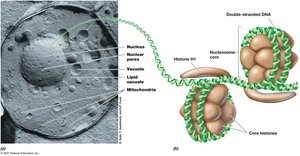
Eukaryotic DNA is wrapped around histone proteins to form nucleosomes.
DNA Replication in Bacteria
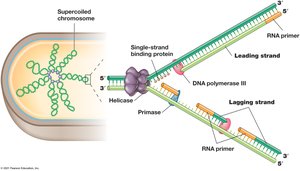
DNA replication is a semi-conservative process, beginning at the origin of replication and proceeding bidirectionally.
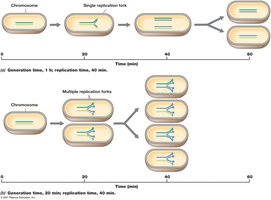
Multiple replication forks can be used to speed up replication in rapidly growing cells.
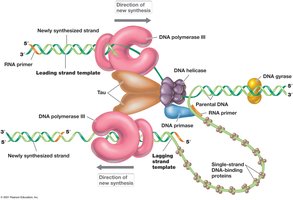
The replisome is a complex of enzymes responsible for DNA synthesis.
Major enzymes include DNA polymerase III, DNA helicase, primase, and DNA gyrase.
Lagging Strand Synthesis
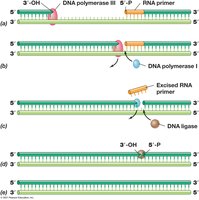
RNA primers are removed and replaced with DNA by DNA polymerase I.
DNA ligase seals the fragments by forming phosphodiester bonds.
Replication of Circular DNA: Theta Structure
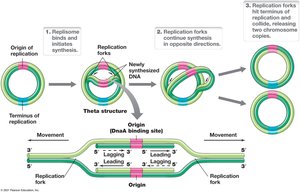
Replication of circular chromosomes produces a theta-shaped intermediate.
Replication forks move in opposite directions until they meet at the terminus.
Termination of Replication
In bacteria, Ter sites and Tus proteins block replication fork progression.
Eukaryotes use telomerase to complete the ends of linear chromosomes.
Bacterial Cell Division: Protein Machinery
Min proteins ensure the divisome forms at the cell center.
FtsZ proteins form a ring at the division site.
FtsA proteins anchor the FtsZ ring to the membrane.
MreB proteins determine cell shape by directing cell wall synthesis.
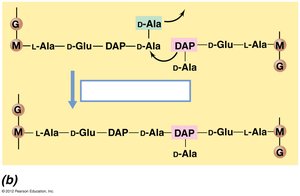
FtsI proteins (penicillin-binding proteins) catalyze peptidoglycan crosslinking.
Peptidoglycan Structure and Cell Wall Synthesis
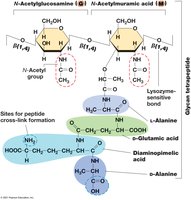
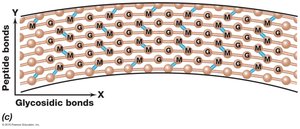
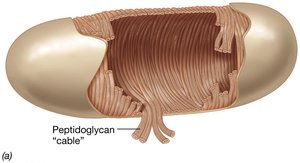
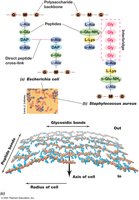
Peptidoglycan is a polymer of sugars and amino acids forming the bacterial cell wall.
Repeating units of N-acetylglucosamine and N-acetylmuramic acid are linked by glycosidic bonds.
Peptide crosslinks provide structural integrity.
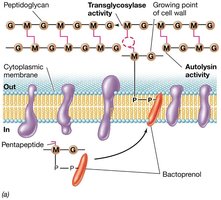
Cell wall synthesis involves autolysins, transglycosylases, and transpeptidases.
Bactoprenol is a lipid carrier that transports peptidoglycan precursors across the membrane.
Cell Division in Different Bacterial Morphologies
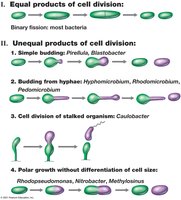
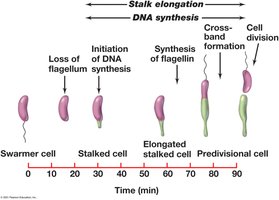
Bacteria exhibit diverse modes of cell division, including binary fission, budding, and division in stalked cells.
Binary fission produces equal daughter cells.
Budding and polar growth produce unequal products.
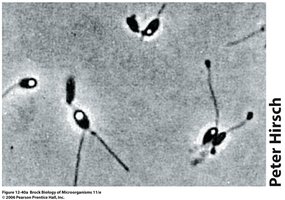
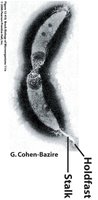
Stalked bacteria (e.g., Caulobacter) undergo specialized division cycles.
Eukaryotic Microbial Life Cycles
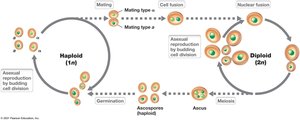
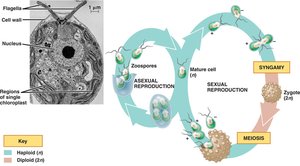
Eukaryotic microbes may reproduce sexually, asexually, or both.
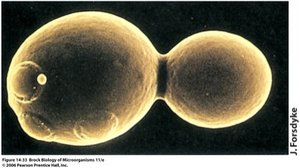
Saccharomyces cerevisiae (yeast) reproduces by budding and can undergo sexual reproduction.
Chlamydomonas reinhardtii alternates between haploid and diploid stages.
Microbial Growth Cycle and Phases
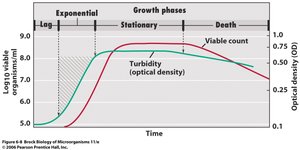
When inoculated into fresh medium, microbial populations exhibit characteristic growth phases:
Lag phase: Cells adapt and synthesize necessary enzymes.
Exponential phase: Cells divide regularly, population increases rapidly.
Stationary phase: Nutrients deplete, waste accumulates, growth ceases.
Death phase: Cells die due to unfavorable conditions.
Generation Time and Exponential Growth
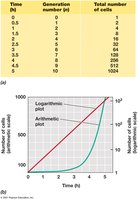
Generation time (g): Time required for one cell to divide into two.
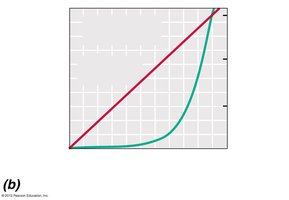
Exponential growth: Cell number doubles at regular intervals.
Mathematical expression: where N = final cell number, N0 = initial cell number, n = number of generations.
Generation time: where t = time of exponential growth.
Batch vs. Continuous Cultures
Batch culture: Closed system with fixed volume, used for routine lab procedures.
Continuous culture (chemostat): Open system, maintains cells in exponential phase by controlling dilution rate and nutrient concentration.
Summary Table: Modes of Bacterial Cell Division
Mode | Example Organisms | Products |
|---|---|---|
Binary fission | Most bacteria | Equal |
Simple budding | Pirellula, Blastobacter | Unequal |
Budding from hyphae | Hyphomicrobium, Rhodomicrobium | Unequal |
Stalked cell division | Caulobacter | Unequal |
Polar growth | Rhodopseudomonas, Nitrobacter | Unequal |
Key Equations for Microbial Growth
Final cell number:
Generation time:
Practical Implications
Exponential growth can lead to rapid spoilage of nutrient-rich foods.
Understanding growth dynamics is essential for controlling microbial populations in industrial and clinical settings.
