 Back
BackMicrobial Growth and Control: Chapter 6 Microbiology Study Guide
Study Guide - Smart Notes
 Tailored notes based on your materials, expanded with key definitions, examples, and context.
Q1. How could you determine whether a microbe is a strict anaerobe?
Background
Topic: Oxygen Requirements of Microbes
This question tests your understanding of how different microbes respond to oxygen and how to experimentally determine their oxygen requirements.
Key Terms and Concepts:
Strict anaerobe: An organism that cannot survive in the presence of oxygen.
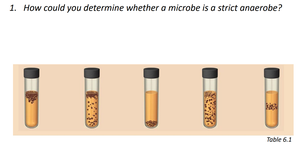
Thioglycollate broth: A medium used to test oxygen requirements, with an oxygen gradient from top (aerobic) to bottom (anaerobic).
Step-by-Step Guidance
Inoculate the microbe into a tube of thioglycollate broth, which creates an oxygen gradient.
Incubate the tube and observe where the microbial growth occurs.
Compare the growth pattern to known oxygen requirement profiles (e.g., growth only at the bottom indicates strict anaerobe).
Try solving on your own before revealing the answer!
Final Answer:
A strict anaerobe will only grow at the bottom of the thioglycollate broth tube, where oxygen is absent. This is because oxygen is toxic to strict anaerobes, so they avoid the oxygen-rich upper part of the tube.
Q2. If bacterial cells were given radioactive phosphorus (P-32) in their culture media, where would you find the P-32 in the cells? Radioactive nitrogen (N-15)?
Background
Topic: Microbial Nutrition and Macromolecules
This question tests your knowledge of the cellular components that contain phosphorus and nitrogen.
Key Terms and Concepts:
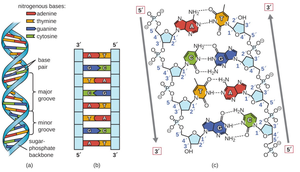
Phosphorus (P): Essential for nucleic acids (DNA, RNA), ATP, and phospholipids.
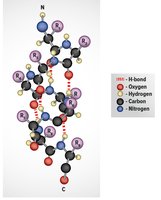
Nitrogen (N): Found in proteins (amino acids), nucleic acids, and other cellular molecules.
Step-by-Step Guidance
Recall which macromolecules contain phosphorus (e.g., DNA, RNA, ATP, phospholipids).
Recall which macromolecules contain nitrogen (e.g., proteins, nucleic acids).
Think about where these molecules are located within the cell (e.g., cytoplasm, membranes, chromosomes).
Try solving on your own before revealing the answer!
Final Answer:
P-32 would be found in nucleic acids (DNA and RNA), ATP, and phospholipids. N-15 would be found in proteins (amino acids) and nucleic acids (nitrogenous bases). These elements are incorporated into the cell's genetic material and structural components.
Q3. Describe the term “biofilm” and explain how/where it is formed.
Background
Topic: Microbial Communities and Biofilms
This question tests your understanding of what biofilms are, their formation, and their significance in microbiology.
Key Terms and Concepts:
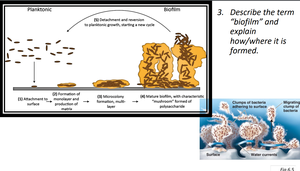
Biofilm: A complex community of microorganisms adhering to a surface, embedded in a self-produced extracellular matrix.
Extracellular polymeric substances (EPS): The matrix that holds the biofilm together.
Step-by-Step Guidance
Define what a biofilm is and the main characteristics of biofilm communities.
Describe the steps of biofilm formation: initial attachment, microcolony formation, maturation, and dispersal.
Give examples of where biofilms are commonly found (e.g., teeth, medical devices, water pipes).
Try solving on your own before revealing the answer!
Final Answer:
A biofilm is a structured community of microorganisms attached to a surface and embedded in a self-produced matrix of extracellular polymeric substances. Biofilms form when microbes adhere to surfaces, multiply, and produce EPS, creating a protective environment. They are found on teeth (dental plaque), medical devices, and natural environments like rocks in streams.
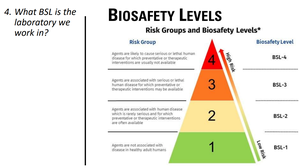
Q4. What BSL is the laboratory we work in?
Background
Topic: Biosafety Levels (BSL)
This question tests your understanding of laboratory safety and the classification of biosafety levels.
Key Terms and Concepts:
Biosafety Level (BSL): A set of biocontainment precautions required to isolate dangerous biological agents in an enclosed laboratory facility.
BSL-1 to BSL-4: Increasing levels of containment, with BSL-1 being the lowest and BSL-4 the highest.
Step-by-Step Guidance
Review the characteristics of each biosafety level (BSL-1 to BSL-4).
Consider the types of organisms and procedures used in your laboratory.
Match your lab's practices to the appropriate BSL description.
Try solving on your own before revealing the answer!
Final Answer:
Most introductory microbiology teaching labs operate at BSL-1 or BSL-2, depending on the organisms handled. BSL-1 is for well-characterized agents not known to cause disease in healthy adults, while BSL-2 is for moderate-risk agents. Check your lab manual or instructor for the specific level.
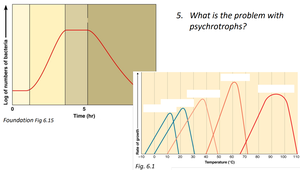
Q5. What is the problem with psychrotrophs?
Background
Topic: Microbial Growth and Temperature
This question tests your understanding of how temperature affects microbial growth, especially in the context of food safety.
Key Terms and Concepts:
Psychrotrophs: Microorganisms that can grow at low temperatures (0–30°C), including refrigerator temperatures.
Food spoilage: Psychrotrophs are responsible for spoiling refrigerated foods.
Step-by-Step Guidance
Recall the temperature range at which psychrotrophs can grow.
Consider why their ability to grow at low temperatures is problematic for food storage.
Think about examples of foods that spoil in the refrigerator due to psychrotrophs.
Try solving on your own before revealing the answer!
Final Answer:
Psychrotrophs can grow at refrigerator temperatures, leading to the spoilage of refrigerated foods. This makes them a concern for food safety, as they can multiply even when food is kept cold.
