 Back
BackMicrobial Growth and Control: Study Notes for College Microbiology
Study Guide - Smart Notes
 Tailored notes based on your materials, expanded with key definitions, examples, and context.
Microbial Growth
Physical and Chemical Requirements for Microbial Growth
Microbial growth is influenced by both physical and chemical factors. Understanding these requirements is essential for culturing microbes and controlling their growth in various environments.
Physical requirements: Include temperature, pH, and osmotic pressure.
Chemical requirements: Include sources of carbon, nitrogen, sulfur, phosphorus, trace elements, oxygen, and organic growth factors.
Temperature Requirements
Microbes are classified based on their preferred temperature ranges, which affect their growth rate and ecological niche.
Psychrophiles: Cold-loving microbes, optimal growth at low temperatures.
Psychrotrophs: Grow at low temperatures but have higher optimums than psychrophiles.
Mesophiles: Moderate-temperature-loving microbes, optimal at 20–45°C; most human pathogens are mesophiles.
Thermophiles: Heat-loving microbes, optimal at 45–70°C.
Hyperthermophiles: Extreme thermophiles, optimal above 80°C.
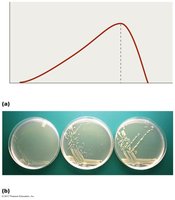
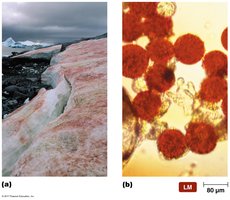
Food spoilage: Occurs at temperatures that support microbial growth, especially by psychrotrophs and mesophiles.
pH Requirements
Microbial growth is also affected by pH, with most bacteria preferring neutral conditions, while molds and yeasts tolerate more acidic environments.
Most bacteria: Grow at pH 6.5–7.5.
Molds and yeasts: Grow at pH 5–6.
Acidophiles: Tolerant of acidity; some can survive at pH 1.
Alkalinity: Inhibits microbial growth; rarely used for food preservation.
Osmotic Pressure
Osmotic pressure is crucial for microbial growth and is used in food preservation. High salt or sugar concentrations create hypertonic environments that inhibit microbial growth.
Extreme halophiles: Require high salt concentrations (e.g., Dead Sea organisms).
Obligate halophiles: Must have high salt to survive.
Facultative halophiles: Can tolerate moderate salt concentrations.
Chemical Requirements: Carbon, Nitrogen, Sulfur, Phosphorus
Microbes require various elements for growth, each serving specific functions in cellular metabolism and structure.
Carbon: Structural backbone of organic compounds; half the dry weight of bacteria.
Nitrogen: Needed for proteins, nucleic acids; acquired via nitrogen fixation, ammonium ions, or nitrates.
Sulfur: Used in amino acids and vitamins.
Phosphorus: Essential for nucleic acids, phospholipids, and ATP.
Trace elements: Iron, copper, molybdenum, zinc—required in small amounts for enzyme function.
Oxygen Requirements
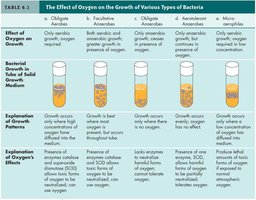
Microbes are classified based on their oxygen requirements, which affect their growth patterns and survival in different environments.
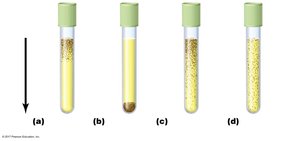
Obligate aerobes: Require oxygen for growth.
Facultative anaerobes: Can grow with or without oxygen, but grow better with oxygen.
Obligate anaerobes: Cannot tolerate oxygen.
Aerotolerant anaerobes: Do not use oxygen but can tolerate it.
Microaerophiles: Require low levels of oxygen.
Culture Media
Culture media are nutrient materials prepared for the growth of microorganisms in the laboratory. They can be chemically defined or complex.
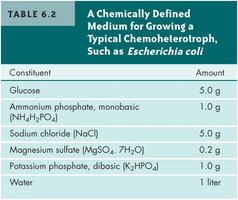
Chemically defined media: Exact chemical composition is known.
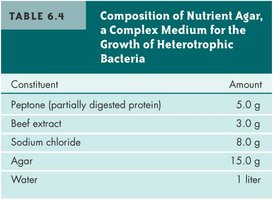
Complex media: Contains extracts from yeasts, meat, or plants; composition varies.
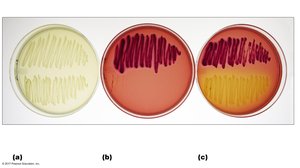
Selective media: Suppress unwanted microbes and encourage desired ones.
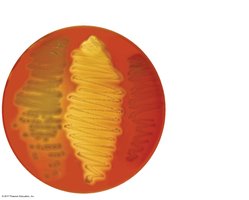
Differential media: Distinguish colonies of desired organisms from others.
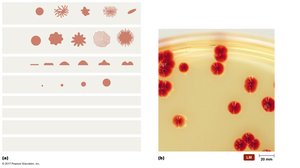
Phases of Microbial Growth
Growth Curve and Generation Time
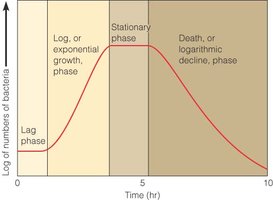
Bacterial populations grow in distinct phases, each with unique characteristics. Generation time is the period required for a cell to divide.
Lag phase: Cells adjust to environment; no increase in cell number.
Log (exponential) phase: Rapid cell division; population doubles at each generation.
Stationary phase: Growth rate slows; nutrients deplete, waste accumulates.
Death phase: Cells die at a logarithmic rate.
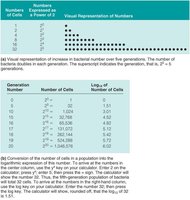
Generation time: Can be calculated using the formula:
Where N is the final number of cells, N_0 is the initial number, and n is the number of generations.
Measuring Microbial Growth
Direct Methods
Direct methods involve counting individual cells or colonies.
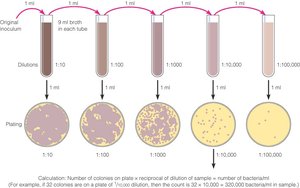
Plate counts: Count colonies formed on agar plates after serial dilution.
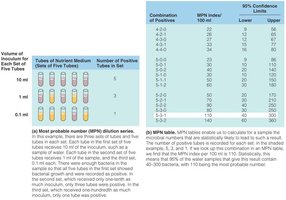
Most Probable Number (MPN): Statistical estimation based on dilution series.
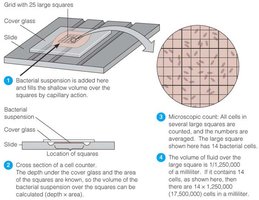
Direct microscopic count: Cells counted under a microscope using a counting chamber.
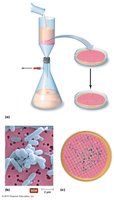
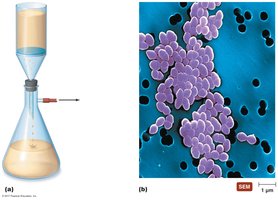
Membrane filtration: Microbes are trapped on a filter and then cultured.
Indirect Methods
Indirect methods estimate cell numbers based on metabolic activity, turbidity, or dry weight.
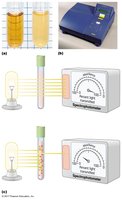
Turbidity: Measured using a spectrophotometer; more cells scatter more light.
Metabolic activity: Measurement of products like CO2 or acids.
Dry weight: Cells are dried and weighed, useful for filamentous organisms.
Microbial Control
Terminology of Microbial Control
Microbial control involves various processes to reduce or eliminate microorganisms.
Sterilization: Destroys all viable microbes, including endospores.
Disinfection: Destroys vegetative pathogens, not endospores.
Sanitization: Lowers microbe counts to safe levels.
Degermation: Mechanical removal of microbes from limited areas.
Biocide/germicide: Kills microorganisms.
Bacteriostasis: Inhibits growth, does not kill.
Rate of Microbial Death
Microbial populations die at a constant rate when exposed to control agents. Factors influencing effectiveness include number of microbes, environment, time of exposure, and microbial characteristics.
Actions of Microbial Control Agents
Control agents act by altering membrane permeability, damaging cell walls, proteins, and nucleic acids.
Physical Methods of Microbial Control
Physical methods include moist heat, dry heat, filtration, low temperature, radiation, high pressure, desiccation, and osmotic pressure.
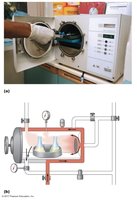
Moist heat: Denatures proteins; includes boiling, autoclaving, pasteurization.
Dry heat: Coagulates proteins; includes incineration, flaming, hot-air sterilization.
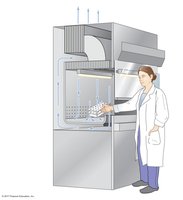
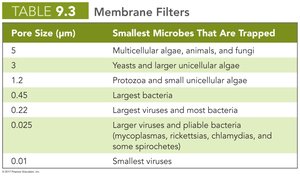
Filtration: Removes microbes from liquids or gases using filters.
Low temperature: Inhibits growth; includes refrigeration and freezing.
Radiation: Ionizing (gamma rays, X-rays) and nonionizing (UV light) sterilize by damaging DNA.
High pressure: Inactivates vegetative cells by altering protein and carbohydrate structures.
Desiccation: Removes water, inhibiting growth.
Osmotic pressure: Creates hypertonic environments to inhibit growth.

Chemical Methods of Microbial Control
Chemical agents include disinfectants and antiseptics, each with specific modes of action and uses.
Phenol and phenolics: Disrupt cell membranes and proteins; used in disinfectants like Lysol.
Bisphenols: Used in surgical and hospital settings.
Biguanides (Chlorhexidine): Used for surgical hand scrubs and skin preparation.
Halogens: Denature proteins; includes iodine and chlorine.
Alcohols: Denature proteins and dissolve lipids; includes ethanol and isopropanol.
Aldehydes: Denature proteins and modify DNA; includes formaldehyde and glutaraldehyde.
Peroxygens: Oxidize cellular components; includes hydrogen peroxide and peracetic acid.
Gaseous chemosterilizers: Sterilize in closed chambers; includes ethylene oxide.
Heavy metals: Cause protein denaturation; includes copper, zinc, mercury, silver.
Surface-active agents: Soaps and detergents; good degerming agents.
Quaternary ammonium compounds (Quats): Disinfect medical equipment.
Summary Table: Microbial Growth and Control
Factor | Effect on Microbial Growth |
|---|---|
Temperature | Determines optimal growth; psychrophiles, mesophiles, thermophiles, hyperthermophiles |
pH | Most bacteria prefer neutral; molds/yeasts prefer acidic; acidophiles tolerate low pH |
Osmotic Pressure | High salt/sugar inhibits growth; halophiles tolerate high salt |
Oxygen | Obligate aerobes, facultative anaerobes, obligate anaerobes, aerotolerant anaerobes, microaerophiles |
Chemical Elements | Carbon, nitrogen, sulfur, phosphorus, trace elements required for metabolism |
Culture Media | Chemically defined, complex, selective, differential media |
Control Methods | Physical (heat, filtration, radiation), chemical (disinfectants, antiseptics) |
