 Back
BackMicrobial Growth and Its Control: Parameters, Mechanisms, and Environmental Factors
Study Guide - Smart Notes
 Tailored notes based on your materials, expanded with key definitions, examples, and context.
Microbial Growth: Importance and Overview
Why Study Microbial Growth?
Understanding microbial growth is essential for applications in industry, medicine, and environmental science. Microbial growth refers to an increase in the population of microbes, not individual cell size. This knowledge is crucial for culturing microbes in vitro, maintaining microbiomes, and mitigating diseases.
Industrial Relevance: Microbial growth is harnessed in biotechnology, fermentation, and pharmaceuticals.
Microbiome Maintenance: Proper growth conditions are vital for sustaining beneficial microbial communities.
Disease Mitigation: Controlling microbial growth helps prevent and treat infections.
Mechanisms of Microbial Growth
Binary Fission
Most prokaryotes (bacteria and archaea) reproduce by binary fission, a process resulting in two genetically identical daughter cells. Doubling times vary by species and environmental conditions.
Definition: Binary fission is the primary mode of cell division in prokaryotes.
Doubling Time: The time required for a population to double in number.
Environmental Impact: Microbes grow slower in natural environments due to resource limitations and competition.
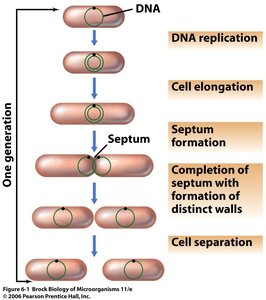
Example: Escherichia coli can double every 20 minutes under optimal laboratory conditions.
Alternative Cell Division Mechanisms
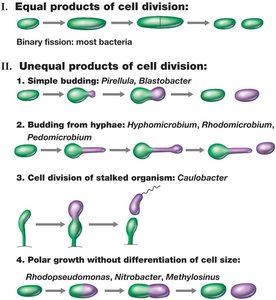
Some bacteria and archaea use mechanisms other than binary fission, such as budding or polar growth.
Budding: New cells form as outgrowths from the parent cell.
Polar Growth: Cell growth occurs at one end of the cell.
Phases of Microbial Growth
Bacterial Growth Curve
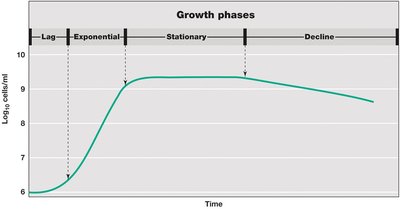
Microbial populations in batch culture exhibit distinct growth phases: lag, exponential (log), stationary, and decline (death).
Lag Phase: Cells adjust to new environment; little to no division.
Exponential Phase: Rapid cell division; population increases logarithmically.
Stationary Phase: Growth rate equals death rate; nutrients become limited.
Decline Phase: Death rate exceeds growth rate due to depletion of resources and accumulation of waste.
Measuring Microbial Growth
Direct and Indirect Methods
Several techniques are used to quantify microbial growth:
Direct Cell Counts: Counting cells using a microscope and a counting chamber.
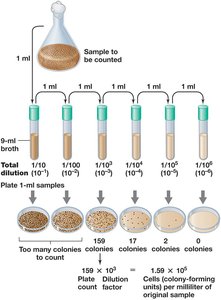
Viable Plate Counts: Counting colony-forming units (CFU) after plating serial dilutions.
Optical Density (OD): Measuring turbidity using a spectrophotometer at 600 nm (OD600).
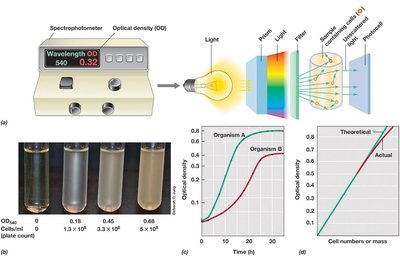
Example: A culture with an OD600 of 0.5 may contain approximately 5 x 10⁸ cells/mL.
Environmental Factors Affecting Microbial Growth
Temperature
Microbes are classified based on their optimal growth temperatures:
Psychrophiles: Grow best at low temperatures (≤15°C).
Mesophiles: Optimal growth at moderate temperatures (20–45°C).
Thermophiles: Thrive at high temperatures (45–80°C).
Hyperthermophiles: Grow at extremely high temperatures (≥80°C).
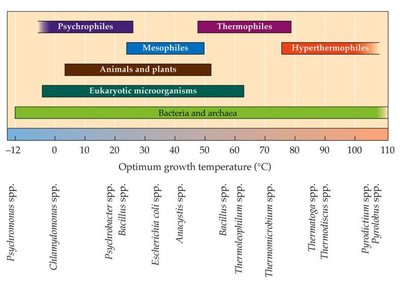
Adaptations: Cold-adapted microbes have more unsaturated fatty acids in membranes; heat-adapted microbes have heat-stable enzymes and saturated fatty acids.
pH
Microbes are also classified by their pH preferences:
Acidophiles: Grow optimally at low pH (≤5.5).
Neutrophiles: Prefer neutral pH (6.5–7.5).
Alkaliphiles: Thrive at high pH (≥8).
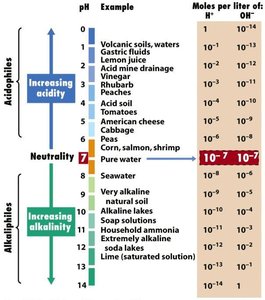
Example: Acidithiobacillus ferrooxidans is an acidophile found in acidic mine drainage.
Osmolarity and Water Activity
Water availability, expressed as water activity (aw), is critical for microbial survival.
Halophiles: Require high salt concentrations.
Osmophiles: Thrive in high-sugar environments.
Xerophiles: Adapted to very dry environments.
Note: The lower limit for life is aw = 0.6.
Oxygen Requirements
Microbes vary in their oxygen requirements:
Obligate Aerobes: Require oxygen for growth.
Facultative Anaerobes: Can grow with or without oxygen.
Obligate Anaerobes: Oxygen is toxic; grow only in its absence.
Microaerophiles: Require low levels of oxygen.
Aerotolerant Anaerobes: Do not use oxygen but tolerate its presence.
Example: Thioglycollate medium is used to test oxygen requirements in the lab.
Biofilms
Structure and Function
Biofilms are structured communities of microbes attached to surfaces and embedded in a self-produced extracellular polymeric substance (EPS) matrix.
EPS Composition: Polysaccharides, DNA, proteins, and outer membrane vesicles.
Organization: Biofilms have water channels and distinct functional roles (e.g., secretors, adherent cells, persistor cells).
Medical Relevance: ~80% of chronic infections involve biofilms.
Control of Microbial Growth
Physical Methods
Sterilization: Complete removal or killing of all microorganisms.
Decontamination: Inhibition of microbial growth on surfaces.
Disinfection: Targeting pathogens, may not eliminate all microbes.
Heat Sterilization: Uses high temperatures to denature proteins and destroy cell structures. Effectiveness depends on time, temperature, and medium conditions.
Autoclaving: Steam under pressure (121°C) for sterilization.
Pasteurization: Controlled heat to reduce microbial load without destroying the medium.
Radiation: UV and ionizing radiation damage DNA and cellular components; not effective against spores.
Filtration: Used for heat-sensitive liquids; 0.2 µm filters trap bacteria but not most viruses.
Chemical Methods
Bacteriostatic Agents: Inhibit growth without killing cells.
Bactericidal Agents: Kill cells but do not lyse them.
Bacteriolytic Agents: Kill and lyse cells, releasing contents.
Sterilants: Destroy all microorganisms, including spores; used for inanimate objects.
Disinfectants: Kill most microbes (not spores); used on surfaces.
Antiseptics: Safe for living tissues; kill or inhibit microbes but not spores.
Sanitizers: Reduce microbial load; less harsh than disinfectants.
Antibiotics
Antibiotics are chemicals that target specific bacterial structures or processes, such as cell wall synthesis, protein synthesis, or DNA replication. Resistance can develop through gene acquisition or mutation.
Targets: Peptidoglycan synthesis, ribosomes, DNA replication machinery.
Resistance: Bacteria may acquire resistance genes or mutate to evade antibiotic action.
Summary Table: Microbial Growth Parameters
Parameter | Microbial Group | Adaptation/Example |
|---|---|---|
Temperature | Psychrophiles, Mesophiles, Thermophiles, Hyperthermophiles | Cold-active enzymes, heat-stable enzymes |
pH | Acidophiles, Neutrophiles, Alkaliphiles | Acid mine drainage, soda lakes |
Osmolarity | Halophiles, Osmophiles, Xerophiles | Salt lakes, sugary environments, deserts |
Oxygen | Obligate aerobes, facultative anaerobes, obligate anaerobes, microaerophiles, aerotolerant | Thioglycollate medium test |
Additional info: This guide integrates foundational concepts from microbial physiology, environmental microbiology, and applied microbiology, providing a comprehensive overview suitable for exam preparation and practical applications.
