 Back
BackMicrobial Growth and Reproduction: Key Concepts and Laboratory Applications
Study Guide - Smart Notes
 Tailored notes based on your materials, expanded with key definitions, examples, and context.
Microbial Growth and Reproduction
Binary Fission
Binary fission is the primary method by which many bacteria and some other microbes reproduce. This process results in the formation of two genetically identical daughter cells from a single parent cell.
Definition: Binary fission is an asexual mode of reproduction in prokaryotes where the cell divides into two equal halves.
Steps of Binary Fission:
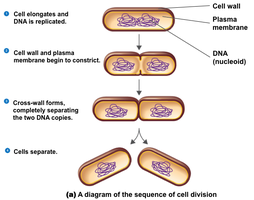
Cell elongates and DNA is replicated.
Cell wall and plasma membrane begin to constrict.
A cross-wall forms, completely separating the two DNA copies.
The cells separate, resulting in two daughter cells.
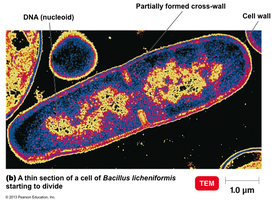
Example: Bacillus licheniformis dividing by binary fission.
Generation Time
Generation time, also known as doubling time, is the time required for a microbial population to double in number. This is a critical parameter in microbiology for understanding microbial growth rates.
Formula: The number of cells after a certain number of generations can be calculated as:
Example: If Streptococcus pneumoniae has a generation time of 30 minutes and you start with 2 cells, after 4 hours (8 generations), you would have cells.
Microbial Growth Curve
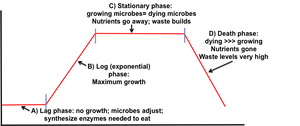
Microbial populations in batch culture typically exhibit a characteristic growth curve with four distinct phases:
Lag Phase: Cells adjust to new environment; little or no cell division occurs.
Log (Exponential) Phase: Cells divide at a constant and rapid rate; population growth is exponential.
Stationary Phase: Growth rate slows as nutrients are depleted and waste products accumulate; the rate of cell death equals the rate of cell division.
Death Phase: Nutrients are exhausted and waste levels are high; cells die at an exponential rate.
Parameters Affecting Microbial Growth in the Laboratory
Temperature
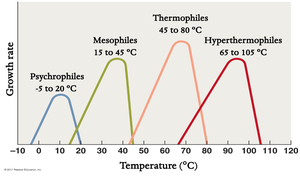
Temperature is a critical factor influencing microbial growth. Microbes are classified based on their optimal temperature ranges:
Psychrophiles: Grow best at -5 to 20°C.
Mesophiles: Grow best at 15 to 45°C (includes most human pathogens).
Thermophiles: Grow best at 45 to 80°C.
Hyperthermophiles: Grow best at 65 to 105°C.
pH
Microbes also have specific pH ranges for optimal growth. Most bacteria prefer neutral pH (6.5-7.5), but some thrive in acidic or alkaline environments.
Acidophiles: Grow best in acidic environments (pH < 6).
Neutrophiles: Grow best at neutral pH (6.5-7.5).
Alkaliphiles: Grow best in alkaline environments (pH > 8).
Osmotic Pressure
Osmotic pressure affects water availability and solute concentration, influencing microbial survival and growth. Halophiles, for example, thrive in high-salt environments.
Oxygen Requirements
Microbes vary in their oxygen requirements:
Obligate aerobes: Require oxygen for growth.
Obligate anaerobes: Cannot tolerate oxygen.
Facultative anaerobes: Can grow with or without oxygen.
Microaerophiles: Require low levels of oxygen.
Aerotolerant anaerobes: Do not use oxygen but can tolerate its presence.
Microbes that live in the presence of oxygen contain enzymes (e.g., catalase, superoxide dismutase) that detoxify harmful byproducts of oxygen metabolism.
Growth Media and Laboratory Classification
Types of Growth Media
Culture media provide nutrients for microbial growth in the laboratory. They can be classified as:
Chemically Defined Media: Exact chemical composition is known.
Complex Media: Contains extracts (e.g., yeast, meat) with unknown exact composition.
Selective Media: Inhibits growth of some microbes while allowing others to grow.
Differential Media: Distinguishes between different types of microbes based on their biological characteristics.
Some media can be both selective and differential (e.g., MacConkey agar, Mannitol salt agar).
Laboratory Biosafety Levels
Laboratories are classified based on the types of microbes handled and the safety precautions required (BSL-1 to BSL-4). BSL-4 labs handle the most dangerous pathogens and require specialized containment and procedures.
Measuring and Monitoring Microbial Growth
Direct Methods
Direct methods involve counting microbial cells or colonies:
Viable Plate Count: Counts colonies formed on agar plates; results expressed as colony-forming units per milliliter (cfu/ml).
Formula:
Membrane Filtration: Used for water samples; colonies are counted after filtration and incubation.
Formula:
Indirect Methods
Indirect methods estimate microbial growth by measuring parameters such as turbidity (cloudiness) of liquid cultures, which correlates with cell density.
Turbidity Measurement: Spectrophotometers are used to measure optical density (OD) at specific wavelengths.
Additional info: The study notes above expand on the provided material with definitions, examples, and formulas to ensure completeness and academic quality for microbiology students.
