 Back
BackMicrobial Growth in Natural Environments: Biofilms and Symbiotic Nitrogen Fixation
Study Guide - Smart Notes
 Tailored notes based on your materials, expanded with key definitions, examples, and context.
Microbial Growth in Natural Environments
Complexity of Microbial Habitats
Microbial environments are highly complex and dynamic, containing both microorganisms and macroorganisms. Most microbes inhabit oligotrophic environments, where nutrient levels are low. In response to nutrient limitation or unfavorable conditions, some microbes enter growth arrest, ceasing active division to conserve energy.
Oligotrophic environments: Habitats with low nutrient availability, common in nature.
Growth arrest: A survival strategy where microbes stop dividing and reduce metabolic activity.
Microbial Responses to Starvation and Stress
Microbes have evolved various strategies to survive starvation and environmental stress:
Morphological changes: Formation of endospores or cysts for protection.
Stationary phase entry: Cells stop dividing, use storage inclusions for nutrients, and reduce in size to increase surface area-to-volume ratio for efficient nutrient uptake.
Protective proteins and genes: Expression of genes that protect DNA and enhance survival.
Virulence increase: Some microbes, such as Salmonella enterica, become more virulent under starvation conditions.
Biofilms
Definition and Significance
Most microbes in nature grow attached to surfaces (sessile) rather than free-floating (planktonic). These surface-associated communities are called biofilms, which are slime-enclosed and highly structured. Biofilms are ubiquitous in aquatic environments and can form on any conditioned surface.
Biofilm: A complex community of microorganisms attached to a surface and embedded in a self-produced extracellular matrix.
Examples of biofilm impact: Corrosion of ship hulls, contamination of medical devices, and delayed wound healing.
Biofilm Formation Process
Biofilm development is a multi-step process involving microbial attachment, matrix production, and community maturation:
1. Surface conditioning: Surfaces are first coated with proteins and other molecules.
2. Reversible attachment: Microbes attach to the conditioned surface.
3. Extracellular matrix production: Microbes secrete polysaccharides, proteins, and DNA to form the matrix.
4. Biofilm maturation: Additional polymers are produced, and the community becomes more complex and dynamic.
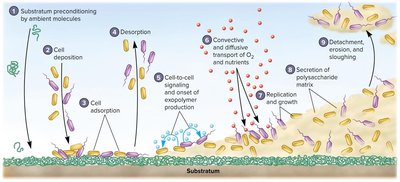
Cell-to-Cell Communication: Quorum Sensing
Mechanism and Importance
Bacterial cells within biofilms communicate using a process called quorum sensing, which is density-dependent. Quorum sensing regulates various cellular functions, including bioluminescence, virulence, biofilm formation, and antibiotic resistance.
Quorum sensing: Cell-to-cell communication mechanism that enables bacteria to sense and respond to population density via signaling molecules.
Competence: Some bacteria, such as Streptococcus pneumoniae, become competent (able to take up DNA) when quorum sensing signals reach a threshold.
Pathogenesis: Quorum sensing can trigger virulence factor expression, leading to diseases like pneumonia and meningitis.
Quorum Sensing Molecules
The primary autoinducer in many Gram-negative bacteria is N-acyl homoserine lactone (AHL). AHL diffuses freely across the plasma membrane and helps cells assess population density.
AHL: A signaling molecule used in quorum sensing by Gram-negative bacteria.
Threshold effect: When AHL concentration reaches a critical level, it induces gene expression for group behaviors.
Quorum Sensing in Symbiosis: Vibrio fischeri and Squid
Quorum sensing regulates symbiotic relationships, such as the interaction between Vibrio fischeri and the Hawaiian bobtail squid. At high cell densities, AHL induces bioluminescence, which is visible in the squid's light organ.
Symbiosis: Vibrio fischeri produces light only when a sufficient population is present, benefiting both the bacteria and the squid.
Cell density: Bioluminescence is triggered at approximately cells/mL.
Symbiotic Nitrogen Fixation: Rhizobia and Legumes
Rhizobium-Legume Symbiosis
Rhizobia are Gram-negative, motile, non-sporulating rods that form mutualistic relationships with leguminous plants (e.g., alfalfa, beans, clovers, peas, soybeans). They colonize root nodules, where they fix atmospheric nitrogen into ammonia, which plants can use.
Mutualism: Plants provide sugars and nutrients to rhizobia; rhizobia supply fixed nitrogen.
Nitrogen fixation reaction:
ATP requirement: Nitrogen fixation is energy-intensive, requiring 16 ATP molecules per N2 reduced.
Free-living nitrogen fixers: Azotobacter (aerobic, cyst-forming) and Clostridium (anaerobic, spore-forming).
Nodule Formation and Host Recognition
Root cells release chemicals into the soil, promoting the growth of rhizobia in the rhizosphere. Flavonoids secreted by roots activate nod genes in rhizobia, leading to nodule formation. Specific interactions between bacterial cell walls and root surfaces ensure host specificity.
Flavonoids: Plant compounds that induce nod gene expression in rhizobia.
Nodules: Specialized plant structures housing nitrogen-fixing bacteria.
Oxygen Regulation in Nodules
Rhizobia regulate oxygen levels in nodules using leghemoglobin, a red, iron-containing protein similar to hemoglobin. Leghemoglobin binds oxygen, providing enough for bacterial respiration but preventing inactivation of nitrogenase, the enzyme complex responsible for nitrogen fixation.
Leghemoglobin: Produced by both plant and bacterial genes; essential for protecting nitrogenase from oxygen.
Nitrogenase: Oxygen-sensitive enzyme complex that reduces N2 to NH3.
Oxygen Sensitivity of Nitrogenase
Nitrogenase is inactivated by oxygen. Free-living nitrogen-fixing bacteria use alternative strategies to protect nitrogenase, such as high metabolic rates (e.g., Azotobacter) or physical barriers.
High respiration rate: Azotobacter maintains low intracellular oxygen by rapid consumption.
Physical barriers: Some bacteria form cysts or thick capsules to limit oxygen diffusion.
