 Back
BackMicrobial Growth: Mechanisms, Kinetics, and Environmental Influences
Study Guide - Smart Notes
 Tailored notes based on your materials, expanded with key definitions, examples, and context.
Microbial Growth
Definition and Overview
Microbial growth refers to the increase in the number of cells within a population, rather than the size of individual cells. This process is fundamental to microbiology, as it underpins population dynamics, colony formation, and the spread of microorganisms in various environments.
Population: A group of microorganisms growing together.
Colony: A visible mass of microbial cells originating from a single cell.
How Bacteria Divide
Binary Fission
Binary fission is the primary method by which most bacteria reproduce. It involves a series of steps that result in the formation of two genetically identical daughter cells.
Cell elongation: The cell grows and elongates.
Septum formation: A septum forms, dividing the cell into two compartments.
Completion of septum and cell separation: The septum is completed, cell walls form, and the cells separate.
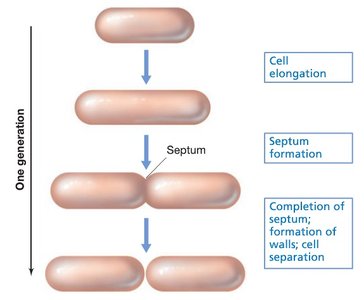
Molecular Mechanism of Binary Fission
The process of binary fission is tightly regulated and involves the replication and segregation of the bacterial chromosome, followed by the formation of a division septum.
Chromosome replication: The chromosome is duplicated.
FtsZ ring formation: The FtsZ protein forms a ring at the future site of division, guiding septum formation.
Membrane and cell wall infolding: The cell membrane and wall constrict, leading to division.
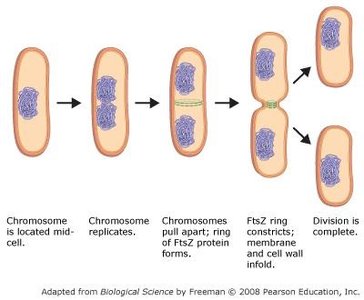
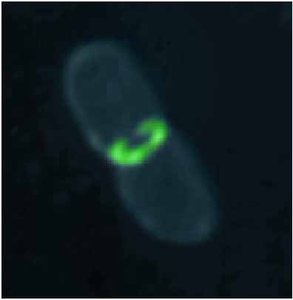
Alternative Modes of Bacterial Growth
Budding in Caulobacter
Some bacteria, such as Caulobacter, reproduce by budding, where a new cell develops as a protrusion from the parent cell.
Hypha formation: The parent cell forms a hypha.
Bud development: A new bud forms and receives a copy of the nucleoid.
Swarming cells: Specialized cells with flagella may be produced.
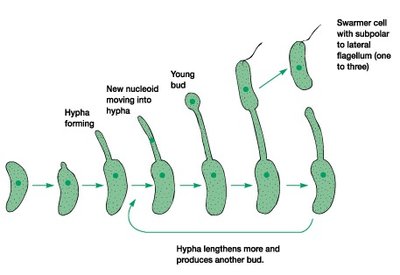
Filamentous Bacteria
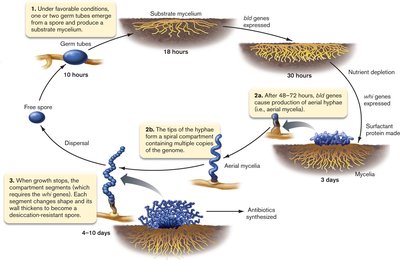
Filamentous bacteria grow in a manner similar to fungi, forming long hyphae and mycelia.
Substrate mycelium: Germ tubes emerge and form substrate mycelium.
Aerial mycelium: Under nutrient depletion, aerial hyphae are produced, often containing multiple genome copies.
Spore formation: Growth segments change shape and form spores for dispersal.
Kinetics of Bacterial Growth
Exponential Growth
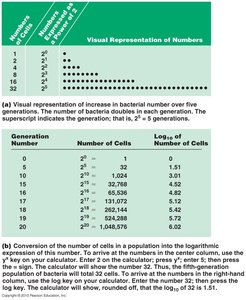
Bacterial populations grow exponentially under optimal conditions, doubling with each generation.
Mathematical model: where is the final cell number, is the initial cell number, and is the number of generations.
Generation time: The time required for a population to double.
Logarithmic Representation
Growth is often represented on a logarithmic scale to simplify calculations and visualize exponential increases. 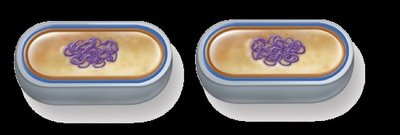
Growth Rate and Generation Time Calculations
Number of generations:
Growth rate:
Generation time:
Bacterial Growth in Laboratory Cultures
Batch Culture
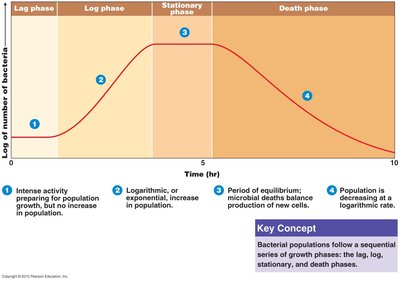
Batch culture is a closed system where nutrients are finite and waste accumulates.
Growth phases: Lag, exponential (log), stationary, and death phases.
Continuous Culture
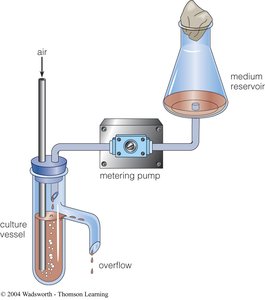
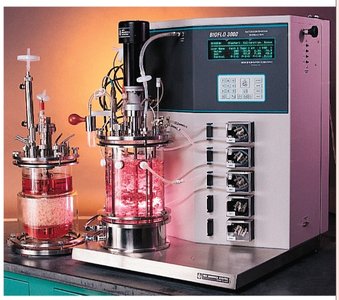
Continuous culture systems, such as chemostats, maintain bacterial populations in a constant state by continuously adding nutrients and removing waste.
Chemostat: Device used to maintain continuous culture.
Constant cell number: Limiting nutrient concentration controls population size.
Environmental Factors Influencing Bacterial Growth
Temperature
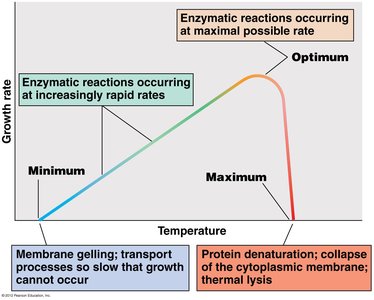
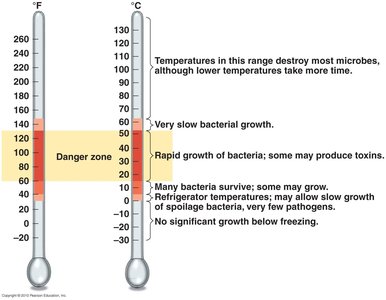
Temperature affects membrane fluidity, enzyme activity, and overall metabolism.
Cardinal temperatures: Minimum, optimum, and maximum temperatures for growth.
Membrane gelling: At low temperatures, membranes become rigid.
Protein denaturation: At high temperatures, proteins lose function.
Classification by Temperature Preference
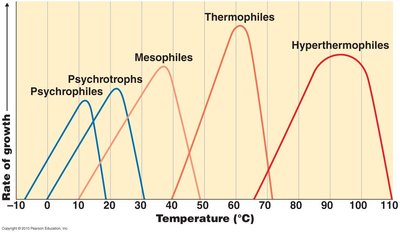
Psychrophiles: Optimal growth at 15°C or lower.
Psychrotrophs: Grow between 0°C and 30°C; cause food spoilage.
Mesophiles: Optimal growth at 32–37°C; most human pathogens.
Thermophiles: Optimal growth at 55°C or higher.
Hyperthermophiles: Optimal growth at 100°C or higher.
Pressure
Barophiles (piezophiles): Grow at very high pressures, often found in deep ocean environments.
Barotolerant: Can tolerate a range of pressures but optimal growth is at lower pressures.
pH
Enzyme activity and membrane stability are influenced by pH.
pH homeostasis: Bacteria regulate internal pH to maintain enzyme function.
Growth ranges: Most bacteria grow between pH 6.5 and 7.5; molds and yeasts between pH 5 and 6.
Alkalophiles: Grow in alkaline environments (e.g., soda lakes).
Acidophiles: Grow in acidic environments (e.g., sulfur springs).
Neutralophiles: Grow at pH 5–8; includes most pathogens.
Osmotic Pressure
Hypertonic environments: Cause plasmolysis due to water loss.
Halophiles: Require high salt concentrations for growth.
Facultative halophiles: Can tolerate high salt but do not require it.
Oxygen Requirements
Obligate aerobes: Require oxygen for growth.
Obligate anaerobes: Killed by oxygen.
Aerotolerant anaerobes: Can tolerate oxygen but do not use it.
Facultative anaerobes: Can grow with or without oxygen.
Microaerophiles: Require low levels of oxygen.
Bacterial Growth in Nature
Biofilms
In natural environments, bacteria often grow in biofilms—complex, polysaccharide-encased communities.
Architecture: Biofilms have channels for nutrient and waste transport.
Quorum sensing: Bacteria communicate via chemical signals to coordinate group behaviors.
Protection: Biofilms protect bacteria from environmental stresses, antibiotics, and immune responses.
Implications: Biofilms are involved in dental plaque, chronic infections, and industrial fouling, but also play roles in bioremediation and wastewater treatment.
Medical Implications of Biofilms
Infectious biofilms: Can form on medical devices, heart valves, and in the lungs of cystic fibrosis patients.
Resistance: Biofilms are highly resistant to antibiotics and host defenses.
Summary Table: Environmental Factors Affecting Microbial Growth
Factor | Effect | Microbial Adaptation |
|---|---|---|
Temperature | Membrane fluidity, enzyme activity | Psychrophiles, mesophiles, thermophiles |
Pressure | Cell structure stability | Barophiles, barotolerant |
pH | Enzyme function, membrane stability | Acidophiles, alkalophiles, neutralophiles |
Osmotic Pressure | Water balance | Halophiles, facultative halophiles |
Oxygen | Metabolic pathways | Obligate aerobes/anaerobes, facultative anaerobes, microaerophiles |
Key Equations
Exponential growth:
Number of generations:
Growth rate:
Generation time:
