Back
BackMicrobial Growth: Nutrition, Environmental Factors, and Measurement
Study Guide - Smart Notes
 Tailored notes based on your materials, expanded with key definitions, examples, and context.
Microbial Growth
Introduction to Nutrition
Nutrition is the process by which chemical substances, known as nutrients , are acquired from the environment and used for cellular activities. Microorganisms require essential nutrients, which must be provided externally as they cannot synthesize them.
Macronutrients: Required in large quantities; play principal roles in cell structure and metabolism (e.g., proteins, carbohydrates).
Micronutrients (Trace Elements): Required in small amounts; involved in enzyme function and maintenance of protein structure (e.g., manganese, zinc, nickel).
Definition of Microbial Growth
Microbial growth refers to an increase in cell number, not cell size. Populations of bacteria can increase rapidly, forming colonies containing billions of cells. The primary method of bacterial growth is binary fission, with typical generation times of 20–30 minutes. 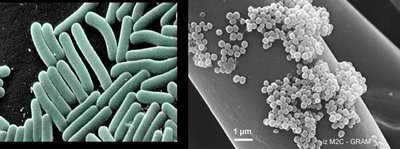
Binary Fission in Bacteria
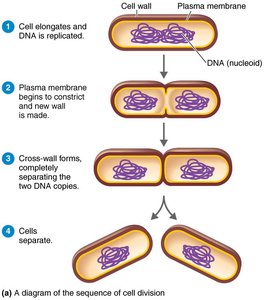
Binary fission is the process by which bacteria reproduce, resulting in two identical daughter cells.
Step 1: Cell elongates and DNA is replicated.
Step 2: Plasma membrane begins to constrict and new cell wall is made.
Step 3: Cross-wall forms, completely separating the two DNA copies.
Step 4: Cells separate.
Bacterial Growth Rates
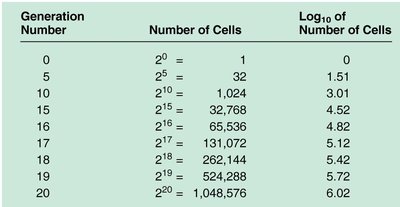
The time required for a complete fission cycle is called the generation time or doubling time. Each cycle increases the population by a factor of 2, resulting in exponential (logarithmic) growth.
Equation for population size: Where is the final number of cells, is the initial number of cells, and is the number of generations.
Bacterial Growth Curve
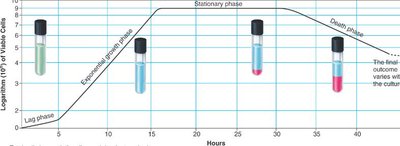
Bacterial populations follow a characteristic growth curve with four phases:
Lag phase: Cells adjust to environment; no significant increase in cell number.
Log (Exponential) phase: Rapid cell division; population increases exponentially.
Stationary phase: Growth rate slows; nutrients deplete, waste accumulates.
Death phase: Cell death exceeds cell division; population declines.
Measuring Bacterial Growth
Direct Count
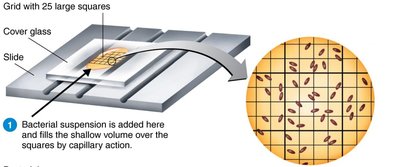
Direct counting methods involve physically counting cells.
Counting chamber: A slide with a grid is used to count cells under a microscope.
Viable Count
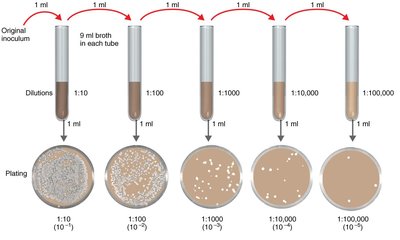
Viable counting methods estimate the number of living cells.
Plate count method: Serial dilutions are plated, and colonies are counted.
Filtration: Cells are filtered and then cultured on agar plates.
Indirect Count
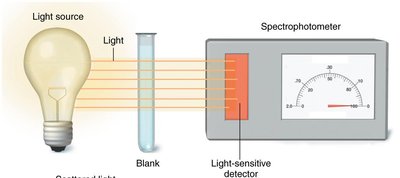
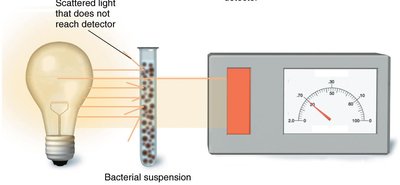
Indirect methods estimate cell numbers based on turbidity (cloudiness) of a culture, measured by a spectrophotometer.
Spectrophotometer: Measures the amount of light absorbed or scattered by a bacterial suspension.
Environmental Factors Affecting Microbial Growth
Temperature
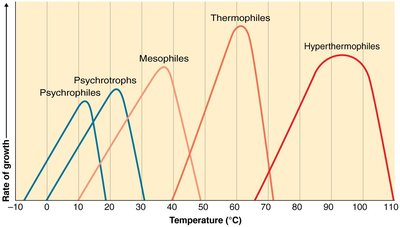
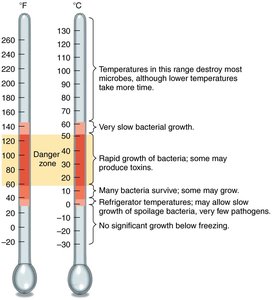
Microorganisms are classified based on their preferred temperature ranges:
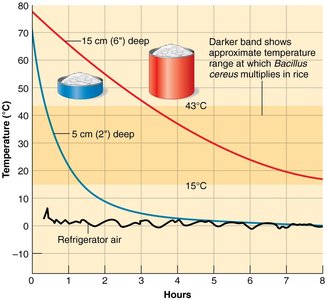
Psychrophiles: Prefer -5 to 15°C
Psychrotrophs: Prefer 20 to 30°C, can grow in refrigerators
Mesophiles: Prefer 25 to 40°C
Thermophiles: Prefer 50 to 60°C
Hyperthermophiles: Prefer >80°C
pH Requirements
Microorganisms vary in their pH preferences:
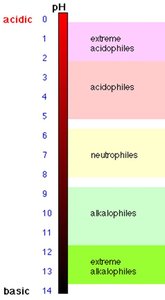
Neutrophiles: Grow best at neutral pH (6–8)
Acidophiles: Prefer acidic environments (pH < 6)
Alkalophiles: Prefer alkaline environments (pH > 8)
Osmotic Pressure
Osmotic pressure is influenced by dissolved solutes such as salts and sugars.
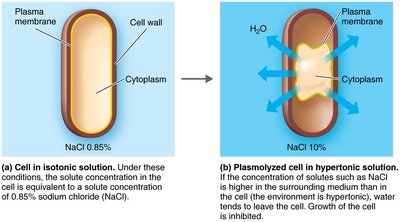
Hypertonic: Higher solute concentration outside the cell; water leaves the cell, causing plasmolysis.
Hypotonic: Lower solute concentration outside the cell; water enters the cell.
Isotonic: Equal solute concentration inside and outside the cell.
Bacteria and Osmotic Pressure
Extreme halophiles: Require high salt concentrations.
Facultative halophiles: Can tolerate high salt but do not require it.
Energy and Carbon Sources
Chemotrophs: Gain energy from chemical compounds.
Phototrophs: Gain energy through photosynthesis.
Heterotrophs: Obtain carbon in organic form from other organisms.
Autotrophs: Use CO2 as carbon source; not nutritionally dependent on other living things.
Nitrogen, Sulfur, and Phosphorus
Nitrogen: Obtained from proteins, ammonium ions (NH4+), nitrites (NO3-), or atmospheric N2 (nitrogen-fixing bacteria).
Sulfur: Most bacteria decompose protein for sulfur.
Phosphorus: Obtained from phosphate.
Organic Growth Factors
Organic growth factors are compounds required for growth that must be obtained from the environment.
Examples: Vitamins, amino acids
Fastidious bacteria: Require many growth factors
Trace Elements
Trace elements are needed in small amounts and include iron, copper, and zinc.
Oxygen Requirements and Detoxification
Toxic Derivatives of Oxygen
Oxygen can form toxic derivatives that must be detoxified by enzymes:
Superoxide dismutase (SOD): Removes superoxide radicals. Reaction:
Catalase: Removes hydrogen peroxide. Reaction:
Peroxidase: Removes hydrogen peroxide. Reaction:
Categories of Oxygen Requirements
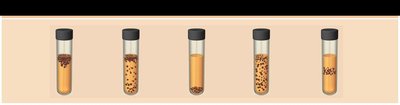
Obligate (strict) aerobe: Requires oxygen
Obligate (strict) anaerobe: Cannot tolerate oxygen
Facultative anaerobe: Can grow with or without oxygen
Aerotolerant anaerobe: Tolerates oxygen but does not use it
Microaerophile: Requires low levels of oxygen
Providing Appropriate Oxygen Conditions
Carbon dioxide incubators: Control CO2 levels, simulating human body conditions.
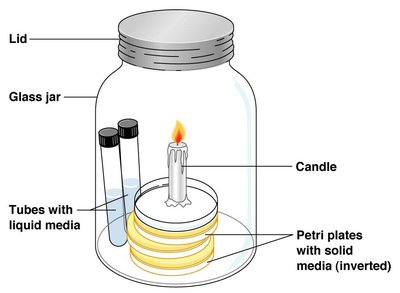
Candle jar: Burning candle uses O2 and produces CO2.
Reducing media: Used for cultivation of anaerobes.
Cultivation of Anaerobes
Anaerobic growth chambers and incubators replace oxygen with nitrogen gas or use media such as thioglycollate broth. 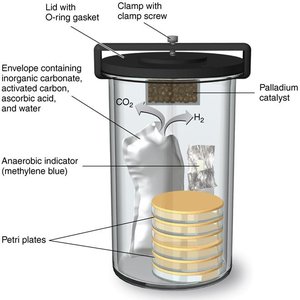
Cultivation of Microaerophiles
Microaerophiles are cultivated using candle jars or CO2 incubators, which create environments with reduced oxygen and increased carbon dioxide.