 Back
Microbial Growth: Nutrition, Environmental Factors, and Measurement
Study Guide - Smart Notes
 Tailored notes based on your materials, expanded with key definitions, examples, and context.
Microbial Growth
Introduction to Nutrition
Microbial growth refers to the increase in the number of cells in a population, not the size of individual cells. Microorganisms require nutrients from their environment to support cellular activities and growth. These nutrients are classified based on the quantity required and their role in cellular processes.
Macronutrients: Required in large amounts; essential for cell structure and metabolism (e.g., proteins, carbohydrates).
Micronutrients (Trace Elements): Needed in small amounts; important for enzyme function and protein structure (e.g., manganese, zinc, nickel).
Essential Nutrients: Must be provided to an organism because it cannot synthesize them.
Microbial populations can increase rapidly, often doubling every 20–30 minutes under optimal conditions. The primary method of growth in bacteria is binary fission.
Definition of Microbial Growth
Microbial growth is defined as an increase in the number of cells in a population. Bacterial colonies can contain billions of cells due to rapid population doubling through binary fission.
Binary Fission and Bacterial Growth Rates
Binary Fission
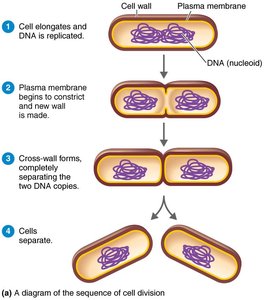
Binary fission is the process by which most bacteria reproduce. The cell elongates, replicates its DNA, and divides into two genetically identical daughter cells.
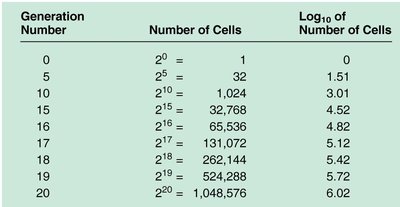
Generation Time: The time required for a population to double in number. Typical generation time for bacteria is about 20 minutes.
Exponential (Logarithmic) Growth: Each fission cycle doubles the population, leading to rapid increases in cell numbers.
Equation for Population Growth
The number of cells in a population after a certain number of generations can be calculated using the following equation:
Nf: Final number of cells
Ni: Initial number of cells
n: Number of generations
Bacterial Growth Curve
Phases of Growth
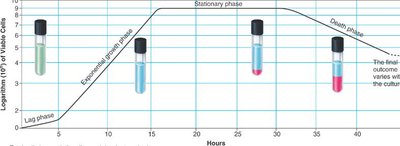
Bacterial populations in a closed system (batch culture) exhibit a characteristic growth curve with four distinct phases:
Lag Phase: Cells adapt to new environment; little or no cell division.
Log (Exponential) Phase: Rapid cell division; population doubles at a constant rate.
Stationary Phase: Growth rate slows; number of new cells equals number of dying cells due to nutrient depletion and waste accumulation.
Death Phase: Number of dying cells exceeds new cells formed; population declines.
Measuring Bacterial Growth
Direct Count
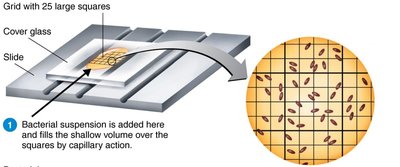
Direct counting methods involve physically counting cells using specialized equipment.
Counting Chamber: A slide with a grid used to count cells under a microscope.
Viable Count
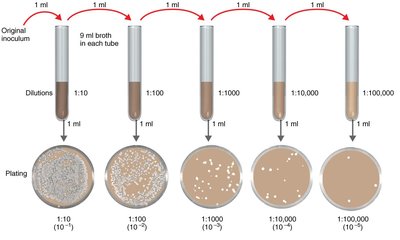
Viable count methods estimate the number of living cells capable of forming colonies.
Plate Count Method: Serial dilutions of a sample are plated on agar; colonies are counted to estimate cell number.
Filtration: Used for samples with low bacterial numbers; bacteria are trapped on a filter, then transferred to agar for colony counting.
Indirect Count
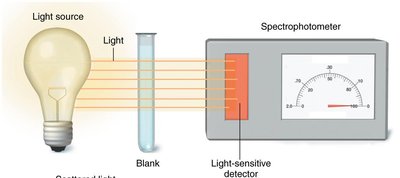
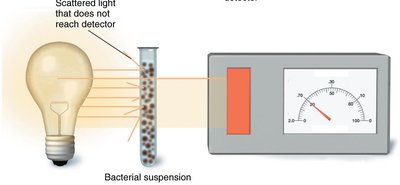
Indirect methods estimate cell density by measuring turbidity (cloudiness) of a culture using a spectrophotometer.
Spectrophotometer: Measures the amount of light scattered by a bacterial suspension; higher turbidity indicates more cells.
Environmental Factors Affecting Microbial Growth
Temperature
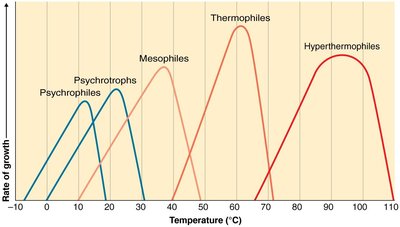
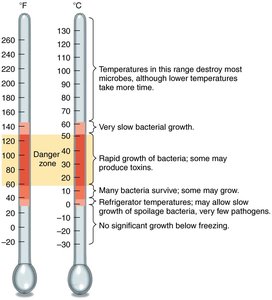
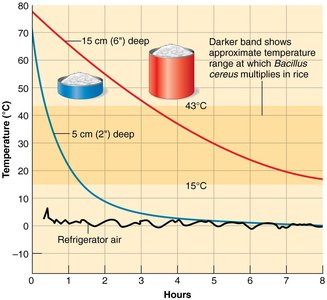
Microorganisms have specific temperature ranges for growth, classified as follows:
Psychrophiles: Grow best at -5 to 15°C
Psychrotrophs: Grow at 20–30°C, but can grow in refrigerators
Mesophiles: Grow at 25–40°C (most human pathogens)
Thermophiles: Grow at 50–60°C
Hyperthermophiles: Grow above 80°C
pH Requirements
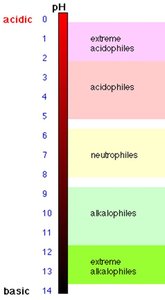
Microorganisms also have specific pH ranges for optimal growth:
Neutrophiles: Grow best at neutral pH (6.5–7.5)
Acidophiles: Prefer acidic environments (pH < 6)
Alkalophiles: Prefer basic environments (pH > 8)
Osmotic Pressure
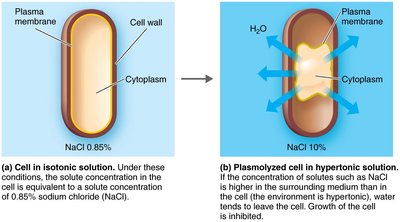
Osmotic pressure affects microbial cells due to the movement of water across the cell membrane in response to solute concentrations.
Hypertonic Solution: Higher solute concentration outside the cell; water leaves the cell, causing plasmolysis.
Hypotonic Solution: Lower solute concentration outside; water enters the cell.
Isotonic Solution: Equal solute concentration inside and outside the cell.
Halophiles: Organisms that thrive in high salt concentrations.
Nutritional Requirements for Microbial Growth
Sources of Energy and Carbon
Chemotrophs: Obtain energy from chemical compounds.
Phototrophs: Obtain energy from light via photosynthesis.
Heterotrophs: Require organic carbon sources from other organisms.
Autotrophs: Use CO2 as their carbon source.
Nitrogen, Sulfur, and Phosphorus
Nitrogen: Obtained from proteins, ammonium ions (NH4+), nitrites (NO3-), or nitrogen fixation from atmospheric N2.
Sulfur: Sourced from protein decomposition or inorganic compounds.
Phosphorus: Provided as phosphate (PO43-).
Trace Elements and Organic Growth Factors
Trace Elements: Required in small amounts (e.g., iron, copper, zinc).
Organic Growth Factors: Compounds such as vitamins and amino acids that must be obtained from the environment. Fastidious bacteria require many growth factors.
Oxygen Requirements and Detoxification
Toxic Derivatives of Oxygen
Oxygen can form toxic derivatives that must be detoxified by enzymes:
Superoxide Dismutase (SOD): Converts superoxide radicals to hydrogen peroxide and oxygen.
Catalase: Converts hydrogen peroxide to water and oxygen.
Peroxidase: Converts hydrogen peroxide to water.
Key reactions:
(SOD)
(Catalase)
(Peroxidase)
Categories of Oxygen Requirements
Obligate Aerobes: Require oxygen for growth.
Obligate Anaerobes: Cannot tolerate oxygen.
Facultative Anaerobes: Can grow with or without oxygen.
Aerotolerant Anaerobes: Tolerate oxygen but do not use it.
Microaerophiles: Require low levels of oxygen.
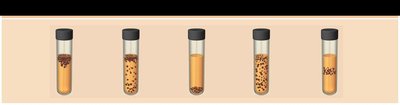
Providing Appropriate Oxygen Conditions
Methods for Cultivating Anaerobes and Microaerophiles
CO2 Incubators: Control CO2 levels to mimic body conditions.
Candle Jar: Burning candle reduces O2 and increases CO2 in a sealed jar.
Anaerobic Growth Chamber: Removes oxygen using chemical reactions (e.g., hydrogen and palladium catalyst).
Anaerobic Media: Thioglycollate broth reduces oxygen for anaerobic growth.
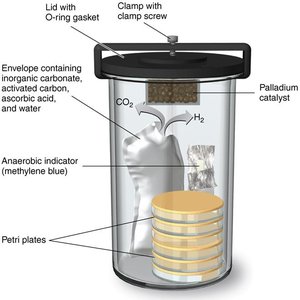
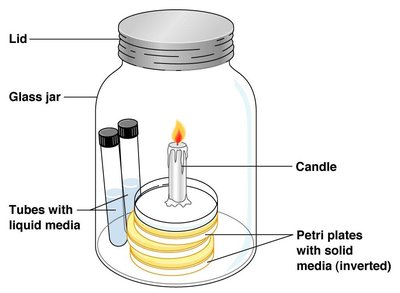
Additional info: These methods are essential for cultivating bacteria with specific oxygen requirements, such as obligate anaerobes and microaerophiles, which cannot grow in atmospheric oxygen levels.
