 Back
BackMicrobial Growth: Physical and Chemical Requirements, Culture Methods, and Growth Measurement
Study Guide - Smart Notes
 Tailored notes based on your materials, expanded with key definitions, examples, and context.
Microbial Growth
Introduction to Microbial Growth
Microbial growth refers to the increase in the number of microbial cells, not the size of individual cells. Understanding the requirements and methods for microbial growth is essential for microbiology, including applications in medicine, food safety, and biotechnology.
Physical Requirements for Microbial Growth
Temperature
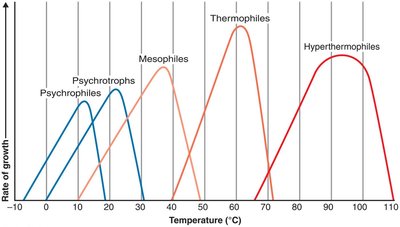
Temperature is a critical factor influencing microbial growth. Microorganisms are classified based on their preferred temperature ranges:
Psychrophiles: Grow at 0°C, optimum at 15°C; found in deep oceans and polar regions.
Psychrotrophs: Grow at 0°C, optimum between 20–30°C; responsible for food spoilage in refrigerators.
Mesophiles: Optimum growth at 25–40°C; includes most human pathogens and normal microbiota.
Thermophiles: Optimum growth at 50–60°C; found in hot springs and compost piles.
Hyperthermophiles: Optimum growth above 80°C; often found in extreme environments like hydrothermal vents.
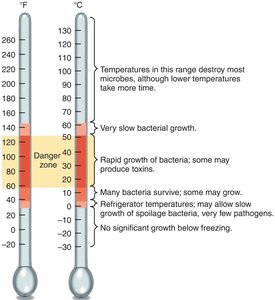
Example: Food safety guidelines are based on the temperature ranges that support rapid bacterial growth and toxin production.
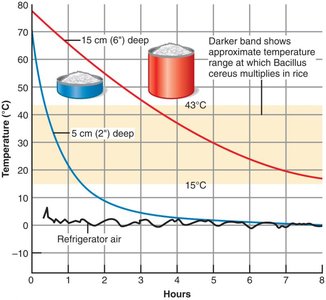
Additional info: Large volumes of food cool more slowly, increasing the risk of bacterial multiplication, such as Bacillus cereus in rice.
pH
Microorganisms have specific pH ranges for optimal growth:
Most bacteria: pH 6.5–7.5
Molds and yeasts: pH 5–6
Acidophiles: Grow in acidic environments
Buffers are often added to laboratory media to maintain stable pH.
Osmotic Pressure
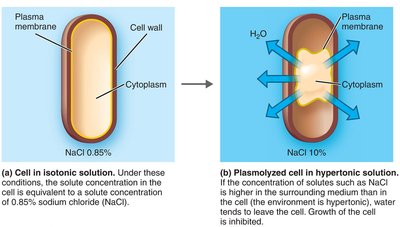
Osmotic pressure affects water movement across cell membranes:
Hypertonic environments (high solute concentration) cause plasmolysis, inhibiting growth.
Extreme or obligate halophiles: Require high salt concentrations (up to 30% NaCl).
Facultative halophiles: Tolerate high salt (2–10% NaCl).
Chemical Requirements for Microbial Growth
Major Elements
Carbon: Backbone of organic molecules; chemoheterotrophs use organic carbon, autotrophs use CO2.
Nitrogen: Needed for proteins, DNA, ATP; obtained from protein decomposition, NH4+, NO3-, or nitrogen fixation.
Sulfur: Found in amino acids, thiamine, biotin; sourced from proteins, SO42-, or H2S.
Phosphorus: Component of DNA, RNA, ATP, and membranes; supplied as PO43-.
Trace Elements
Trace elements such as iron, copper, molybdenum, and zinc are required in small amounts, mainly as enzyme cofactors.
Oxygen Requirements
Microorganisms vary in their oxygen requirements:
Obligate aerobes: Require oxygen.
Facultative anaerobes: Grow with or without oxygen (better with oxygen).
Obligate anaerobes: Cannot tolerate oxygen.
Aerotolerant anaerobes: Tolerate but do not use oxygen.
Microaerophiles: Require low oxygen concentrations.
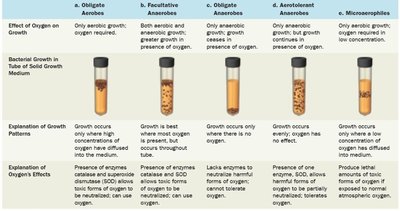
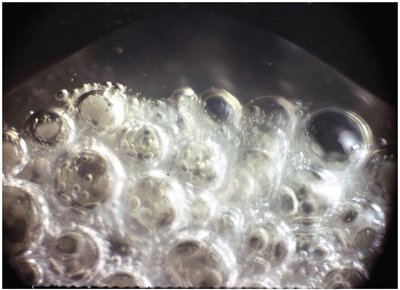
Toxic forms of oxygen (e.g., superoxide radicals, peroxide anion, hydroxyl radical) are neutralized by enzymes such as superoxide dismutase (SOD), catalase, and peroxidase:
Organic Growth Factors
These are essential organic compounds that microbes cannot synthesize, such as vitamins, amino acids, purines, and pyrimidines.
Biofilms
Formation and Significance
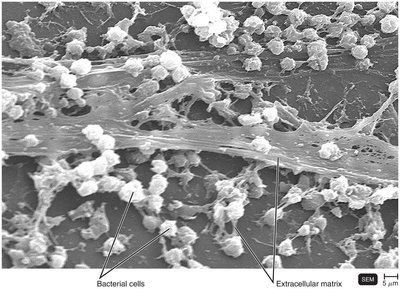
Biofilms are complex microbial communities that adhere to surfaces and are embedded in a self-produced matrix. They communicate via quorum sensing and share nutrients, providing protection from environmental threats.
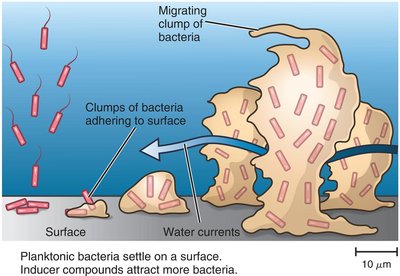
Biofilms are found in natural and artificial environments, including medical devices, and are highly resistant to antimicrobial agents.
Culture Media and Techniques
Types of Culture Media
Chemically defined media: Exact chemical composition is known; used for fastidious organisms.
Complex media: Contains extracts (yeast, meat, plants); composition varies.
Agar: Solidifying agent, not metabolized by microbes; melts at 100°C, solidifies at ~40°C.
Special Media and Methods
Reducing media: For anaerobes; contains chemicals to remove oxygen.
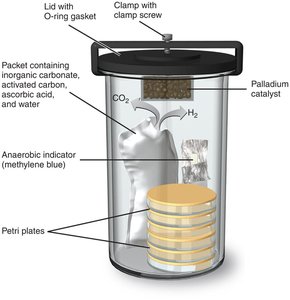
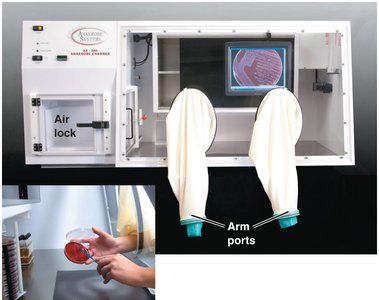
Selective media: Suppress unwanted microbes, encourage desired ones (e.g., bismuth sulfite agar for Salmonella Typhi).
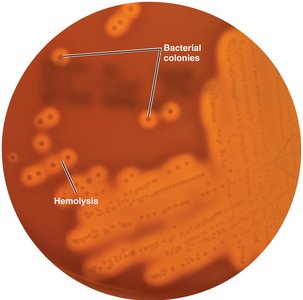
Differential media: Distinguish colonies of different microbes (e.g., blood agar for hemolysis).
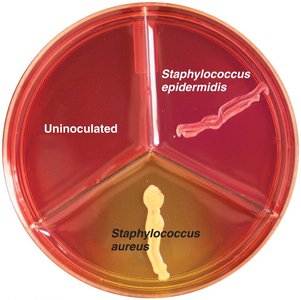
Enrichment culture: Increases numbers of desired microbes to detectable levels.
Biosafety Levels
BSL-1: Basic teaching labs, no special precautions.
BSL-2: Lab coat, gloves, eye protection.
BSL-3: Biosafety cabinets, negative pressure, air filters.
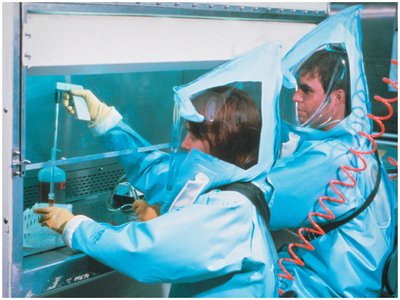
BSL-4: Sealed, negative pressure, "space suits," double HEPA filtration.
Obtaining and Preserving Pure Cultures
Isolation Techniques
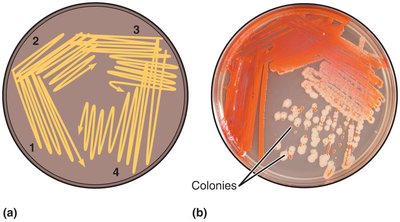
A pure culture contains only one species or strain. The streak plate method is commonly used to isolate pure cultures.
Preservation Methods
Deep-freezing: -50°C to -95°C
Lyophilization (freeze-drying): Frozen at -54°C to -72°C and dehydrated in a vacuum
Bacterial Division and Growth
Binary Fission
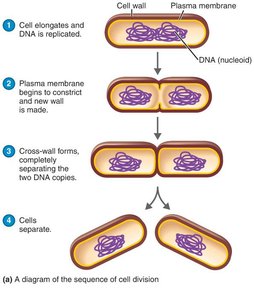
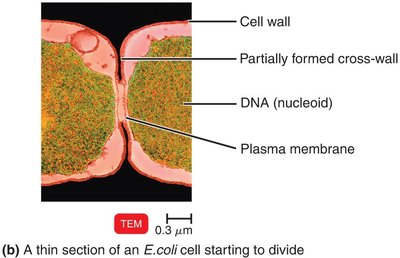
Bacteria typically reproduce by binary fission, resulting in exponential population growth. Other methods include budding and fragmentation.
Generation Time and Growth Curves
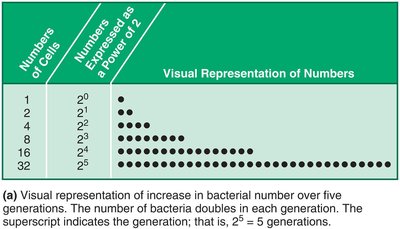
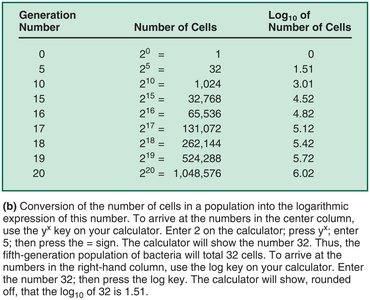
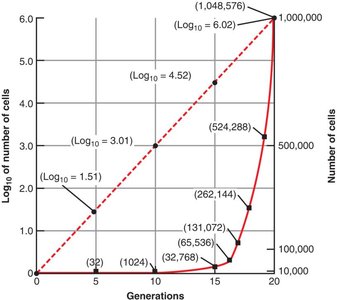
The generation time is the time required for a cell to divide, typically 20 minutes to 24 hours. The number of cells doubles each generation:
Formula:
Where = final number of cells, = initial number of cells, = number of generations
Phases of Bacterial Growth
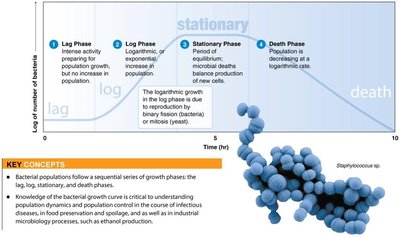
Lag phase: Intense metabolic activity, no increase in cell number.
Log (exponential) phase: Rapid cell division, population doubles at constant rate.
Stationary phase: Growth rate slows, deaths balance new cells, nutrients deplete, wastes accumulate.
Death phase: Deaths exceed new cells, population declines logarithmically.

Measuring Microbial Growth
Direct Measurement Methods
Plate count: Counts colonies (30–300 CFUs) after serial dilution and plating (pour or spread plate methods).
Filtration: Bacteria collected on a filter, then cultured on nutrient media.
Most Probable Number (MPN): Statistical estimation using multiple tube tests.
Direct microscopic count: Uses a Petroff-Hausser cell counter to count cells in a defined volume.
Indirect Measurement Methods
Turbidity: Measures cloudiness with a spectrophotometer; proportional to cell density.
Metabolic activity: Amount of metabolic product correlates with cell number.
Dry weight: Cells are filtered, dried, and weighed; useful for filamentous organisms.
