 Back
BackMicrobial Growth: Physical and Chemical Requirements, Culture Techniques, and Quantitative Aspects
Study Guide - Smart Notes
 Tailored notes based on your materials, expanded with key definitions, examples, and context.
Microbial Growth
Physical Requirements for Growth
Microbial growth is influenced by several physical factors, including temperature, pH, and osmotic pressure. These factors affect cellular structures and metabolic processes, determining where and how microorganisms can thrive.
Temperature: Affects membrane fluidity and protein stability. High temperatures can cause protein denaturation and membrane lysis, while low temperatures slow metabolism and decrease membrane fluidity.
Cardinal Temperatures:
Minimum temperature: Lowest temperature permitting growth.
Optimum temperature: Temperature with the shortest generation time.
Maximum temperature: Highest temperature permitting growth.
Temperature Classes of Organisms:
Psychrophiles: Optimal growth below 0°C to 20°C; have unsaturated fatty acids for membrane fluidity.
Mesophiles: Optimal growth between 20-40°C; includes most human-associated microbes.
Thermophiles: Optimal growth at 45°C or above; possess heat-stable proteins and saturated fatty acids.
Hyperthermophiles: Optimal growth at 80°C or above; found in extreme environments like hydrothermal vents.
pH: Microbes grow within 2-3 pH units of their optimum.
Alkaliphiles: Grow best at pH > 8; found in soda lakes.
Acidophiles: Grow best at pH < 5.5; membranes adapted to low pH.
Neutrophiles: Grow best at pH 5.5-8.
Osmotic Pressure:
Nonhalophiles: Do not tolerate high osmotic pressure (e.g., Escherichia coli).
Halotolerant: Tolerate some solutes; grow best without them (e.g., Staphylococcus aureus).
Halophiles: Grow best with ≈5% NaCl (e.g., Aliivibrio fischeri).
Extreme halophiles: Require >10% NaCl (e.g., Halobacterium salinarum).
Example: Halotolerant bacteria like Staphylococcus aureus can survive on human skin, which is a salty environment.
Chemical Requirements for Growth
Microorganisms require various elements for biosynthesis and metabolism. These include macronutrients and trace elements.
Macronutrients:
Carbon: Needed for nucleic acids, amino acids, carbohydrates, and lipids.
Nitrogen: Required for nucleic acids and proteins.
Phosphorus: Essential for nucleic acids, phospholipids, and protein phosphorylation.
Sulfur: Found in amino acids like cysteine and methionine.
Trace Elements:
Iron: Component of cytochromes in the electron transport chain.
Oxygen Requirements
The oxygen requirement of a microorganism is linked to its metabolism and ability to detoxify reactive oxygen species (ROS).
ROS (Reactive Oxygen Species): Include superoxide (O2-) and hydrogen peroxide (H2O2), detoxified by enzymes such as superoxide dismutase (SOD), catalase, and peroxidase.
Major Bacterial Classes:
Obligate Aerobes: Require oxygen; have many detoxifying enzymes.
Microaerophiles: Require low oxygen; have detoxifying enzymes.
Facultative Anaerobes: Grow better with oxygen but can ferment or respire anaerobically; have detoxifying enzymes.
Aerotolerant Anaerobes: Not affected by oxygen; ferment; have few detoxifying enzymes.
Obligate Anaerobes: Cannot grow in oxygen; lack detoxifying enzymes.
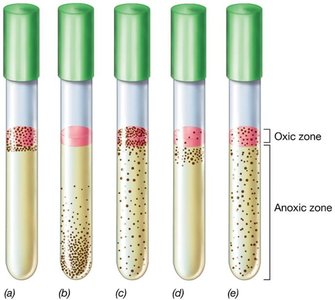
Example: Growth patterns in thioglycolate medium can distinguish these classes based on where bacteria grow in the tube (oxic vs. anoxic zones).
Culture Techniques and Media
Culture Media Types and Definitions
Microbiologists use various media to cultivate and study microorganisms. The choice of medium depends on the nutritional requirements of the organism and the experimental goal.
Chemically Defined Media: Exact chemical composition is known.
Complex Media: Contains extracts and digests of yeasts, meat, or plants; composition varies.
Agar: Solidifying agent; not metabolized by most microbes.
Selective Media: Suppress unwanted microbes and encourage desired ones (e.g., MSA selects for staphylococci).
Differential Media: Distinguish colonies of different microbes (e.g., MSA differentiates based on mannitol fermentation using phenol red indicator).
Enriched Media: Contains additional nutrients for fastidious organisms.
Blood Agar: Both enriched and differential; detects hemolysins.
Thioglycolate Medium: Used to test oxygen requirements.
Definitions:
Culture medium: Nutrient material for microbial growth.
Sterile: Free of living microbes.
Inoculum: Introduction of microbes into medium.
Culture: Microbes growing in/on medium.
Fastidious organisms: Require many growth factors; grow only on enriched media.
Colonies and Pure Cultures
Obtaining pure cultures is essential for studying microbial physiology and genetics.
Pure Culture: Population of cells derived from a single cell.
Bacterial Colony: Visible mass of cells on solid medium.
Colony Forming Units (CFU): Used to quantify viable cells; each CFU arises from one or a group of cells.
Streak Method: Used to isolate pure cultures by spreading cells over the surface of agar.
Bacterial Growth and Quantitative Aspects
Cell Division and Population Growth
Bacteria typically reproduce by binary fission, resulting in exponential population growth under optimal conditions.
Binary Fission: Cell divides into two equal daughter cells.
Septum: Partition formed during cell division.
Types of Cell Division:
Equal products: Most bacteria.
Unequal products: Polar growth, such as budding.
Generation Time (G): Time required for a population to double. Varies by species and conditions (e.g., E. coli: ~20 min; Mycobacterium tuberculosis: 16-24 hrs).
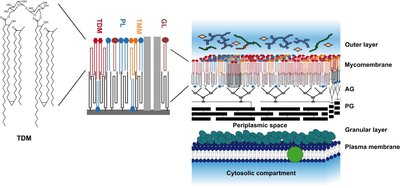
Additional info: The mycomembrane in Mycobacterium tuberculosis contains mycolic acids, contributing to slow growth and resistance to chemicals.
Exponential Growth and Equations
Bacterial populations grow exponentially under optimal conditions. The following equations describe this growth:
Number of cells after n generations:
Generation time (G):
Number of generations in time t:
Number of cells as a function of time:
Example: If a culture grows from 2×10⁶ to 8×10⁶ cells/mL in 1 hour, the generation time can be calculated using the above equations.
Growth Curves and Phases
In batch culture, bacterial growth follows a characteristic curve with distinct phases:
Lag Phase: Cells adapt to new environment; little to no division.
Log (Exponential) Phase: Rapid, constant cell division; optimal conditions.
Stationary Phase: Growth rate slows; nutrient depletion and waste accumulation; division rate equals death rate.
Death Phase: More cells die than divide.
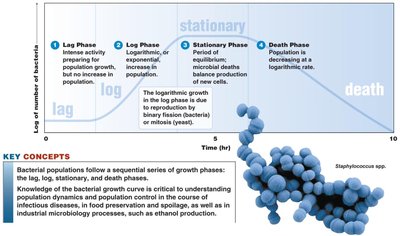
Example: Understanding growth curves is essential for clinical microbiology, food safety, and industrial processes.
Quantifying Bacteria in Samples
Direct Measurement Methods
Plate Count: Counts CFUs; serial dilution may be required for accuracy.
Filtration: Used for low bacterial concentrations; bacteria are trapped on a filter and then cultured.
Most Probable Number (MPN): Statistical estimation based on dilution and growth patterns.
Direct Microscopic Count: Cells counted directly under a microscope.
Indirect Measurement Methods
Turbidity: Measured by absorbance; proportional to cell number.
Metabolic Activity: Enzymatic activity correlates with cell number.
Dry Weight: Biomass is proportional to cell number.
Lifestyle of Microorganisms
Planktonic, Sessile, Biofilms, and Microbial Mats
Microorganisms can exist in different lifestyles, affecting their survival and ecological roles.
Planktonic: Free-floating in suspension.
Sessile: Attached to surfaces; may form biofilms.
Biofilms: Communities of microorganisms attached to surfaces, embedded in a self-produced matrix. Provide protection, nutrient sharing, and resistance to environmental stress.
Microbial Mats: Multilayered sheets of microorganisms, often found in extreme environments like hot springs.
Example: Biofilms are medically significant, contributing to infections on catheters, heart valves, and dental surfaces.
Additional info: Oligotrophic environments are nutrient-poor habitats where biofilm formation can be advantageous for survival.
