 Back
BackMicrobial Growth: Physical and Chemical Requirements, Culture Techniques, and Measurement Methods
Study Guide - Smart Notes
 Tailored notes based on your materials, expanded with key definitions, examples, and context.
Microbial Growth
Physical Requirements for Microbial Growth
Microbial growth is influenced by several physical factors, including temperature, pH, and osmotic pressure. Understanding these requirements is essential for culturing and controlling microorganisms.
Temperature: Microbes are classified based on their preferred temperature ranges:
Psychrophiles: Cold-loving microbes, optimal growth at 15°C or lower.
Mesophiles: Moderate-temperature-loving microbes, optimal growth at 25–40°C. Most human pathogens are mesophiles.
Thermophiles: Heat-loving microbes, optimal growth at 50–60°C.
Hyperthermophiles: Grow above 80°C, often found in oceanic depths.
pH: Most bacteria grow best at a pH between 6.5 and 7.5. Acidophiles thrive at lower pH values.
Osmotic Pressure: High osmotic pressure can cause plasmolysis in most microbes. Halophiles tolerate high salt concentrations.
Example: Sugar is added to jams and jellies to create a hypertonic environment, inhibiting bacterial growth by causing plasmolysis.
Microbial Growth at Different Temperatures
The growth rates of different bacteria at various temperatures can be visualized using growth curves. These curves demonstrate how temperature affects microbial proliferation.
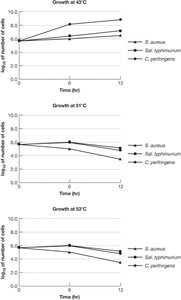
Interpretation: The graphs show that Staphylococcus aureus, Salmonella typhimurium, and Clostridium perfringens have different growth rates at 43°C, 50°C, and 53°C. Growth is optimal at lower temperatures and declines as temperature increases beyond their tolerance.
Chemical Requirements for Microbial Growth
Microorganisms require various chemical elements for growth, which serve as building blocks and energy sources.
Carbon: Essential for synthesizing cellular molecules. Chemoheterotrophs use organic molecules; autotrophs use CO2.
Nitrogen: Needed for proteins and nucleic acids. Sources include protein decomposition, NH4+, NO3-, and nitrogen fixation.
Sulfur: Found in some amino acids and vitamins.
Phosphorus: Component of phospholipids and nucleic acids.
Trace Elements: Required in small amounts for enzyme function.
Organic Growth Factors: Vitamins, amino acids, purines, and pyrimidines.
Example: If bacteria are grown with radioactive sulfur (35S), the isotope will be found in proteins containing sulfur-rich amino acids.
Oxygen Requirements and Toxicity
Microbes are classified by their oxygen requirements:
Obligate aerobes: Require oxygen.
Facultative anaerobes: Can grow with or without oxygen.
Obligate anaerobes: Cannot tolerate oxygen.
Aerotolerant anaerobes: Tolerate oxygen but do not use it.
Microaerophiles: Require low oxygen concentrations.
To avoid damage from toxic oxygen forms, aerobes produce enzymes such as superoxide dismutase, catalase, and peroxidase:
Biofilms
Biofilms are communities of microbes that adhere to surfaces and are embedded in a self-produced matrix. They are common in nature and have significant implications for infection and antibiotic resistance.
Biofilms form on solid surfaces in contact with water.
Microbes in biofilms are more resistant to antibiotics than free-swimming cells.
Biofilm formation is beneficial to pathogens by providing protection and facilitating nutrient acquisition.
Culture Media and Techniques
Microbes are grown in laboratory media, which can be classified as:
Chemically defined media: Exact chemical composition is known.
Complex media: Composition varies slightly from batch to batch.
Selective media: Inhibit unwanted organisms, allowing growth of desired microbes.
Differential media: Distinguish between different organisms based on biochemical reactions.
Enrichment culture: Encourages growth of a particular microorganism in a mixed culture.
Example: EMB agar is both selective (inhibits gram-positive bacteria) and differential (lactose fermenters produce colored colonies).
Obtaining and Preserving Pure Cultures
A pure culture contains only one species or strain. The streak plate method is commonly used to isolate pure cultures. Microbes can be preserved by deep-freezing or lyophilization (freeze-drying).
Bacterial Growth and Division
Bacterial growth refers to an increase in cell number, typically by binary fission. The population doubles every generation, and growth can be represented logarithmically.
Generation time (G): Time required for a cell to divide or a population to double.
Formula: where t = time interval, a = initial cell number, A = final cell number.
Phases of Microbial Growth
Lag phase: Little or no change in cell number; high metabolic activity.
Log phase: Rapid cell division; population increases exponentially.
Stationary phase: Equilibrium between cell division and death.
Death phase: Cell deaths exceed new cell formation.
Measuring Microbial Growth
Microbial growth can be measured by direct and indirect methods:
Direct methods: Plate count, filtration, direct microscopic count, most probable number (MPN).
Indirect methods: Turbidity (spectrophotometry), metabolic activity, dry weight.
Example: Plate counts are preferred for analyzing bacterial growth in food samples because they determine viable cells and are not affected by particles in the sample.
Microbiome and Circadian Rhythms
Microbial growth in the human intestine may vary with sleep patterns, and disruption of these patterns can affect the diversity of the intestinal microbiota. This area is under active research, with implications for health and disease.
Additional info: The notes include references to ASM curriculum guidelines and clinical applications, emphasizing the importance of safe laboratory practices and the relevance of microbial growth to food safety and infection control.
