 Back
BackMicrobial Growth: Physical and Chemical Requirements
Study Guide - Smart Notes
 Tailored notes based on your materials, expanded with key definitions, examples, and context.
Microbial Growth: Physical and Chemical Requirements
Introduction
Microbial growth refers to the increase in the number of cells in a microbial population. Understanding the requirements for microbial growth is essential for microbiology students, as these factors influence the cultivation, control, and study of microorganisms. This section covers the physical and chemical requirements for microbial growth, including temperature, pH, and osmotic pressure. 
The Requirements for Growth
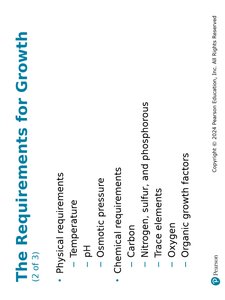
Microorganisms require specific environmental conditions to grow. These requirements are divided into physical and chemical categories.
Physical requirements: Temperature, pH, and osmotic pressure
Chemical requirements: Carbon, nitrogen, sulfur, phosphorus, trace elements, oxygen, and organic growth factors

Physical Requirements
Temperature
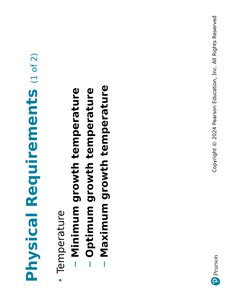
Temperature is a critical factor affecting microbial growth. Each microorganism has a minimum, optimum, and maximum growth temperature.
Minimum growth temperature: Lowest temperature at which growth occurs
Optimum growth temperature: Temperature at which growth rate is highest
Maximum growth temperature: Highest temperature at which growth occurs
Classification by Temperature Preference
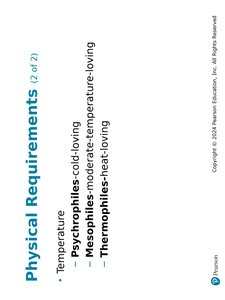
Microorganisms are classified based on their preferred temperature ranges:
Psychrophiles: Cold-loving microbes
Mesophiles: Moderate-temperature-loving microbes
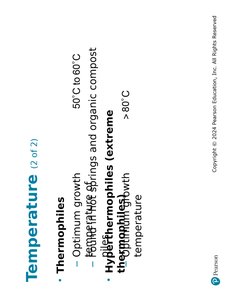
Thermophiles: Heat-loving microbes
Growth Rates and Temperature
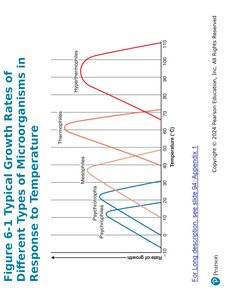
The growth rate of microorganisms varies with temperature. The following table summarizes typical growth rates for different types of microorganisms:
Microbe Type | Optimum Temperature Range (°C) |
|---|---|
Psychrophiles | ~15 |
Psychrotrophs | 20-30 |
Mesophiles | 25-40 |
Thermophiles | 50-60 |
Hyperthermophiles | >80 |
Temperature Details
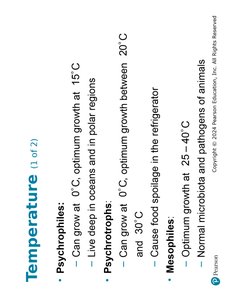
Psychrophiles: Can grow at 0°C, optimum growth at 15°C; live deep in oceans and polar regions
Psychrotrophs: Optimum growth between 20°C and 30°C; cause food spoilage in the refrigerator
Mesophiles: Optimum growth at 25–40°C; normal microbiota and pathogens of animals
Food Safety and Temperature
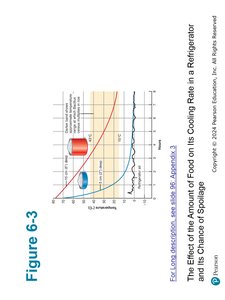
Temperature control is crucial for food safety, as improper cooling can lead to microbial growth and spoilage. 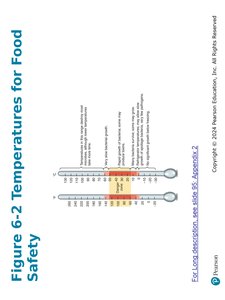
Thermophiles: Optimum growth at 50°C to 60°C; found in hot springs and organic compost
Hyperthermophiles (extreme thermophiles): Optimum growth >80°C; found in deep-sea hydrothermal vents
pH
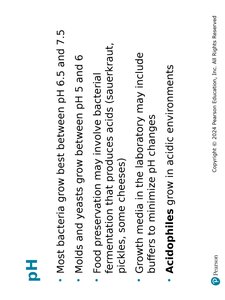
The pH of the environment affects microbial growth. Most bacteria grow best between pH 6.5 and 7.5, while molds and yeasts prefer slightly acidic conditions.
Food preservation: Often involves bacterial fermentation that produces acids (e.g., sauerkraut, pickles, some cheeses)
Laboratory media: Buffers are used to minimize pH changes
Acidophiles: Microbes that grow in acidic environments
Osmotic Pressure
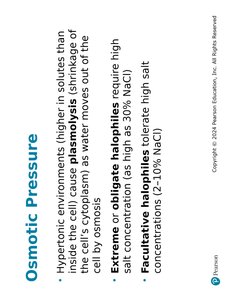
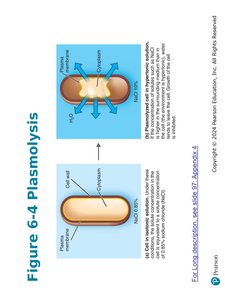
Osmotic pressure refers to the effect of solute concentration on microbial cells. Hypertonic environments cause plasmolysis, where water leaves the cell, leading to shrinkage of the cytoplasm.
Extreme or obligate halophiles: Require high salt concentrations (up to 30% NaCl)
Facultative halophiles: Tolerate high salt concentrations (2–10% NaCl)
Check Your Understanding
Why are hyperthermophiles that grow at 100°C found only in oceanic depths?
Other than controlling acidity, what is an advantage of using phosphate salts as buffers in growth media?
Describe at least one example of modern food-preservation techniques that rely on osmotic pressure.

Example: Serratia marcescens Bacteria
Serratia marcescens is a bacterium that can be studied for its growth requirements and environmental adaptations. 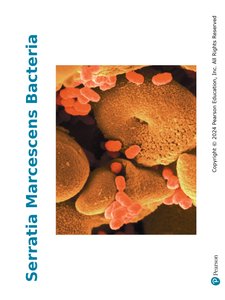
Additional info: Expanded explanations and context were added to ensure completeness and academic quality.
