 Back
Chapter 6: Microbial Growth: Physical and Chemical Requirements, Media, and Growth Dynamics
Study Guide - Smart Notes
 Tailored notes based on your materials, expanded with key definitions, examples, and context.
Microbial Growth: Physical and Chemical Requirements
Introduction
Microbial growth refers to the increase in the number of cells in a population, not the size of individual cells. Understanding the requirements for microbial growth is essential for controlling microbial populations in clinical, industrial, and food settings. This chapter covers the physical and chemical factors influencing microbial growth, types of culture media, and the dynamics of bacterial population growth.
Physical Requirements for Microbial Growth
Temperature
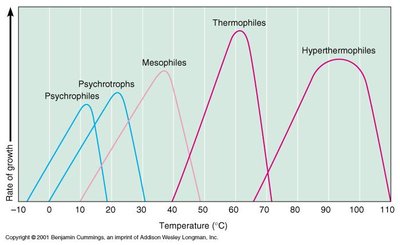
Temperature is a critical factor affecting microbial metabolism and growth. Each microorganism has a minimum, optimum, and maximum temperature for growth, allowing classification based on temperature preference:
Psychrophiles: "Cold-loving" microbes; optimum growth at 15°C, do not grow above 25°C.
Psychrotrophs: Grow at 0°C, optimum 20–30°C, responsible for most food spoilage.
Mesophiles: "Moderate-temperature-loving"; optimum 25–40°C (most pathogens are mesophiles).
Thermophiles: "Heat-loving"; optimum 50–60°C.
Hyperthermophiles: Optimum 80°C or higher; often Archaea.
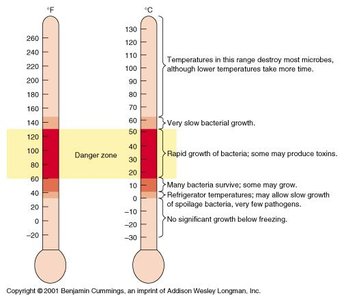
Food Safety Note: The 'danger zone' (15–50°C) is where rapid bacterial growth and toxin production can occur. Proper refrigeration and cooking are essential to prevent foodborne illness.
pH
Most microorganisms grow best near neutrality (pH 6.5–7.5). Pathogens typically thrive at the pH of blood (~7.38). Acidophiles are a small group of microbes that prefer acidic environments (pH < 4). Acidic conditions are used to preserve foods such as cheese, sauerkraut, and pickles.
Osmotic Pressure
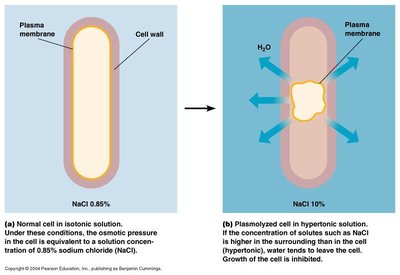
Osmotic pressure is the force required to prevent water movement across a selectively permeable membrane. Microbes are affected by the tonicity of their environment:
Isotonic solution: No net water movement; cell remains stable.
Hypertonic solution: Water leaves the cell, causing plasmolysis (cell shrinkage); used in food preservation with salt or sugar.
Hypotonic solution: Water enters the cell, possibly causing plasmoptysis (cell bursting).
Chemical Requirements for Microbial Growth
Essential Elements
Carbon (C): Backbone of all organic molecules; ~50% of cell mass.
Nitrogen (N): Needed for proteins, DNA, RNA, ATP; sources include proteins, ammonium, nitrate, and nitrogen gas.
Sulfur (S): For amino acids and some vitamins; sources include sulfate, hydrogen sulfide, and amino acids.
Phosphorus (P): For nucleic acids, ATP, and phospholipids; source is phosphate ions.
Trace elements: Iron, copper, zinc, magnesium, etc., act as enzyme cofactors.
Oxygen Requirements
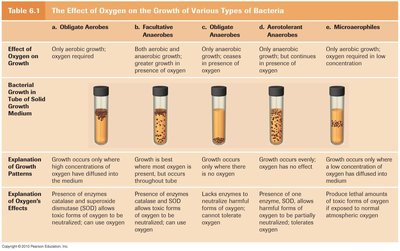
Microorganisms vary in their oxygen requirements, which affects their growth patterns and the enzymes they possess to detoxify reactive oxygen species:
Obligate aerobes: Require oxygen; possess superoxide dismutase (SOD) and catalase/peroxidase.
Facultative anaerobes: Grow with or without oxygen, but better with oxygen.
Obligate anaerobes: Cannot tolerate oxygen; lack SOD and catalase.
Aerotolerant anaerobes: Do not use oxygen but tolerate its presence.
Microaerophiles: Require low oxygen concentrations.
Culture Media
Types of Media
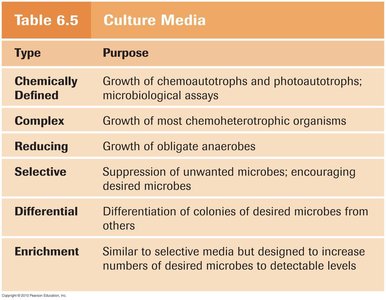
Culture media provide the nutrients and conditions necessary for microbial growth. They are classified based on their composition and purpose:
Type | Purpose |
|---|---|
Chemically Defined | Growth of chemoautotrophs and photoautotrophs; microbiological assays |
Complex | Growth of most chemoheterotrophic organisms |
Reducing | Growth of obligate anaerobes |
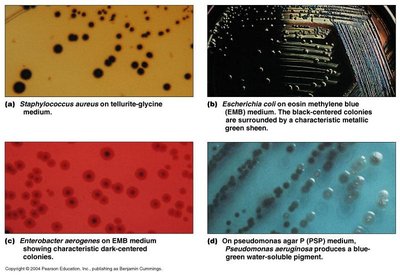
Selective | Suppression of unwanted microbes; encouraging desired microbes |
Differential | Differentiation of colonies of desired microbes from others |
Enrichment | Similar to selective media but designed to increase numbers of desired microbes to detectable levels |
Bacterial Growth and Division
Binary Fission
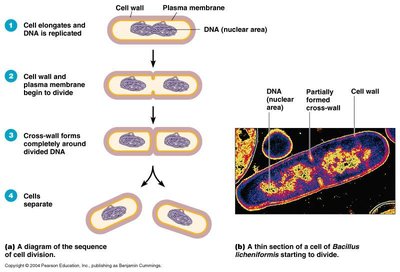
Bacteria typically reproduce by binary fission, a process resulting in two genetically identical daughter cells. The steps include:
DNA replication
Cell wall and plasma membrane begin to divide
Cross wall forms completely around divided DNA
Cells separate
Generation Time
Generation time is the time required for a cell to divide or a population to double. It varies widely among species and environmental conditions. For example, Escherichia coli can divide every 20 minutes under optimal conditions, while Mycobacterium leprae may take 12 days.
Bacterial Growth Curve
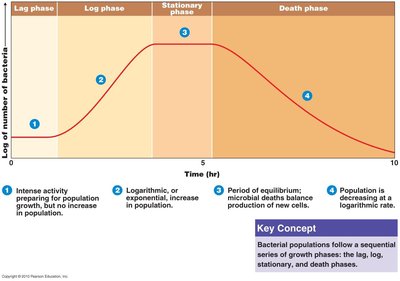
Bacterial populations grow in a characteristic pattern when cultured in a closed system, described by the bacterial growth curve:
Lag phase: Metabolic activity without division; cells adapt to new environment.
Log (Exponential) phase: Rapid cell division; population doubles at a constant rate; cells are most sensitive to adverse conditions.
Stationary phase: Growth rate slows; cell deaths balance new cells; nutrients deplete, waste accumulates.
Death phase: Cell deaths exceed new cells; population declines logarithmically.
Summary
Microbial growth is influenced by physical (temperature, pH, osmotic pressure) and chemical (nutrients, oxygen) factors.
Microbes are classified by their temperature and oxygen requirements.
Culture media are designed to support the growth of specific microbes or to differentiate among them.
Bacterial growth follows a predictable curve with distinct phases, and binary fission is the primary mode of division.
