Back
BackMicrobial Growth: Principles, Environmental Factors, and Laboratory Methods
Study Guide - Smart Notes
 Tailored notes based on your materials, expanded with key definitions, examples, and context.
Microbial Growth
Binary Fission and Cell Division
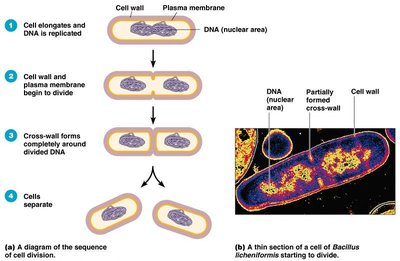
Microbial growth refers to the increase in the number of cells, not cell size. Most bacteria reproduce by binary fission, a process in which one cell divides to form two identical daughter cells. This process is fundamental to bacterial population expansion.
Binary Fission: The cell elongates, DNA is replicated, and a cross-wall forms, dividing the cell into two.
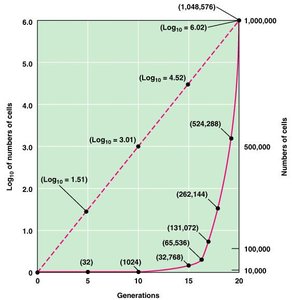
Exponential Growth: Bacterial populations double at regular intervals, following a logarithmic (exponential) progression, described by the formula , where n is the number of generations.
Generation Time: The time required for a cell to divide and its population to double.
Phases of Growth: Includes lag phase, log (exponential) phase, stationary phase, and death phase.
Environmental Factors Affecting Microbial Growth
Temperature Groups
Microorganisms are classified based on their optimum temperature for growth:
Psychrophiles: Grow best at -5°C to 15°C (cold-loving).
Psychrotrophs: Grow at low temperatures but have higher optimums than psychrophiles.
Mesophiles: Grow best at 25°C to 45°C (moderate temperatures; includes most pathogens).
Thermophiles: Grow best at 45°C to 70°C (heat-loving).
Hyperthermophiles: Grow best at 70°C to 110°C (extreme heat).
pH Preferences
Neutrophiles: Optimum pH 5–8 (most bacteria).
Acidophiles: Optimum pH below 5.5 (e.g., bacteria in coal mine drainage).
Alkaliphiles: Optimum pH above 8.5.
Molds and Yeasts: Grow best at pH 5–6.
Osmotic Pressure and Halophiles
Osmotic pressure affects microbial cells due to water movement across the plasma membrane.
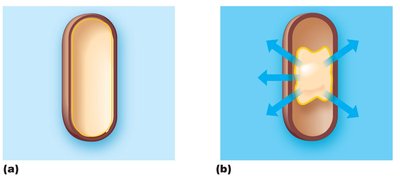
Hypertonic Environments: High salt/sugar causes plasmolysis (cell shrinkage).
Facultative Halophiles: Tolerate high osmotic pressure.
Obligate Halophiles: Require high osmotic pressure for growth.
Chemical Requirements for Microbial Growth
Major Elements
Carbon: Structural component and energy source. Chemoheterotrophs use organic carbon; autotrophs fix CO2.
Nitrogen: Found in amino acids and proteins. Some bacteria fix atmospheric N2.
Sulfur: In amino acids, thiamine, and biotin.
Phosphorus: In DNA, RNA, ATP, and membranes.
Trace Elements: Inorganic elements (e.g., iron, copper, zinc) required in small amounts as enzyme cofactors.
Organic Growth Factors: Compounds like vitamins, amino acids, purines, and pyrimidines that must be obtained from the environment if the organism cannot synthesize them.
Culture Media
Types of Media
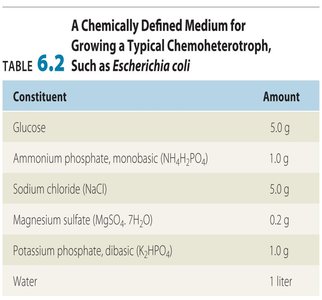
Chemically Defined Media: Exact chemical composition is known. Used for specific growth requirements.
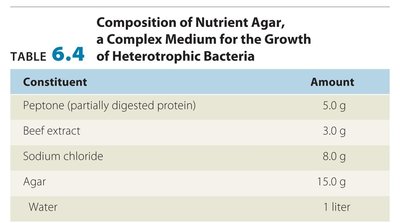
Complex Media: Contains extracts and digests of yeasts, meat, or plants; composition varies.
Agar: A solidifying agent derived from algae, not metabolized by most microbes. Melts at 100°C, solidifies at ~40°C.
Constituent | Amount |
|---|---|
Glucose | 5.0 g |
Ammonium phosphate, monobasic (NH4H2PO4) | 1.0 g |
Sodium chloride (NaCl) | 5.0 g |
Magnesium sulfate (MgSO4·7H2O) | 0.2 g |
Potassium phosphate, dibasic (K2HPO4) | 1.0 g |
Water | 1 liter |
Constituent | Amount |
|---|---|
Peptone (partially digested protein) | 5.0 g |
Beef extract | 3.0 g |
Sodium chloride | 8.0 g |
Agar | 15.0 g |
Water | 1 liter |
Selective, Differential, and Enrichment Media
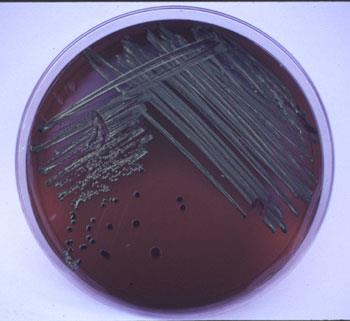
Selective Media: Suppress unwanted microbes and encourage desired microbes (e.g., Mannitol Salt Agar for staphylococci).
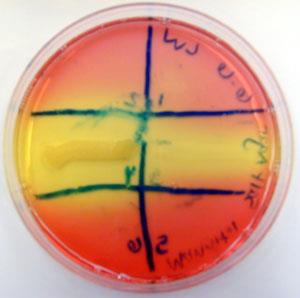
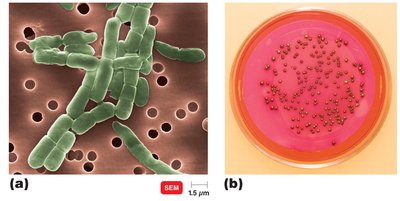
Differential Media: Distinguish colonies of different microbes (e.g., Eosin Methylene Blue Agar for coliforms).
Enrichment Culture: Encourages growth of a particular microorganism from a mixed culture.
Oxygen Requirements
Types of Oxygen Requirements
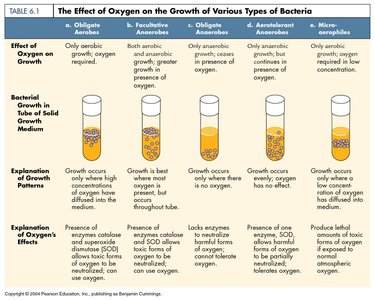
Type | Growth Pattern | Explanation |
|---|---|---|
Obligate Aerobes | Only aerobic growth; oxygen required | Growth occurs only where high concentrations of oxygen have diffused into the medium |
Facultative Anaerobes | Both aerobic and anaerobic growth; greater growth in presence of oxygen | Growth is best where most oxygen is present, but occurs throughout tube |
Obligate Anaerobes | Only anaerobic growth; ceases in presence of oxygen | Growth occurs only where there is no oxygen |
Aerotolerant Anaerobes | Only anaerobic growth; but continues in presence of oxygen | Growth occurs evenly; oxygen has no effect |
Microaerophiles | Only aerobic growth; oxygen required in low concentration | Growth occurs only where a low concentration of oxygen has diffused into medium |
Toxic Forms of Oxygen
Singlet Oxygen (1O2*): Highly reactive form of oxygen.
Superoxide Free Radicals (O2−): Detoxified by superoxide dismutase.
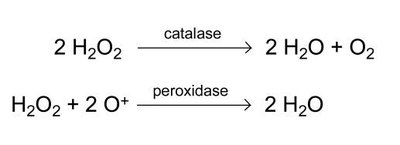
Peroxide Anion (O22−): Detoxified by catalase and peroxidase.
Hydroxyl Radical (OH•): Highly reactive and damaging.
Key detoxification reactions:
Anaerobic Culture Methods
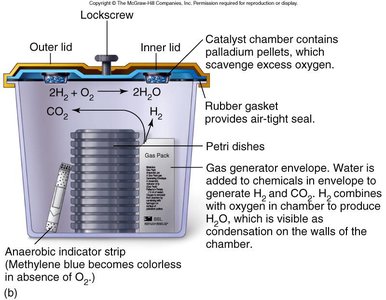
Reducing Media: Contains chemicals that remove oxygen (e.g., sodium thioglycollate).
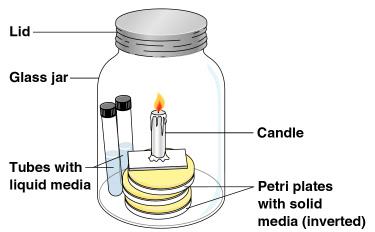
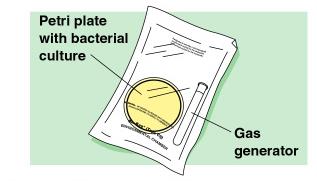
Anaerobic Jars and Chambers: Used to cultivate obligate anaerobes by removing oxygen from the environment.
Capnophiles
Capnophiles are microorganisms that require elevated CO2 concentrations for optimal growth, resembling conditions found in the intestinal and respiratory tracts.
Biofilms
Formation and Importance
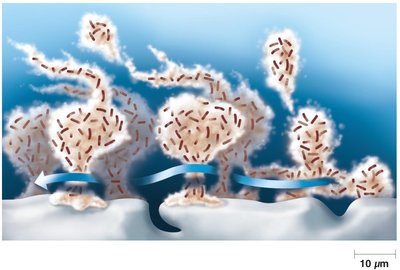
Biofilms are structured communities of microorganisms attached to a surface and embedded in a self-produced extracellular polymeric substance (EPS) matrix. They are important in both environmental and clinical contexts.
Formation: Begins with reversible attachment, followed by irreversible attachment using fimbriae, and development of EPS matrix.
Quorum Sensing: Bacteria communicate to coordinate activity based on population density.
Benefits: Useful in sewage treatment and as a defense against pathogens.
Harms: Can cause infections on medical devices and contribute to dental and inflammatory diseases.
Biosafety Levels
BSL-1: No special precautions.
BSL-2: Lab coat, gloves, eye protection.
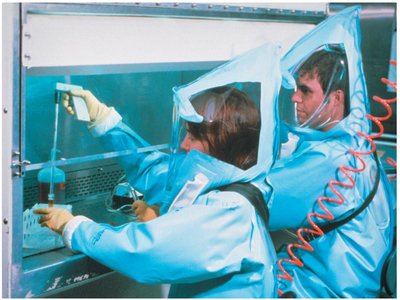
BSL-3: Biosafety cabinets to prevent airborne transmission.
BSL-4: Sealed, negative pressure labs; exhaust air filtered twice.
Obtaining and Preserving Pure Cultures
Colony: A population of cells arising from a single cell or group of attached cells, often called a colony-forming unit (CFU).
Streak Plate Method: Used to isolate pure cultures.
Preservation: Deep-freezing and lyophilization (freeze-drying) are common methods for long-term storage.
Measuring Microbial Growth
Direct Measurement Methods
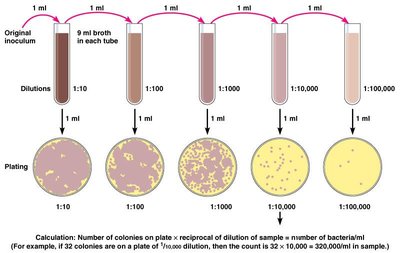
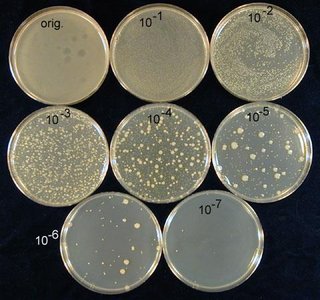
Standard Plate Count: Counts viable cells; assumes each bacterium forms a single colony (reported as CFU).
Filtration: Used for low bacterial counts; bacteria are trapped on a filter and cultured.
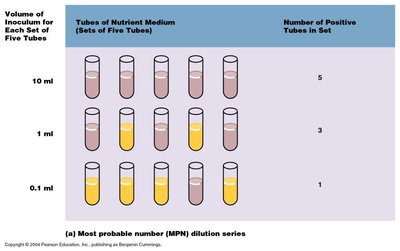
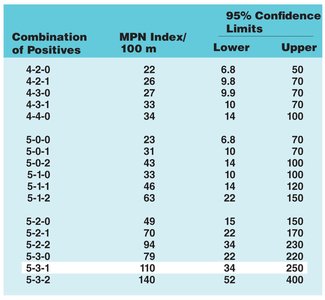
Most Probable Number (MPN): Statistical estimation based on growth in liquid media.
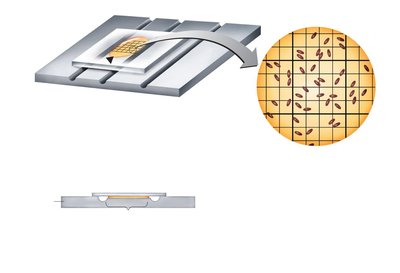
Direct Microscopic Count: Uses a Petroff-Hausser cell counter to count cells in a known volume.
Indirect Measurement Methods
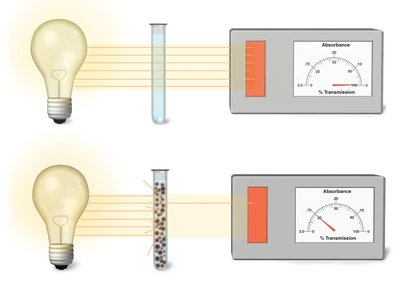
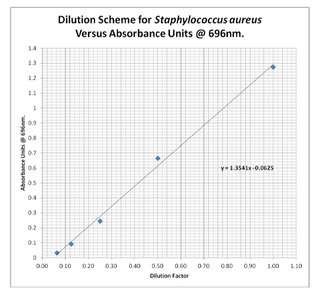
Turbidity: Measured using a spectrophotometer; optical density correlates with cell concentration.
Other Methods: Metabolic activity and dry weight can also be used to estimate growth.