Back
BackMicrobial Growth: Requirements, Culture, and Measurement
Study Guide - Smart Notes
 Tailored notes based on your materials, expanded with key definitions, examples, and context.
Microbial Growth
Introduction to Microbial Growth
Microbial growth refers to the increase in the number of cells, not cell size. This process can result in the formation of visible colonies, and different microbial species have distinct requirements for optimal growth.
Growth is measured by cell number, not cell size.
Visible colonies may form on solid media.
Species-specific requirements for growth must be considered.
Requirements for Microbial Growth
Physical Requirements
Microorganisms require specific physical conditions for growth, including temperature, pH, and osmotic pressure.
Temperature: Each species has a minimum, optimum, and maximum growth temperature.
pH: Most bacteria grow between pH 6.5 and 7.5; acidophiles thrive in acidic environments; molds and yeasts prefer pH 5-6.
Osmotic Pressure: Hypertonic environments cause plasmolysis; obligate halophiles require high salt, while facultative halophiles tolerate but do not require it.
Temperature Ranges for Microbial Growth
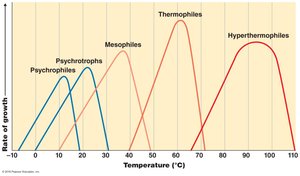
Microorganisms are classified based on their preferred temperature ranges:
Psychrophiles: Cold-loving, optimal growth at 0°C.
Psychrotrophs: Grow between 0°C and 20–30°C; often cause food spoilage.
Mesophiles: Moderate-temperature-loving, optimal at 25–40°C.
Thermophiles: Heat-loving, optimal at 50–60°C.
Hyperthermophiles: Grow at temperatures above 80°C.
Osmotic Pressure and Plasmolysis
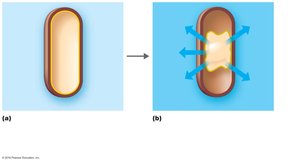
Hypertonic environments can lead to plasmolysis, where water leaves the cell, inhibiting growth. This is an effective method for controlling microbial growth.
Obligate halophiles require high salt concentrations.
Facultative halophiles tolerate high salt but do not require it.
Chemical Requirements
Microbes need various chemical elements for growth:
Carbon: Backbone of organic molecules.
Nitrogen: Essential for proteins, DNA, and ATP.
Sulfur: Used in amino acids, thiamine, and biotin.
Phosphorus: Required for DNA, RNA, ATP, and membrane phospholipids.
Trace Elements: Potassium, magnesium, calcium, iron, copper, molybdenum, and zinc are needed in small amounts as enzyme cofactors.
Oxygen: Microbes vary in their oxygen requirements.
Oxygen Requirements
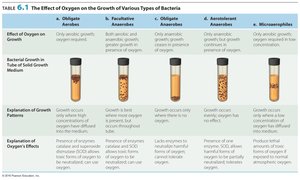
Microorganisms are classified by their oxygen needs:
Obligate aerobes: Require oxygen.
Facultative anaerobes: Can grow with or without oxygen.
Obligate anaerobes: Cannot tolerate oxygen.
Aerotolerant anaerobes: Tolerate but do not use oxygen.
Microaerophiles: Require lower oxygen concentrations than atmospheric levels.
Type | Growth in Tube | Explanation |
|---|---|---|
Obligate Aerobes | Growth at top | Require oxygen for growth |
Facultative Anaerobes | Growth throughout, more at top | Grow with or without oxygen, but better with oxygen |
Obligate Anaerobes | Growth at bottom | Cannot tolerate oxygen |
Aerotolerant Anaerobes | Growth evenly | Tolerate oxygen, do not use it |
Microaerophiles | Growth in middle | Require low oxygen concentration |
Culture Media and Methods
Culture Media
Culture media are nutrient solutions used to grow microbes in the laboratory. Media must be sterile, contain optimal nutrients, moisture, and pH, and be incubated under proper conditions.
Agar: A complex polysaccharide used as a solidifying agent; not metabolized by most microbes.
Chemically defined media: Exact chemical composition is known; used for fastidious organisms.
Complex media: Contains extracts and digests of yeasts, meat, or plants; composition varies.
Reducing media: Used for anaerobic bacteria; contains chemicals to remove oxygen.
Types of Culture Media
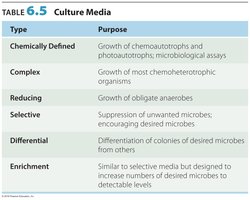
Type | Purpose |
|---|---|
Chemically Defined | Growth of chemoautotrophs and photoautotrophs; microbiological assays |
Complex | Growth of most chemoheterotrophic organisms |
Reducing | Growth of obligate anaerobes |
Selective | Suppression of unwanted microbes; encouraging desired microbes |
Differential | Differentiation of colonies of desired microbes from others |
Enrichment | Similar to selective media but designed to increase numbers of desired microbes to detectable levels |
Selective and Differential Media
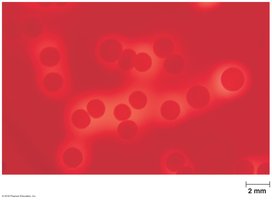
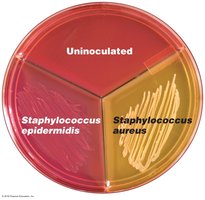
Selective media: Suppress unwanted microbes and encourage desired ones.
Differential media: Allow distinction between colonies of different microbes based on visual reactions.
Some media combine both selective and differential properties.
Obtaining Pure Cultures
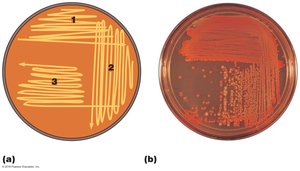
A pure culture contains only one species or strain, which is necessary for most laboratory work. Colonies arise from a single cell or group of attached cells and are called colony-forming units (CFUs).
Streak plate method: Used to isolate pure cultures by spreading cells across the surface of solid media.
Colonies may be sparse or crowded; overcrowding interferes with accurate counts.
Preserving Bacterial Cultures
Preservation methods depend on the species and intended use:
Refrigeration: Short-term storage.
Deep-freezing: Long-term storage at –50°C to –95°C.
Lyophilization (freeze-drying): Water is removed by vacuum, then organisms are frozen; allows for years of storage.
Bacterial Division and Growth
Binary Fission
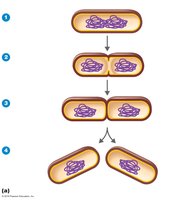
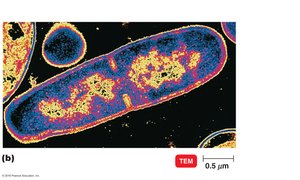
Bacteria increase in number by binary fission, producing clonal colonies. This process is distinct from reproduction in multicellular organisms.
Binary fission: Cell elongates, DNA replicates, cell wall and membrane constrict, cross-wall forms, cells separate.
Other Methods of Division
Budding: Unequal division; small outgrowth breaks off to form a new cell.
Fragmentation: Cell breaks into multiple pieces.
Generation Time and Growth Curves
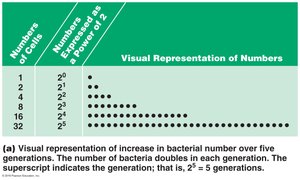
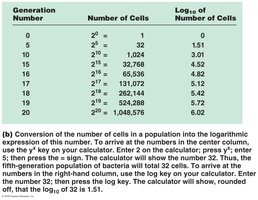
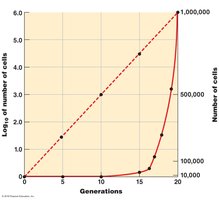
Generation time is the period required for a bacterial cell to divide. Binary fission doubles the number of cells each generation, and growth curves are plotted logarithmically.
Generation time varies from 20 minutes to 24 hours.
Most bacteria have a generation time of 1–3 hours.
Total number of cells after n generations:
Phases of Bacterial Growth
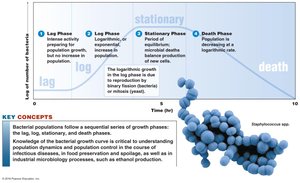
Bacterial populations follow a sequential series of growth phases:
Lag phase: Metabolic activity, preparation for growth, no increase in population.
Log phase: Exponential growth, constant generation time.
Stationary phase: Cell deaths equal new cells; nutrients become limited, waste accumulates.
Death phase: Cell deaths exceed new cells; population declines logarithmically.
Measurement of Microbial Growth
Direct Measurement Methods
Direct methods count microbial cells or measure total population mass.
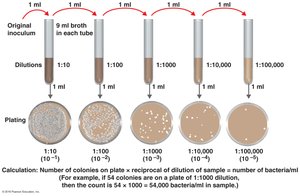
Plate count: Count colonies (CFUs) on agar plates; requires serial dilution for accurate counts.
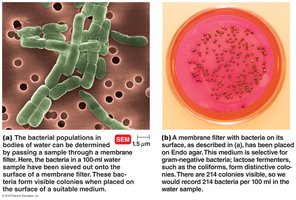
Filtration: Liquid sample passed through a filter; bacteria collected and grown on agar.
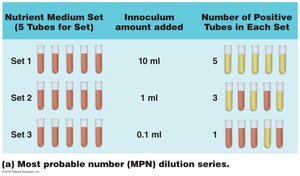
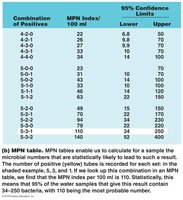
Most Probable Number (MPN): Multiple tube test; statistical estimation based on positive tubes.
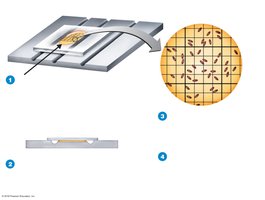
Direct microscopic count: Cells counted on a microscope grid; uses Petroff-Hausser cell counter.
Indirect Measurement Methods
Indirect methods estimate bacterial numbers by measuring turbidity, metabolic activity, or dry weight.
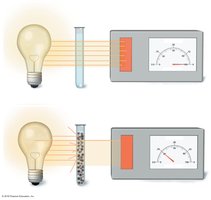
Turbidity: Cloudiness measured with a spectrophotometer; more cells = more turbidity.
Metabolic activity: Amount of metabolic product is proportional to cell number.
Dry weight: Organisms are filtered, dried, and weighed; used for filamentous organisms.