 Back
Microbial Growth: Requirements, Culture Media, and Measurement
Study Guide - Smart Notes
 Tailored notes based on your materials, expanded with key definitions, examples, and context.
Microbial Growth
Definition and Overview
Microbial growth refers to the increase in the number of cells in a population, not the size of individual cells. Understanding microbial growth is fundamental for microbiology, as it impacts population dynamics, disease progression, and industrial applications.
Populations: Groups of microorganisms growing together.
Colonies: Visible masses of cells arising from a single cell or group.
Physical Requirements for Microbial Growth
Temperature
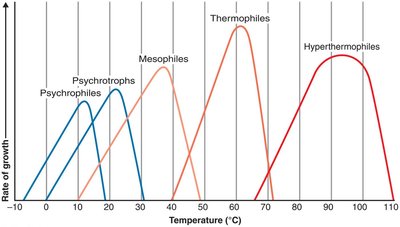
Temperature is a critical factor influencing microbial growth, with microorganisms classified into five groups based on their optimal temperature ranges.
Minimum growth temperature: Lowest temperature at which growth occurs.
Optimum growth temperature: Temperature at which growth rate is highest.
Maximum growth temperature: Highest temperature at which growth occurs.
Psychrophiles: Grow at 0°C, optimum at 15°C; found in polar regions and deep oceans.
Psychrotrophs: Grow at 0°C, optimum 20–30°C; cause food spoilage in refrigerators.
Mesophiles: Optimum 25–40°C; include most pathogens and normal microbiota.
Thermophiles: Optimum 50–60°C; found in hot environments.
Hyperthermophiles: Optimum above 80°C; found in extreme heat, such as hydrothermal vents.
Food Safety and Temperature
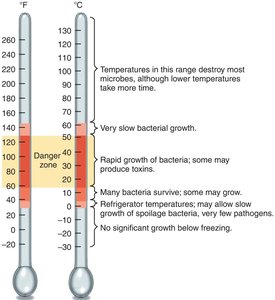
Temperature control is essential for food safety, as certain ranges promote rapid bacterial growth and toxin production.
Temperatures above 60°C destroy most microbes.
Danger zone (15–50°C): Rapid growth and toxin production.
Refrigerator temperatures (0–5°C): Slow growth of spoilage bacteria; few pathogens.
No significant growth below freezing.
Cooling Rate and Food Spoilage
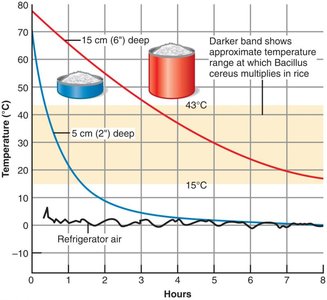
The rate at which food cools affects its susceptibility to microbial spoilage, especially for deep containers.
Large containers cool more slowly, remaining in the danger zone longer.
Bacillus cereus can multiply in rice within the danger zone.
pH
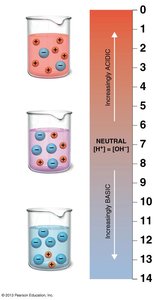
Microorganisms have specific pH requirements for growth.
Neutrophiles: Grow best at pH 6.5–7.5; most bacteria, including those in the human body.
Acidophiles: Thrive at pH below 5.5; some grow in the stomach.
Alkalophiles: Grow at pH above 8.5.
Molds and yeasts prefer pH 5–6.
Osmotic Pressure
Osmotic pressure affects microbial survival and growth.
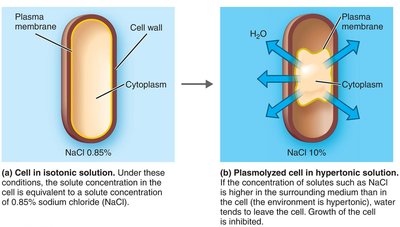
Hypertonic environments: Cause plasmolysis, inhibiting growth.
Extreme/obligate halophiles: Require high salt concentrations (up to 30% NaCl).
Facultative halophiles: Tolerate moderate salt concentrations (2–10% NaCl).
Chemical Requirements for Microbial Growth
Major Elements
Carbon: Structural component and energy source. Chemoheterotrophs use organic carbon; autotrophs use CO2.
Nitrogen: In amino acids and proteins. Most bacteria decompose proteins; some use NH4+, NO3-, or fix N2.
Sulfur: In amino acids, thiamine, biotin. Used as SO42- or H2S.
Phosphorus: In DNA, RNA, ATP, membranes. Supplied as PO43-.
Trace Elements
Required in small amounts, usually as enzyme cofactors (e.g., iron, copper, zinc).
Oxygen Requirements
Microorganisms vary in their oxygen requirements and tolerance.
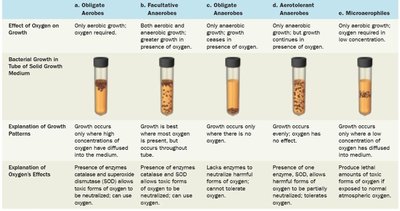
Obligate aerobes: Require oxygen for growth.
Facultative anaerobes: Can grow with or without oxygen; greater growth with oxygen.
Obligate anaerobes: Cannot tolerate oxygen.
Aerotolerant anaerobes: Tolerate oxygen but do not use it.
Microaerophiles: Require low concentrations of oxygen.
Category | Effect of Oxygen on Growth | Growth Pattern in Tube | Explanation | Oxygen Effects |
|---|---|---|---|---|
Obligate Aerobes | Only aerobic growth; oxygen required | Cluster at top | Growth where oxygen diffuses | Catalase & SOD neutralize toxic oxygen |
Facultative Anaerobes | Both aerobic & anaerobic; more with oxygen | Cluster at top, spread throughout | Best growth where oxygen present | Catalase & SOD present |
Obligate Anaerobes | Only anaerobic; growth ceases with oxygen | Cluster at bottom | Growth where no oxygen | Lacks enzymes for detoxification |
Aerotolerant Anaerobes | Only anaerobic; growth continues with oxygen | Evenly distributed | Oxygen has no effect | SOD present |
Microaerophiles | Only aerobic; oxygen required in low concentration | Cluster at center | Growth where low oxygen diffuses | Produce lethal amounts of toxic oxygen if exposed to normal levels |
Detoxification of Oxygen
Aerobes and some anaerobes possess enzymes to detoxify harmful oxygen forms.
Superoxide dismutase (SOD): Converts superoxide radicals to hydrogen peroxide.
Catalase: Converts hydrogen peroxide to water and oxygen.
Peroxidase: Converts hydrogen peroxide to water.
Organic Growth Factors
Organic compounds obtained from the environment, such as vitamins, amino acids, purines, and pyrimidines.
Biofilms
Formation and Characteristics
Biofilms are complex microbial communities that form on surfaces, providing protection and enhanced survivability.
Form slime or hydrogels adhering to surfaces.
Bacteria communicate via quorum sensing, secreting inducers to attract others.
Share nutrients and shelter from environmental hazards.
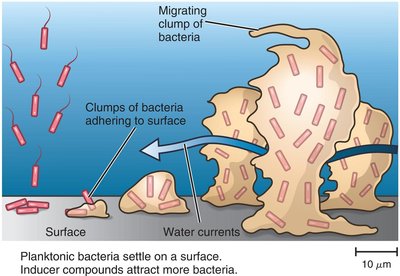
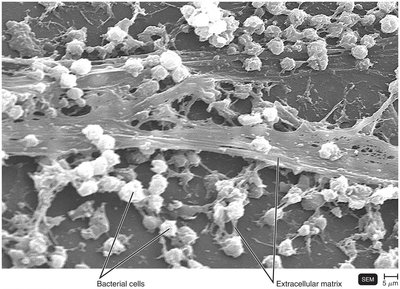
Biofilms are found in digestive systems, sewage treatment, and medical devices.
They are highly resistant to microbicides and involved in many infections.
Culture Media
Types of Media
Culture media provide nutrients for microbial growth and are classified based on their composition and purpose.
Chemically defined media: Exact chemical composition is known.
Complex media: Contains extracts and digests of yeasts, meat, or plants; most bacteria grow well.
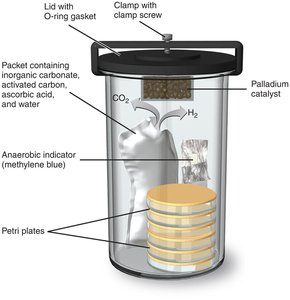
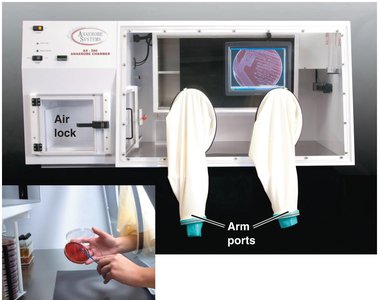
Reducing media: Used for cultivating anaerobic bacteria; contains chemicals to remove oxygen.
Selective media: Suppress unwanted microbes and encourage desired ones.
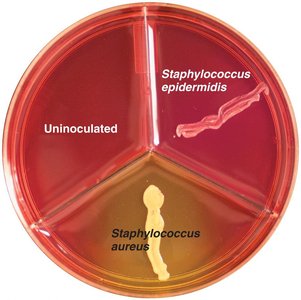
Differential media: Distinguish colonies of different microbes.
Enrichment culture: Increases numbers of desired microbes to detectable levels.
Selective and Differential Media
Bismuth sulfite agar: Selective for Salmonella Typhi.
Sabouraud’s dextrose agar: Selective for fungi.
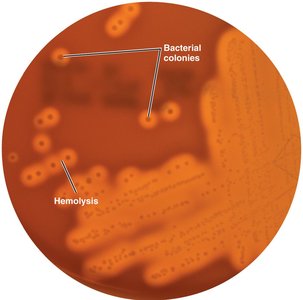
Blood agar: Differential medium; shows hemolysis.
Obtaining Pure Cultures
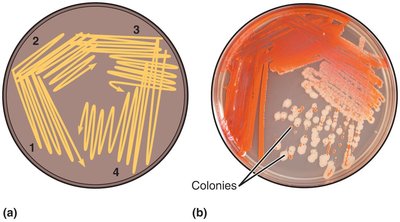
A pure culture contains only one species or strain. The streak plate method is commonly used to isolate pure cultures.
Colony-forming unit (CFU): A single cell or group giving rise to a colony.
Streak plate method: Sequential dilution of bacteria on agar to isolate colonies.
Preserving Bacterial Cultures
Deep-freezing: -50°C to -95°C.
Lyophilization (freeze-drying): Frozen and dehydrated in a vacuum.
Growth of Bacterial Cultures
Bacterial Division
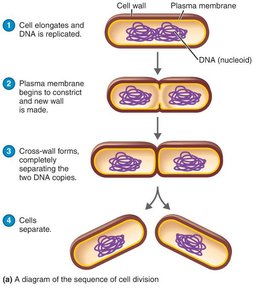
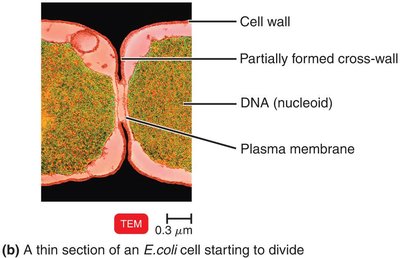
Bacterial growth is primarily through binary fission, though some species use budding or fragmentation.
Binary fission: Cell divides into two identical cells.
Budding: New cell forms as a protrusion from parent.
Conidiospores: Produced by actinomycetes.
Fragmentation: Filaments break into new cells.
Generation Time and Growth Curves
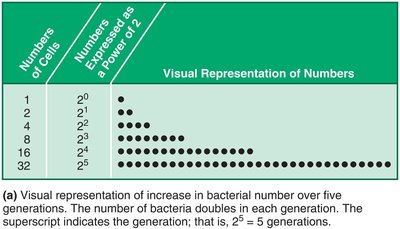
Generation time: Time required for a cell to divide (20 min to 24 hours).
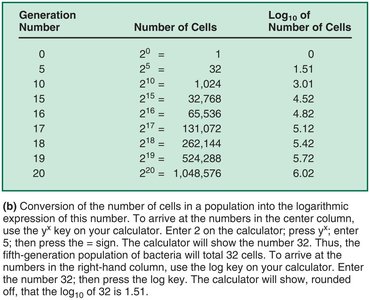
Binary fission doubles cell number each generation.
Total number of cells:
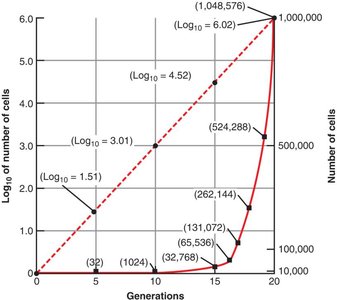
Growth curves are plotted logarithmically.
Phases of Growth
Bacterial populations follow a sequential series of growth phases:
Lag phase: Intense metabolic activity, no increase in cell number.
Log phase: Exponential increase in cell number.
Stationary phase: Growth slows, cell deaths balance new cells.
Death phase: Deaths exceed new cell production; population decreases.
Measurement of Bacterial Growth
Direct Methods
Plate count: Count colonies on plates with 30–300 CFUs; requires serial dilution.
Filtration: Solution passed through filter; bacteria collected and grown on medium.
Most probable number (MPN): Multiple tube test; count positive tubes and compare with statistical table.
Direct microscopic count: Count cells in a known volume using a cell counter.
Indirect Methods
Turbidity: Measure cloudiness with a spectrophotometer.
Metabolic activity: Amount of product proportional to cell number.
Dry weight: Filter, dry, and weigh cells; used for filamentous organisms.
Key Terminology
Binary fission
Biofilms
Psychrophiles, psychrotrophs, mesophiles, thermophiles
Obligate aerobes, obligate anaerobes, facultative anaerobes, microaerophiles, aerotolerant anaerobes
Neutrophiles, acidophiles, alkalophiles, halophiles, halotolerant, capnophiles, CFU
Summary Table: Types of Culture Media
Type | Purpose |
|---|---|
Chemically Defined | Growth of chemoautotrophs and photoautotrophs; microbiological assays |
Complex | Growth of most chemoheterotrophic organisms |
Reducing | Growth of obligate anaerobes |
Selective | Suppression of unwanted microbes; encouraging desired microbes |
Differential | Differentiation of colonies of desired microbes from others |
Enrichment | Increase numbers of desired microbes to detectable levels |
Equations
Total number of cells after n generations:
Logarithmic expression:
